|
|
|
August 26, 2008 Today is My Last Tuesday (plus Sex Ed for Preschoolers) 
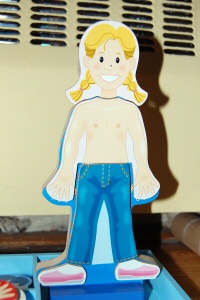
You turned the page! So now I have something less than four workdays left. And then I will be unemployed. (Says Greg: A student!) Income-free. Whatever. Of course, when you are the mother of a technically-preschooler-even-though-she-goes-to-kindergarten, education doesn't just happen in the school between the hours of 9 and 3:30. For instance, when we were driving up to Ann's cottage for our second annual mommyblogging cottage weekend (Ann, Marla and Josephine were also there), I got to explain bedrock. You don't have to drive far to find yourself on the Canadian Shield around here, and when you do, the roads have been blasted straight through the bedrock, which rises up steeply on either side of the car like rust-coloured mountains covered with a thin green fuzz of shrubbery and evergreens. All the rock, Mummy! she said. Wow. It's fun trying to explain bedrock in a way that a four-and-a-half year old will understand--that bedrock is everywhere and if you dig down far enough you'll find it no matter where you are, but here it's a lot closer to the ground so you can see it all over. Or stars, which I got to tell her are actually much bigger than the earth, only they are very very far away. (But I'm going to let her keep believing that fairytaleland is on Jupiter, and when she is old enough we will buy a spaceship and go there together.) Or that rivers have currents and only go in one direction, whereas oceans have tides and the water goes both ways. And lakes are still. Or that sometimes babies are born when doctors cut their mummy's bellies open, but most of the time babies are born when they come out of their mother's vaginas. And most of the time babies drink milk that their mummies make out of their nipples, but sometimes babies drink milk out of bottles. And that sea turtles don't make milk for their babies. And that girls have vulvas and boys have penises and that's what makes them different, not clothes or hair or toys or size; and that girls also have lots and lots of little eggs in their tummies, and girls can grow up and decided to turn some of their eggs into babies. That they don't have to, some grown-up ladies decide not to, but a lot do. That you don't have to be married to a boy if you want to have a baby, that sometimes two men marry each other or two women, and sometimes a lady decides she doesn't want to get married and turns her egg into a baby on her own. Because families can come lots of different ways, and they're all great. But, yes, boys are important too, because they make the seeds that the eggs need to grow (only not until they are almost grown up), and most of the time what happens is that a grown-up man and woman decide they want to turn an egg into a baby and so the man puts his penis into the woman's vagina and that's how the seeds get out, and then one of the seeds finds one of the eggs and it turns into a baby and starts growing, and isn't that cool? But it's something you can really only do when you are a grown-up. But it doesn't work that way for snakes or birds or fish, because they put the eggs on the outside of their bodies and then they turn into babies on the outside. But we turn them into babies on the inside, and so do cats and dogs and guinea pigs and cows and horses and deer and I've lost track of how many other animals we've had this chat for. She knows about umbilical cords and belly buttons and, thanks to her habit of walking into the bathroom and my bedroom without knocking first, a fair bit about puberty and menstruation. If you're wondering if this doesn't make me tremendously squeamish, you bet. But I figure it's my job to wrestle my squirms down so that Frances can get factual, accurate information that she can understand without getting all of my own childhood programming into the mix, just like it's my job to swallow down my body insecurities so she doesn't grow up paranoid about getting fat. I wonder where we got this idea that we need to protect children's innocence re: sex from? It wasn't so long ago that most kids grew up on farms or at any rate in the country where mating animals would not have been an unusual sight. It doesn't seem to have traumatized all previous generations to grow up understanding the biological role of males and females and the nature of sex, though they might not prefer to think about their parents doing it. Frankly I very much prefer not to think about my precious, beautiful little girl growing up and becoming sexual one day, but it's going to happen, and when it does I want her to have the tools to communicate about sex factually and calmly. I don't want her to be hampered by my own squeamishness and get all flustered the first time some boy she likes wants to go farther than she does. Plus, the research I've seen indicates that kids are more comfortable with transgressing gender norms and stereotypes when they understand that sex is biological and that only genitilia can really distinguish between boys/men and girls/women. This is an important goal to me. If you're wondering if this doesn't make Frances tremendously squeamish, not a bit. She finds the whole thing fascinating. When she has questions, I answer them. I don't answer more than she asked for. I ask her to tell me what she thinks I said so I can clarify if she's confused or if I didn't explain it as well as I should. I bought her a person puzzle and a body book that show, besides muscles and bones and organs and blood vessels, anatomically correct reproductive organs and some information about reproduction (in the book) that is age appropriate and, apparently, lots of fun to play with. (Plug: The Human Body by Owl publications is GREAT for this age group and probably a few years older. I can review it if anyone is interested.) She has already decided that when she grows up she is going to turn one of the eggs into her tummy into a baby and become a Mummy, and she will also have pets and a garden. 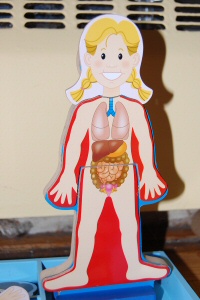
All of the explicit, messy, sometimes icky, squirmish, detailed and factual information so far has only stoked the impassioned pre-Mummy flames. She'll be five in December. So far as I can tell, she understands and remembers all of it. And when she doesn't, we talk about it. Again. Before Frances was born I really hadn't expected to have so many discussions about genitals with my three-year-old (this started last year for us, beginning I think when she got the ideas that a) girls had weenies on the inside, and b) babies were born from belly buttons from the kids at her daycare. So that tells you just how early these peer conversations start up). But she had the interest and was asking questions, and I decided pretty quickly that I wanted two things: When she gets information from friends and from school about sex, I want her to: a) know that her mom has reliable information and that she can be relied on to share it, and b) be innoculated against the misinformation of her less-well-informed peers. Yes, even at eight. Even at six. I can still remember the time in grade one when my giggly classmates put our teacher on the spot by asking her what a girl's private parts were called. Or my classmates in grades two and three who used to draw their interpretations of penises on the backs of their school notebooks. If this doesn't convince you not to turn the page, Dear Readers, what will? Don't you know that there's a Monster at the End of this Blog? Posted by Andrea at 9:54 AM | Comments (13) August 19, 2008 The Lenses in the Pink-Coloured Glasses
At my nephew's recent first birthday party--who, by the way, is enormous; at one year he is already several pounds heavier than Frances is at four-and-a-half, and is almost as tall--he and Frances were playing with his trucks and cars and balls and the rocket-ship we gave him (complete with astronauts, space dog, alien, moonbuggy and crater). "Look at them," said someone whose anonymity I have decided to preserve: "Frances is such a little girl, and Lukas is such a boy!" They were playing together with the same toys. Those toys were mostly "boy" toys. It's true they were playing with them differently. Frances formed her trucks into tribes of friends and families and had them rolling across the floor and talking to each other, whereas Lukas was mostly banging them into the hardwood while crowing "duh!" because he's only one. But Frances was wearing a pink dress and her long hair was left down, whereas Lukas wore a set of blue overalls and his hair--such as it exists to this point--is short. Not that either of them chose their hair or outfits. I chose Frances's pink dress and I decide how long her hair grows; ditto with Lukas. Several adults nodded approvingly at the anonymous adult's comment. I remembered the hour we had spent that morning before the party playing with red Spiderman and black Spiderman, how she had delighted in showing me the way that red Spiderman can shoot webs from his hands to catch bad guys. I remembered her current best friend at daycare--a boy--and the many times I'd watched them play with the big bucket full of dinosaurs. I remembered every time she had pointed out a Ninja Turtle or Transformer in the toystore. I remembered her many complaints that she does not have enough plates to make a fence or a house with her toolset; her delight at catching frogs; her comfort in dirty jeans and t-shirts; her love of lego and other building toys; the way her Barbie lies neglected in the bottom of the toy basket. And, yes, how she loves to nurture Baby Eloise and turn all of her toys into families sometimes. But, on the whole, I'd hardly characterize Frances as a girly-girl. Unless you are bound and determined to see her that way. Based, I repeat, on a pink dress and a haircut. Why do we put so much time and energy into determining the conformism of each child with gender stereotypes, to the point of seeing it when it isn't there? At this point, I'd say Frances is a child with an impressive diversity of interests. She likes colouring and painting and craft projects using cut-and-paste and buttons and pipe cleaners and sparkly glue and mummy's scrapbooking leftovers. She likes to take photographs. She likes jumping in mud-puddles. She likes superheroes and picture books, trucks and dolls, naptimes for her Little People and building them houses out of lego and turning her Wedgits into cakes (by the way, Wedgits are a fabulous toy, my new favourite). She likes playing with her Calico Critters in their dollhouse; she likes her long-neck dinosaurs and all their little friends; she likes flowers and stars and planets and mud and frogs and fairies and fantasy stories and knights and horses and castles and amusement parks. I can't categorize her as girly/boyish/tomboy/whatever, and I don't see the point in trying. She's herself. She's Frances. Why does anybody else care? Why does anyone ever put any time or interest into determining the degree of any child's adherence to gender stereotypes? How does it help us better parent or teach or befriend a child, ever? In what way does it ever benefit them not to simply see them as themselves, as full and complex little people who are still figuring out what they like and who they want to be? Posted by Andrea at 9:23 AM | Comments (7) June 6, 2008 What Women Want
I'm going to be arrogant and generalize my post last week (and the one last year)--because it's not just me, is it? Wanting is fraught territory for women, period. If it weren't, we wouldn't need umpteen gazillion pounds of paper each month on the newsstand devoted to telling us what we are supposed to want, how much, when, and under what circumstances. Even the best of mainstream women's magazines are little more than catalogues, inculcating socially appropriate desires based on class, relationship status, employment and age. Which leads me to think that Freud's famous question: The great question that has never been answered, and which I have not yet been able to answer, despite my thirty years of research into the feminine soul, is "What does a woman want?" likely has no answer. Not because women are mysterious, impenetrable creatures whom no reasonable person (aka man) could possibly be expected to fathom, but because women themselves have been so trained into wanting what they don't want that in many cases we don't know ourselves what it is we do want. If you don't know what I'm talking about, go out and scan the covers on the newsstands. What kinds of shoes are you supposed to want this year, and why? What kinds of skirts, lipstick and jackets? What kinds of relationships with what kinds of men (and it always is men on the newsstands)? What are you supposed to want for dinner? How much? Are you allowed to want desert right now? Sensible and responsible women do not want to vote. The relative positions to be assumed by man and woman in the working out of our civilization were assigned long ago by a higher intelligence than ours. ~Grover Cleveland, 1905 It's easy to mock such sentiments, but the situation has not changed all that much. Yes, we're allowed to want to vote now (but sensible and responsible women do not want to run for office; it's not a good environment for women). But there are still a lot of people out there, many of them not-women, perfectly happy to inform women about what sensible and responsible women do want. Unsurprisingly, it still mostly revolves around other people: We want to look attractive in current ways to impress friends and colleagues and attract mates. We want to eat certain things and do certain kinds of exercises for the same reasons. We want to read the books that other people are reading and watch the shows that other people are watching so we can converse with those other people. We want books and quizzes and articles that will help us save our relationships (funny how men are never supposed to want that). We want recipes to feed the perfect meals, however defined, to our families. Everything that women are sanctioned to want is meant to allow us to perform our societal role--service.
Rephrased: What women are supposed to want for themselves is to be more help to other people. Or: Man can never be a woman's equal in the spirit of selfless service with which nature has endowed her. Mohandas Gandhi I'll bet you didn't know it was biological. Don't you want to give nature a big wet thank-you kiss for endowing you with the spirit of selfless service? Consider that most women still carry the burden not only of the obvious caring work (housework, feeding, cooking, shopping for food, laundry, bathing, etc.) within their families, but also the less-obvious caring work (gifts, cards, invitations, thank-you notes, meal planning, reading about childrearing and nutrition and relationship advice and marriage manuals, keeping track of what housework needs to be done, purchasing clothing and keeping track of kids' sizes and what needs to be replaced, remembering birthdays, etc.). Consider that many women's hobbies even today revolve largely around one of those fields of caring work--knitting, embroidery, scrapbooking, cardmaking, sewing, and so on--so that even when women are having fun it is in the "spirit of selfless service." Consider that the work of service that women still normally perform is still mostly unpaid or underpaid, and that when it is paid women have difficulty asking for money for it or being clear about their expectations of payment. Consider the different emotional reactions of widows and widowers two years after bereavement: Late life widowhood, selfishness and new partnership choices: a gendered perspective KATE DAVIDSON Centre for Research on Ageing and Gender, University of Surrey. Consider that women who know what they want and ask for it are often penalized: Women and Salary Negotiation: The Costs of Self-Advocacy Mary E. Wade Manhattan College Abstract Introducing the concepts of self- and other-advocacy should prove useful as a means of understanding the different contexts in which women and men can effectively and comfortably exert power and influence when making requests. In this conceptual paper, social psychological research is reviewed demonstrating that women can advocate effectively on behalf of others without incurring costs, but gender-linked stereotypes, roles, and norms constrain them from advocating as freely and effectively for themselves. It is argued that women do not frequently make requests for themselves, because they have learned that they may ultimately lose more than they gain. This gendered difference has implications for ongoing pay and promotion inequities. Poor Freud: toiling away for thirty years trying to ask a question of women which by its very nature undermined their femininity. Women and girls aren't supposed to want for themselves, period. Any mother of a daughter can say without hesitation that this is not biological or essential, that little girls come into the world with a full measure of personal entitlement. They want what they want and they say so, sometimes loudly. And then, sometime between girlhood and womanhood, it's lost. Women tend to put others first. This is a very attractive quality to a man. Sometimes a man gets caught in his ego and pride. In the short term there is nothing wrong with this. However in the long term this can create a selfish man. This is why it's very refreshing for a man to be around a woman who is compassionate and cares about others [sic] needs. I'll bet it's refreshing. I'll bet it's convenient, too. I'm perfectly willing to believe that I am an extreme case for a host of unbloggable reasons. But I don't think I'm unique in this. What do you want? If you strip away the audience for your appearance and the clientele for your service work so that clothing, body size or shape, and service wants are eliminated, what's left? What do you want for you, when there is no one else to want things for, or want to be different for? If you had a wife for the next month, someone who would take care of the house for you, do the meals and the cleaning up, take care of the kids, grease the relationships, and everything would run like a well-oiled machine; and moreover, if you were entitled to be oblivious to that work so that you do not have to notice it or be grateful for it--what would you do with that month? What would you want for yourself if, for a month, no one else wanted anything from you? Margaret Oliphant was a writer of fiction and non-fiction who had three kids of her own and three kids of her brothers to raise on a writing income without a spouse (her husband died). This is what she had to say about writing: "The writing ran through everything. But then it was subordinate to everything, to be pushed aside for any little necessity. I had no table even to myself, much less a room to work in, but sat at a corner of the family-table with my writing-book, with everything going on as if I were making a shirt instead of writing a book .... And I don't think I have ever had two hours undisturbed (except at night when everyone is in bed) in my whole literary life." It's that biologically-ordained spirit of selfless service. Again. Contrast with Joseph Conrad: "For twenty months I wrestled with the Lord for my creation ... mind and will and conscience engaged to the full, hour after hour, day after day ... a lonely struggle in great isolation from the world. I suppose I slept and ate the food put before me and talked connectedly on suitable occasions, but I was never aware of the even flow of daily life, made easy and noiseless for me by a silent, watchful, tireless affection." What do you suppose his wife (aka "tireless affection") might have preferred to be doing for those twenty months? This is all disjointed and confusing, I know, but (as I sit typing this with two young girls playing a Shrek adaptation on the floor beside me with Little People, having stolen minutes here and there for all the rest of it between loads of laundry, bouts of dishes, fixing snacks and fetching drinks and calling the super's office to get a toilet fixed) I think one of the things holding back women's progress at this stage of the game is the relentless way in which women are trained in what to want and who to want it for (it's never ourselves, even when it's marketed that way) in order to continue a model of the "spirit of selfless service" and keep the status quo largely unchanged. None of which is to argue that no one should ever put their own wants aside in order to help someone else instead; but that maybe, when we do this, it would be healthier to do it within a context of at least knowing what we want to begin with. I wouldn't mind being Margaret Oliphant, and that quote makes Joseph Conrad look like an arrogant, entitled, ignorant ass, so I don't mind not being him; Frances hasn't only expanded my horizons about writing itself and what I want to write about but has increased my time management skills by a thousandfold. I sincerely cannot fathom what I used to do with all the spare time I used to have. It's the expectation that women are so naturally selfless that they don't have wants for themselves at all that needs to change. Posted by Andrea at 10:33 AM | Comments (5) February 27, 2008 Bitch
I've tried now three times to write something for Julie's Hmm topic for the week: assertiveness, girls, and gendered expectations. Don't I have a thousand things to say about it? Yes, unfortunately, it's all a big muddle. I turned to the dictionary for clarification: as·ser·tive –adjective 1. confidently aggressive or self-assured; positive: aggressive; dogmatic: He is too assertive as a salesman. 2. having a distinctive or pronounced taste or aroma. No help there. Isn't assertive supposed to be good? Isn't aggressive supposed to be bad? Aren't we supposed to be walking the fine line between them? Do I want to have a distinctive or pronounced taste or aroma? ag·gres·sive adj. Characterized by aggression: aggressive behavior. Inclined to behave in an actively hostile fashion: an aggressive regime. Assertive, bold, and energetic: an aggressive sales campaign. Of or relating to an investment or approach to investing that seeks above-average returns by taking above-average risks. Fast growing; tending to spread quickly and invade: an aggressive tumor. Characterized by or inclined toward vigorous or intensive medical treatment: an aggressive approach to treating the infection. Intense or harsh, as in color. No, this just isn't helping at all. So aggressive is hostile? Or bold and energetic? Or vigorous? Is it possible that aggression is getting a bad rap here--that it's not all bad or all good anymore than conciliation is? Is it possible to be assertive without being aggressive? Is it possible to be assertive in such a way that no one could ever perceive you as being aggressive? Is that why, once upon a time, someone who cares about me a great deal pleaded with me before we went to a social gathering together, "Just please say something and act normal, I know you can, when you sit there and don't say anything and stare at the floor you come off like a bitch." Let's ask Psychology Today, that bastion of forward thinking on gender roles: "The real first step toward assertiveness is self-confidence. You develop self-confidence only one way—through the experience of effectiveness in the world. You have to rack up some successes all your own, in specific domains of experience." All right, but how do girls do this? Doesn't that depend on living in a social environment where girls are expected to succeed and not punished for doing so? No, no help there. Let's try this: Management Issues. "A huge difference can exist between claiming a right and being actively hostile." Really? Doesn't that depend on whether or not observers agree that it is a right you are asserting, not a privilege? Isn't the ground between what is considered a man's right or a woman's right still highly contested, where a man's right is often a privilege for a woman and hardly ever the other way around? What public woman has the right to be unattractive and not care about it? What woman has the right not to apologize for being obviously more intelligent than the men around her? What woman has the right to be as sexual as we assume men are? What woman has the right to assert her own sexuality over what her sexuality has been culturally defined as--as it relates to the desires and fantasies of men? What woman has the right not to consider herself first and foremost in a service capacity? I don't know about you, but most days I don't even feel I have the right not to smile in a public place (as I am sometimes reminded by passing men who greet my not-unhappy face with "whatever it is, it can't be that bad"). If you believe you are asserting a human right and the person you are asserting it to does not believe that you are entitled to that right, won't they perceive the act as hostile? How exactly are you supposed to control that? Is there any way, in that situation, not to be perceived as hostile that doesn't amount to acceding your human rights? Is that why, when I was younger and I couldn't cross two street corners in a skirt without someone propositioning me, my honest and immediate responses ("No") were met with hostility, anger and incredulity? ("No, really, I want to fuck you sometime. When are you at home alone?") Is that why when I was younger and I would go out all hours of the night to walk deserted bikepaths to calm my mind down on my own, the response I would get from other people was rarely fear or concern for my safety, and more often, again, hostility and incredulity? "Aggressive conduct: Glares or stares at others Assertive conduct: Makes friendly, considerate eye contact" But how can I possibly control how my eye contact will be perceived? Is this why so many women go around with those idiot grins plastered on their faces all the time? "Aggressive conduct: Values one's self more than others Assertive conduct: Values self as an equal to others" Does this mean I need to preface my assertive statements with "I value myself as an equal to you"? Wouldn't that sound kind of funny? I remember a study where highschool teachers were instructed to call on boy and girl students equally in class that day--time interactions and the number of interactions to achieve this. There was an insurrection in those classes because the male students accused the teachers of favouring the girls--imagine--girls getting precisely their fair share was perceived by the boys as girls getting favoured treatment! Is it even possible for a woman to claim her fair share without being perceived as trying to claim more than her fair share? Don't just jump and say yes. Really think about this. If mathematically precise equal interactions in a classroom are perceived as being biased in girls' favour, how do you really think a woman who is being "assertive" as in "valuing herself equally with others" will be perceived by those around her, especially men? My guess is that she will be perceived as someone who "values herself more than others," or aggressive. Is this why a boy once told me, "I don't think I could date a girl smarter than me"? The problem with contrasting aggression and assertiveness is that in the great grey muddle between the extremes, it is all too easy to view any particular action either way. When I went out dancing that night in Quebec after the boy I'd been dating there was kicked out for speaking too much English, and I danced close to that cute guy who had a crush on my friend but she didn't like him back so it was ok--and I was hoping he'd ask me home, because it was summer and home was far away and I was enjoying myself--and he did--was I being assertive, aggressive, or neither? Doesn't that depend on what your sexual morals are, specifically your beliefs about moral female sexuality? Doesn't that depend on what you think girls are supposed to want? Enough of that. Let's ask the experts: J Pers Soc Psychol. 2001 Jul;81(1):133-45. Changes in women's assertiveness in response to status and roles: a cross-temporal meta-analysis, 1931-1993. Twenge JM. That's good news. That also blows a nice big hole in all the "testosterone" theories of the innate differences between men and women. Put women in a social context where they believe they have a reasonable chance at success and, hey presto, they'll develop an innately assertive personality just as well as boys do. Mind you, this specifically does not state that their assertiveness gets them anywhere. This book preview was great, and then it cut off just when it was getting to the good stuff: "In support of these predictions, several studies have shown that when women in mixed-sex groups present their ideas in an assertive or self-directed style, they are disliked or perceived as untrustworthy and achieve less influence over men...." Don't you wish you knew what came next? Still, that snippet is good on its own. Page 648, if you're scrolling through. What do you want to bet that if those men were asked why they disliked the assertive women, they'd say it was because they were too aggressive? Women and Salary Negotiation: The Costs of Self-Advocacy No wonder it's so much easier for a woman to advocate for her kids than for herself. There's a lot more, and it's all pretty depressing. Let's leave the experts alone. I don't know about you, but I still don't know what assertiveness is exactly, or how it differs from aggressiveness in any sphere but that of physical violence. I still don't know how I can behave so that anyone will perceive that I am being assertive, and not aggressive, regardless of whether they are religious fundamentalists who think I ought to stay in the home or female athletes with a shelf full of trophies or hormonally-adled boys who have been brought up on visions of women based mostly on MTV and Maxim or doctors who think patients who consult the internet are being uppity. You know what? I can't. There is no formula for behaviour that will be viewed as assertive and not-aggressive in all situations and by all people. If I act from what I believe is a healthy interest in protecting my own innate human rights, someone will inevitably believe that I am asking for too much and getting above myself. What is seen by one as a polite and firm voice will be seen by someone else as cold; what is seen by one as a warm and friendly voice will be seen by someone else as overly emotional and inappropriate. I can't dance around stereotypes of female behaviour for the rest of my life, of what I am supposed to want and have and how I am supposed to go after it. I'm not even going to try. You can call me a bitch if you want to. Posted by Andrea at 1:38 PM | Comments (9) February 26, 2008 Because it's not the stuff you know you're doing that you need to worry about.
I don't remember ever playing with dolls. I must have, I had dolls, but I don't remember playing with them. It didn't register in the long-term memory ganglia or whatever neural part it is they reside in. I had a cabbage patch doll. My Mom bought me one for Christmas the year they were all the rage--remember that? Parents trampling each other to buy one for their kids for Christmas?--and she bought it just before they took off, when there were plenty on the shelves, and watched in amazement as it became the It Toy of the year. Her name was Frederica and she had two fat brown braids, and my Mom made her an entire little wardrobe of Cabbage Patch Clothes so she would have outfits. She made me another doll, too, that I named after the Little Matchstick Girl because we learned about her in school that year. She was long and thin and had long, straw-coloured yarn hair and a long blue print dress. I had a little puppet baby doll that had a blanket sewn to her so that when you put your hand inside you could wrap the blanket around her and it would look like a baby, sleeping. I had a dollhouse that my father made; the second floor was removable and it was vaguely patterned after my childhood home. It had doors and windows and white stucco paint on the outside, black sandpaper shingles; when I was a teenager I took to redecorating it as a hobby and it has a few nice pieces in it now. The house itself, though, is a shambles, because in my early twenties my pet ferret took up residence in it and could not be evicted. I had Barbies. I know this because I have found their headless, limbless torsos, blond plastic hair knotted and ratty, at the bottom of toy bins. I must have played with them in the regular fashion at some point; but the only games I remember playing with the Barbies were the ones where I paired them up with my brother's GI Joes and sent them off to battle evil and save the world. I remember lego. I remember my brother's construx and his transformers. I remember constructing elaborate role-playing games complete with hand-drawn currency, rulebooks and manuals that centred, again, on battling evil and saving the world. I do not remember playing with dolls. My parents tell me I did, and treasured them. They have no reason to lie. But the doll-playing wasn't formative. I didn't grow up believing that I had to be a mother. I did grow up believing that I had to save the world. ~~~~~ My bedroom in the new house was blue, sky-blue, and it had one of those wallpaper murals on one wall. I think it was a rainbow. Girly, but not pink. My brother's room was painted grey and black and his mural was a moonscape. Cool, but I had the same aversion to black as a decorating scheme at that age as I do now. I had a microscope somewhere in there. It came with glass slides and solutions and tweezers and a little black scalpel. My parents signed me up for jazz dance when I was little, I can't remember the age. I can remember wearing leotards and dance shoes, and learning to sashay. I took it until I was allowed to quit, sometime late in elementary school. My parents signed my brother up for football. I can't remember the age. I can remember his yellow and black uniform. He took it until he was allowed to quit. I can remember lots and lots of crafty projects from a young age. I had a toy singer sewing machine that really sewed, and knitting tubes that I used to make little round rugs for my dollhouse, and a sewing kit with a pattern for a tiny tiny felt teddy bear smaller than my thumb. I had an easybake oven and used up all the little mixes quick. I had books, of course; reams and reams of books. Narnia and Anne and tons ordered from Scholastic through the school. I love making things, and I love knowing how to do things, now as then; this applies equally well to hanging shelves with a cordless drill, stripping and refinishing furniture, painting, as well as baking, sewing, knitting, etc. But I'll let you guess which were sitting under the tree at Christmas. I'm not saying I didn't ask for these things (except the dance lessons). Maybe I did. But who (knowing the adult I turned into) could argue this was innate? ~~~~~ I remember having two favourite colours in elementary school: red and blue. I remember loving Anne and Narnia and all the rest of my childhood library, until I discovered my father's science fiction and fantasy books in senior public school. And even though The Coming of the Quantum Cats opened up a whole other universe to me, I dropped science after grade 10 and I don't remember anyone complaining. Now I read astrophysics for fun. Now, according to my job classification, I am a professional scientist. ~~~~~ When I visited my parents over the holidays the conversation turned to one of our favourite topics of conversation: Frances. How adorable, how sweet, how loving, how kind, how active, how bright, how thoughtful, how funny. How generally perfect. Also--how girly. How she loves to play with dolls (this is brought out as evidence of girlishness, but her love of lego is not). How caring and nurturing she is of all her little toys. How she loves pink. How she adores to be beautiful in her party clothes. How she thrives on being admired in her party shoes. Not how she loves to try to scare people with tales of the bloodthirsty T Rex. Not how she, too, structures so much of her roleplaying games around saving people or animals. But there it was, that conversation. Frances is such a little girl. "Just like you," said my Dad. (I'll let those of you who've fainted wake up before I continue. Take your time.) "We tried to raise you gender-neutrally, but you just always wanted dolls and your brother wanted trucks." All I could do was stare. ~~~~~ It's not the stuff you know you're doing that you need to watch out for. It's the stuff you don't know you're doing, the stuff you would swear you weren't doing but are doing anyway, because you can't help it, it's unconscious. I don't think my dad is unusually clueless. I think he's normal. Most of you probably have similar tales about your own parents. Our kids will have the same stories to tell about us one day. One day, Frances will be telling her friends how I practically programmed her to love pink and baking and never take the driver's seat when she can avoid it. I hope, when it happens, that I'm not sitting around telling my friends about how hard I tried to be gender-neutral in parenting Frances, but she loved dolls and pink anyway, I guess that stuff is just innate. Posted by Andrea at 7:10 AM | Comments (6) February 20, 2008 Born to Accommodate
Julie's Hump Day Hmm this week is about speaking up vs. staying silent--and it's something I have strong feelings about. No surprise. Only I can't come up with anything that relates to her scenarios, except: It would depend almost entirely on what I ate for breakfast. Yeah. That's it. Am I full, or hungry, or hot, or cold, and how much sleep did Frances let me have the night before? In other words, am I cranky? If I'm cranky, I might say something, or at the least might direct a very pointed look at the offender. I keep my pointed looks sharp with the use of a dedicated whetstone, so you know, these aren't your garden-variety pointed looks. If I'm not cranky, I probably won't say anything. At all. Nice or otherwise. And then people tell me that I'm brave here, only I've always been brave in print, and I still can't speak. In part this is because I think by writing. I know the usual thing is to think by thinking, which leaves one open to the use of any medium at all to express the resulting thoughts. Not me. The best I am likely to do in public when confronted with a new question or issue is a thoughtful, concise and coherent, "Huh." In part, this is because I introject, and if you had seen me last night, Dear Readers, watching the episode of Battlestar Galactica where the new Sharon has to slit her hand open to plug herself into the computer before a cylon virus destroys the ship--sitting on the couch with my eyes clenched shut and my wrists pressed into my stomach because it fucking hurt just to watch it, and yes, I know it's not real--you might understand why I'm meeker in person than I am online. Imagining someone's reaction is quite enough, thank you; actually seeing it often puts me out of commission altogether. Sometimes, even when I know exactly what I want to say, I open my mouth and the words turn to stones in my throat. It's not at that point a conscious decision to keep peace by keeping quiet so much as an internal hijacking by some part of my mind that has decided my words are a kamikaze mission. But why? Is it fear, and if so, of what? It's not what I believe to be right, or good; if you asked me what I believed, I'd say this again, as I have many times before: "In becoming forcibly and essentially aware of my mortality, and of what I wished and wanted for my life, however short it might be, priorities and omissions became strongly etched in a merciless light, and what I most regretted were my silences. Of what had I ever been afraid? To question or to speak as I believed could have meant pain, or death. But we all hurt in so many different ways, all the time, and pain will either change or end. Death, on the other hand, is the final silence. And that might be coming quickly, now, without regard for whether I had ever spoken what needed to be said, or had only betrayed myself into small silences, while I planned someday to speak, or waited for someone else's words. ...I was going to die, if not sooner then later, whether or not I had ever spoken myself. My silences had not protected me. Your silence will not protect you.... What are the words you do not yet have? What do you need to say? What are the tyrannies you swallow day by day and attempt to make your own, until you will sicken and die of them, still in silence?" (Audre Lourde) That is what I would say; but what would I do, if someone made plans in front of me that didn't include me? Excluded someone from a playgroup because of their sex? Repaid good money with shit service? Such small things, shouldn't it be easy? For the monetary transaction conducted at one remove it probably would be, but the others? Stew, ponder, swallow some bile, crease my forehead. Then come home and blog about it. ~~~~~ "Youth Decay" (Sleater Kinney) Acid tooth Well it must be in your head Daddy says I got my mama's mouth Close my mouth Posted by Andrea at 10:53 AM | Comments (9) February 19, 2008 Moral Dilemmas II: where I answer my own rhetorical questions, or start to
Him: What do you think about dating more than one person at a time? Me: I think it's fine, so long as everyone is being honest and knows what is going on. Thinking: And even then... When do you owe someone that honesty? While before the first date is too much too soon, and after marriage is too little too late, there is a wide grey area in between where potential misunderstandings, hurt feelings and awkward conversations abound. This is probably why most people either a) avoid dating more than one person at a time or b) avoid having the conversations, thereby cheating by default. But: is it the expectations that lie at the root of those misunderstandings and hurt feelings--that is, that people date one person at a time, and therefore only exceptions to this rule require communication--or the lack of honesty? If we expected people to be dating more than one person until hearing otherwise directly from them, how would that change? ~~~~~ Last week I read a column in the Globe and Mail titled The Other Woman, all about those poor sad dupes who believe the married guy loves them because he buys them lingerie. Before I get to the part where I choked, I'd like to point out that any woman in any relationship who believes that a guy loves her because he buys her stuff, regardless of their official relationship status, is a poor sad dupe. This is not an affliction that holds only for The Other Woman. All of us are in the position of attempting to judge someone else's intentions and honesty based on a combination of gifts, actions, words, looks, consistency, and so on; none of us will ever fully penetrate or understand the heart of another. Here are the choking hazards: It's true there are women who profess not to care if their man leaves his wife. ...aha, but they are miserable, self-deluded wretches, engaged in a pathetic pretense. Deep down all women want the diamond ring and the white-picket fence. We have chosen to disregard what the women have to say about themselves, and will shortly share with you instead the musings of a group of self-proclaimed 'experts' who have not a shred of evidence among them. But I would suggest that's an unhealthy display of defensiveness and self-degradation, and it points to the problem that many psychologists say underlies the reason single women settle for a part-time man. It's that old bugaboo: low self-esteem. ...because there's no such thing as a psychologically healthy woman who doesn't want to be married or partnered, would rather have several casual relationships over one serious one, enjoys being single or has tried marriage and didn't like it. Since we can't find a mental illness common to all women sleeping with married men which can be treated pharmaceutically (pity, it's so much more profitable), we'll just shame them all into silence or compliance by telling them it's their low self-esteem. Here's one way to see things clearly. Think of yourself as a Ferrari in a garage that you are offering to him to use any time he wants. You fill it up with gas. You keep it clean, finely detailed for his pleasure. ...because clear thinking in relationships always involves objectifying yourself and seeing yourself primarily as a man's ticket to orgasm. This, by the way, also defines high self-esteem (see above). The best advice, however, is the pre-emptive kind. Channel Barbara Amiel: When she was between husband No. 3 (David Graham) and husband No. 4 (Conrad Black), she was in London, moving among the great and the good. There were plenty of men, but she knew what she wanted and what she deserved. ...because Conrad Black may be a felon, but he's a rich felon and he was all hers. Good thinking, Barbara! Ready for more? Let's read a few comments. On second thought, I'll let you read the comments. Except for this one: "Here's one thing I know to be true: Cheaters cheat. It's what they do." Too true. Scientifically proven. DNA studies have in fact found that these types are a separate sub-species, the Homo Sapiens Infidelus. I have been both the jezebel and the frigid bitch. I was the same person both times. Wasn't I? My self-esteem was not sky-high the one time and rock-bottom the other. Being the jezebel, if anything, reduced my sense of myself because what the hell was I doing? Why was I doing this? A scenario that strikes me as more likely (if you believe women are people) than a wilting wallflower waiting for a married man to make her feel complete. My ethics and morals were not substantially different. I was the same person--not, in either case, wholly innocent; not, in either case, wholly to blame; in both cases the same mix of insecurities and strengths, blind spots and clear thinking, wishes and fears, smarts and stupids that I am on most other days. I was me. Anyone can become at any time the person they are sure they will never be, doing the thing they are sure they will never do. What sort of hubris allows one to think they are exempt from human failings? At the very least any woman who's ever been through the first year of motherhood, when all of our precious notions of what sort of mothers we can be and will be crumble into a haze of sleep-deprivation and expert-laden guilt, ought to know better. She ought to know that all of us are capable of failing those we love most on earth simply because we are sometimes not the people we thought we were or wanted to be. Most of the science I've read on the issue of infidelity concludes that both men and women are not lifelong monogamous pair-bonders, but opportunistic adulterers. That is, we will remain faithful so long as we are convinced that this is our best deal (in a modern society, factoring in the cost of divorce, the impact on children, and so on); but once we are presented with something we think is a better deal, we'll take what we can get, for as long as we can get away with it. It's not a flattering portrait of human nature; but then, science can also explain most of our altruistic and nurturing behaviours including within our immediate families through mathematical formulas based on ratios of genetic relatedness. It feels noble, spiritual, pure, high-minded, and it's not. From the gutters of humanity's primate nature (ask any female chimp how many males she fucked per offspring and, if she were human, she'd give you a wicked little laugh) to the heights of romantic idealism in the next installment, since this one is getting long enough, don't you think? Posted by Andrea at 9:03 AM | Comments (4) January 23, 2008 Four Pounds
Dr. S: So how do you think you've been doing with blood sugar control lately? Andrea: Good. Not as well as before, I know my control has been slipping, but I think that's just an adjustment period issue. Dr. S: Makes sense. Yes, it looks like your A1c might be closer to 7 now. Still, that's pretty good. And you've gained four pounds. You'd lost a significant bit last time, though, so that's to be expected. Andrea: Right. Dr. S: Here's a new blood test requisition. See you in six months. ~~~~~ Vanity: Four Pounds! Sanity: Relax. Vanity: Four pounds! Four pounds! Six months! Sanity: (sighs) Vanity: At this rate, I'm going to be 200lbs by the time I'm 40. Sanity: Has that ever happened before? Vanity: I will die alone! Sanity: Are you listening to yourself? Are you crazy? You weighed more than this when you got married. Vanity: I'm fat! Four pounds! Sanity: You can stand barefoot with your feet together and your legs don't touch. You are not fat. Vanity: Four! Pounds! Sanity: It's January: the holidays JUST ended and you JUST had a cookie decorating party for your daughter. It's four freaking pounds. Breathe. Vanity: I liked being slim. It was fun while it lasted. Sanity: Did it make your life any better? Vanity: I could always just cut back on my insulin. That would work. Sanity: Full stop. I don't think so. That could kill you. Four pounds won't. Vanity: Oh no, it'll just end all of my chances for earthly happiness. Maybe I need to get another cold.... Sanity: You are nuts. Didn't you go through all this when you were 22? And decide that as long as you were eating reasonably healthy and getting some exercise that whatever weight you ended up at was obviously the right one? Vanity: (sobs) Sanity: (drums fingers on the metaphorical table) Vanity: Four pounds. Sanity: So now that the festivities are over, cut back on the junk food a bit and see what happens. Vanity: No. How many leftover shortbread cookies do we have? Sanity: Lots. Wait--hold on a second--slow down! Vanity: Four pounds. Sanity: Well, that'll fix it, eh? Vanity: Where's the chocolate? Sanity: You have got to be kidding me.... You're not kidding. Vanity: By next Wednesday you'll have to roll me out of the apartment on a dolly. Sanity: Here's an idea: STOP EATING. Vanity: Are you making fun of me? Vanity: I am absolutely making fun of you. Vanity: Four pounds! Vanity: You have a beautiful daughter, a good job, great friends, you're writing a novel, you manage to keep the house clean and cook fresh meals even though you're single, you work out nearly every day--and you are going crazy over four pounds. Vanity: Are you calling me stupid? SAnity: YES. Check your blood sugar, take your freaking insulin, put down the cookies, and stop freaking out. You are NOT going to ruin our lives over four pounds! Vanity: (sulks) Sanity: Don't make me tie you up and lock you in the basement again. Posted by Andrea at 8:59 AM | Comments (11) December 7, 2007 Frances Friday: Differing Approaches to the Raising of Girl-Children
(I wrote this last May, but am publishing it now so I don't have to come up with a Frances Friday post while battling a cold. Eerily, it could have been written this week. A bit more judgmental than my usual, but I hope you enjoy it.) I took Frances to the doctor about her cough, at the insistence of the daycare workers, who were freaked out when she couldn't sleep for coughing. I knew it was just a cold, this happens every time she gets a cold, it settles into her lungs and takes a month to be coughed out, and I was right. In any case, there I was, and the woman beside me struck up a conversation with my favourite opening gambit: "How old is she?" "How old are you Frances?" I asked. "Three!" said Frances. "Was she premature?" asked my seatmate. Ah, yes. "Only a little," I replied. After fidgeting for a few moments, she decided I wasn't going to engage her in conversation, and so blessed the woman on her right with her powers of observation instead: "Your daughter has her ears pierced! I had my daughter's ears pierced, too. Well, you have to do it when they're babies! Or wait until they're old enough to ask, I guess." (Derisive laugh.) "When I had my daughter's ears done, she spat up that night and the milk dribbled onto her ear and gave her piercing an infection. Just one little dribble straight from her mouth to her ear. What bad luck! It swelled up all purple and the size of a nickel. So of course I had to take it out right away. And then I had to get it repierced a few months later. Well, I only took out the one, you know. What would be the point of taking out both? The other one was fine. So I took out the infected one. Then she wasn't balanced, so I had to repierce it. Only she didn't want to by then, so I had to pin her down so the lady could pierce her ears. I know! But she looks so cute! I love having a girl. It's so much fun to dress them up. And they're so much easier than boys, you know. Boys don't listen. And they would never stand for all the frilly clothes. So thank goodness I have a girl." Meanwhile, Frances played with the pediatrician's dump truck in her stripey blue yoga pants and blue clown t-shirt, her long blond hair a bit wild and tangled. I remembered pinning her down when the nurses had to draw blood from her arm for the genetics test. I remember how she screamed, how her face turned scarlet and tears soaked the bed she was pinned to, how it seemed to take years, how I buried my face in her neck and cried along with her. I could not wrap my mind around pinning her down so an aesthetician could drill a decorative metal stick into her ears. I'm sure she's a perfectly lovely human being. I am also sure that we would never be friends. Posted by Andrea at 10:54 AM | Comments (10) November 12, 2007 See and Be Seen
This will come as a surprise, after my post about colour, but I am a person who cherishes a certain level of invisibility. I enjoy settling in at a table in a crowded place by myself, and watching people, observing their interactions, listening to their conversations, figuring them out, constructing stories about why the pretty girl in the green puffer jacket looks so sad, if that smile on the face of the man in grey dress pants sitting beside the blond woman with the long red nails means what I think it does. It's easier to watch people and turn them into stories when no one really notices you. On the other hand, I regularly wear outfits that make me look like a walking artist's colour wheel. And I see no contradiction in this. Because on the rare occasions when it brings comment, the comment is on my clothing, not on me. It's possible the commenter doesn't draw this distinction, but I do; I don't feel like I'm being seen, at all. No one looks at me walking around in teal patent-leather flats, blue jeans and an orange sweater and thinks, wow, there's a girl who loves to read and write and who enjoys intelligent pop music, science fiction, and reading about psychology in her spare time. They don't see me. They see my clothes, or my face. Sometimes, when I've misjudged the bra/neckline equation, they see my underwear. That's still not me. ("Huh," says Andrea, walking into the shopping centre, suddenly aware that the top centimetre of her bra is showing; "I should fix that. Oh well, too late now." This reminds me of the time I went out dancing in a lilac jersey dress; it was very pretty, and the black lights rendered it translucent, so I ended up dancing in my underwear, for all intents and purposes, for some time without knowing it. Finally someone told me. I looked around, figured everyone in the place had already seen it if they were going to, and thus there was no point in hiding, and kept dancing.) So someone who sees me and judges me based on what I'm wearing is probably going to jump to the wrong conclusion. They won't see Intellectual Bookworm Girl, or Eco Defender Girl, or whichever other persona I'm wearing that day; but that's fine. I don't see it as my problem to dress in such a way as to match my personality to their preconceptions. Their preconceptions are their problem, and I wash my hands of them. I wear what I want to wear to make myself happy. Parts of this discussion have made me very sad, and I'll tell you why: Surely, as feminists, if anything, we should draw pride and a sense of satisfaction in the distance we are able to claim between ourselves and the anorexic faux-blonde white pneumatic model/actress ideal that we are taught to emulate. Surely. Isn't the point of feminism to claim for women a place in public, and therefore in the public eye? Isn't the point of feminism to point out the ridiculousness, the inherent impossibility, the misogyny and hatred embedded in the feminine ideal, and free ourselves of the shackles of trying to conform to it? I fully realize I am writing this from a different position than most women, coming a bit closer to that ideal, physically speaking, than most women do. I'm relatively tall, I'm fairly slim, I'm curvy, I have long legs, and my hair can become blonde without too much effort and it won't look fake (though I don't do so and in fact am letting the greys come in). I don't put a lot of stock in this. No one ever thought I was pretty until I hit highschool, and it hasn't made life easy or perfect, so whatever. But it makes a difference in my subjective experience, and I'm trying to be sensitive to that. I know, or sense, that because I do come closer to that ideal, it is easier for me to get away with certain clothing options. Although, to be perfectly honest, it leads to different and more difficult assumptions too, when it does draw notice. There are portions of the male population that perceive a certain body type as an invitation, and when they've noticed me, the most common reaction I've received has been, "What do you mean, 'no'?" (I meant no. I'm not public property, you know.) But still: being thin and young and pretty (sometimes, to some people--no one is pretty to everyone all the time) doesn't actually solve this problem. The lie that it does is part of what keeps us in our place: don't draw attention to yourself until you're good enough. But it's not so simple as never being good enough, because once you are, the message changes: who do you think you are? Do you think you're prettier than everyone? Why would you wear that if you didn't want attention? (Never mind that you can put the exact same outfit on someone else and it won't send the same message because the body underneath is different. Trust me on this one: I have seen it in action.) If you're going to wear that, then you deserve whatever you get. The hatred remains and it still takes courage and a certain flagrant disregard for the opinions of other people to dress in a way that makes you happy. (When I was in senior public school, way before anyone thought I was cute enough to be dated ever, my Mom passed down to me two brown suede miniskirts she'd worn to highschool in the 60s. They were short. Short short short. Obviously a few decades out of style. But so great, I loved those skirts. I wore them all the time, even though I didn't have the "right" body for them then, either, being too skinny. One day a 'friend' asked me, "don't you think that skirt is a little too slutty?' Uh, no? It's just a skirt. Skirts don't have sexual morals, people do; and you can't tell what someone's values are from measuring their skirt length. Because, again, when you have long legs, everything looks shorter on you than it does on most other people.) You all already know that women are conditioned from birth not to take up space. Speak quietly. Be nice. Accommodate other people. Physically shrink. Keep your knees together on the bus and never use more than half of a shared armrest. Is this any different? It's one thing if what you enjoy wearing and what brings you genuine pleasure just happens to be taupe. But if it's not, and you're wearing taupe anyway because you think you have to be someone else before you can earn the right to wear red, is it any different? I would suggest that it is your very unwillingness to enslave yourself to the pornalicious sexbot ideal of modern femininity that precisely earns you the right to take up visual space and wear red (or purple, yellow, orange, green, chartreuse, what have you). It is your very inability to match that hideous and misogynistic ideal that makes you an authentic and interesting person with integrity and values. No one is ever going to give you permission to dress the way you want (except me). No matter how young or thin or pretty you are. It has to be a right that you claim for yourself, not because you think you are pretty enough to earn the right to be looked at, but because you are smart and strong and good and interesting enough to earn the right to be yourself in every way. And truthfully, no one else is going to care as much as you imagine they might. Don't cede the visual landscape to the stereotypes. Stake your claim to it too. When people look at you, they're not going to see what you are afraid they will see. They will see an interesting person with self-confidence and a sense of style. That's attractive on anyone. Posted by Andrea at 7:49 AM | Comments (13) October 22, 2007 See, I knew I was a good catch
Dear Readers, I rest my case. Feminists, far from being ugly man-hating bitches who are only angry because they can't get laid, not only report better relationship satisfaction than their non-feminist counterparts, but a better sex life, too: Abstract Past research suggests that women and men alike perceive feminism and romance to be in conflict (Rudman and Fairchild, Psychol Women Q, 31:125–136, 2007). A survey of US undergraduates (N = 242) and an online survey of older US adults (N = 289) examined the accuracy of this perception. Using self-reported feminism and perceived partners’ feminism as predictors of relationship health, results revealed that having a feminist partner was linked to healthier relationships for women. Additionally, men with feminist partners reported greater relationship stability and sexual satisfaction in the online survey. Finally, there was no support for negative feminist stereotypes (i.e., that feminists are single, lesbians, or unattractive). In concert, the findings reveal that beliefs regarding the incompatibility of feminism and romance are inaccurate. As reported at The Globe and Mail. Isn't it great to be right? Look at that sea of nodding heads. Of course people in feminist relationships are happier and have better sex. Let's count the many reasons why: 1. Because feminists believe in equality, they are more likely to work at and achieve partnerships that are satisfying for both people. 2. They are less likely to fall into those stereotyped gendered behaviours that are the source of so much sitcom relationship angst. 3. They are more likely to see their partners are individuals and people first, rather than as representatives of a type. 4. Because feminists have by and large discarded the tired old stereotypes about what women and men are supposed to want, they are freer to explore what it is they actually do want. For example, most feminists believe that women like sex just as much as men do, and for the same range of messy, sometimes glorious, sometimes selfish, sometimes ignoble reasons. Feminists, by and large, do not believe that all women only like sex as part of a committed relationship within which they can explore intimacy with a beloved partner, and without which they can't be bothered (and don't label any woman who doesn't fit the stereotype a "slut"). It is a lot easier to have a lot more fun having sex with someone who is not lying back and thinking of England. 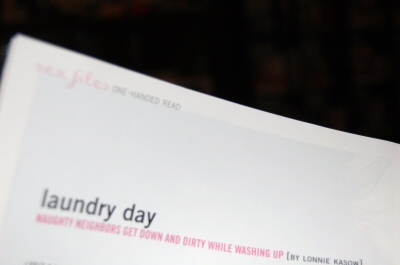 (Just because this popular feminist magazine has a porn feature in every issue doesn't mean anything. It's all part of an elaborate ruse to disarm the North American population. Then, once we've finally convinced everyone we're not anti-sex, we'll strike! Victory shall be ours!)
"What are you talking about, Andrea?" Sorry. I assumed you knew that until the 20th century, it was considered psychologically pathological for a woman to enjoy sex at all, to the point where a woman who conceived out of wedlock was considered mentally ill by default and committed to an asylum; and where women who showed evidence of libido were subjected to psychiatric "treatments" revolving around the application of caustic liquids to their genitals. Those of you who are female are surely well aware of the stock-in-trade in the women's magazine industry and most self-help books relying on the same tired old stereotypes, now slightly updated to allow women to enjoy sex so long as it is with their One True Love (trademarked by deBoers), and a path of true intimacy, enlightenment, and deep emotional sharing. Women, after all, are still the Angels in the House, and as such are not permitted to have an animal nature. 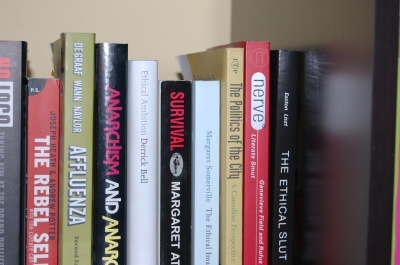
Except that the feminists I know have thrown all that out like the garbage it is. 5. Feminists by definition do not believe that men are innately more intelligent, more interesting, or more important than women. Study after study has shown that despite whatever gains we think we've made, when an objective observer watches men and women interact, most women still serve men, unconsciously and reflexively, and most men act as if they still expect it. It ought to go without saying that any relationship in which only the happiness of one partner really counts is a relationship that ultimately will make no one happy. It ought to really go without saying that any sexually intimate relationship in which sex is still defined as "male partner has orgasm during penetration" (the traditional definition), which by default makes male experience central to the relationship and relegates female experience to the margin, will eventually suck for both parties. What do you say, Dear Readers? Any reasons I have overlooked? But wait! There is a outcry from the peanut gallery!* Josh Taylor from St. John's, Canada writes: Every woman and man should be into equality. All the self proclaimed 'feminists' I met in college were just plain bitter. They are taking years of abuse that they didn't suffer out on the one man who is nice enough to tolerate them. Nuff said. Uh huh. Well, Josh, speaking from my own experience, all of the men I've met who had problems with feminists were misogynistic pea-brained twerps, deeply threatened by any woman not willing to assume the doormat position. Mr. Justice from Canada writes: Most women ARE feminists. Men who want to know what women really think of them should watch THE LIFETIME CHANNEL or THE VIEW, or . . . simply eavesdrop on women-only conversations at restaurants (and other places, obviously). Turns out 'the news' for men isn't good, but it's important for men to know what most women really think of them. Yes! Because the women on The View are the secret heads of a worldwide feminist organization that coordinates our daily activities through seemingly mindless entertainment, all to achieve the eventual goal of the coming Matriarchy! James Cyr from Balmertown, Ontario, Canada writes: joanne dewey: that 'traditional' definition is based on my meetings with so-called feminists and thus is well based in fact. They came across as belligerent, agressive, rude and rather obnoxious. They came across as having a chip on their shoulder and having something to prove. 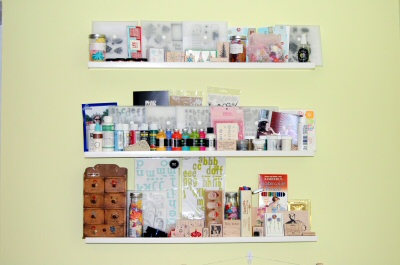
What are you saying exactly, James? Are you calling me belligerent? Are you? Come over here and let me show you belligerence, you .... I mean, aww sweetie, I'm so sorry you've had such a rough time with girls not seeing your obvious charms and your inborn natural need to dominate. Come over here and let me bake you a pie. I can't imagine what about your personality might provoke a belligerent, rude or obnoxious response in feminist women. Does it count as having "something to prove" if I insist on hanging my own shelves but then cover them with crafty stuff? Vladimir Kolcza from Toronto, Canada writes: I think that many people harbour stereotypes about 'feminists' because so many such stereotypes populate government offices and service counters. Vladimir, on behalf of female civil servants throughout Ontario, I can only offer our deepest, most heartfelt apologies on the lack of glamour in our professional wardrobes. joe cormorant from Canada writes: I don't think an arrogant self-absorbed bitc& is sexy. Sorry, I just don't. Fortunately, Joe, this arrogant self-absorbed bitch doesn't think you're so hot either. Gogh Forit from Canada writes: Let me get this straight. The authors of the study are feminists and they concluded that feminists are sexy. No bias there. Pure scientific study at work here. I mean why would anyone question the credibility of this life altering piece of science. And just what is a "feminist" man. Is that a guy who has no testicles or simply that he's not allowed exhibit any male behaviour whatsoever. Well, Gogh, speaking only for myself, yes, that is exactly what I require of feminist men. Castration. No male behaviour whatsoever. In fact, let me just hand you this padded bra and we'll make the transformation complete. (I'm just pretending to be straight, you see.) It gets complicated when the man I've just castrated has to wear a dildo ... never mind. Harbinger from Out West from Prince George, Canada writes: And all this time I thought God created feminists to give ugly women jobs. Boy! Was I wrong. Boy! Were you. Pete Flint from Andover, MA, United States writes: Feminists are always ugly man-hating dykes. Possibly the most physically unattractive group on the planet. Most dogs have more appealing features. Plus, they are usually fat and braless, which makes normal humans puke at the sight of them. Pete, thank you for this clarification. This certainly explains why I have that odd aroma following me everywhere I go. I thought it was just the subway that stank, but now I know: it's because normal people puke at the sight of me. It's a good thing I work in the civil service, where I am surrounded all day by other unglamorous, manly, stupid, bitter, fat feminists. 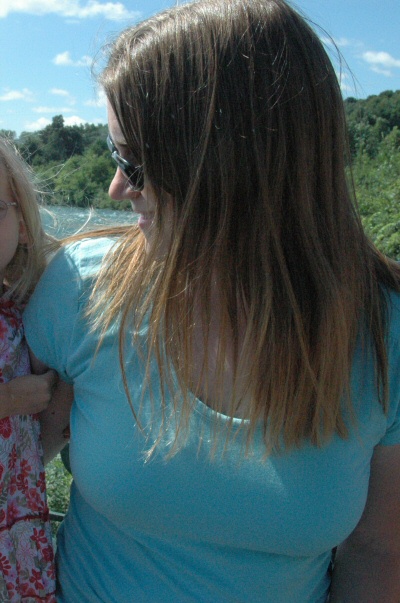
This is what a feminist looks like. 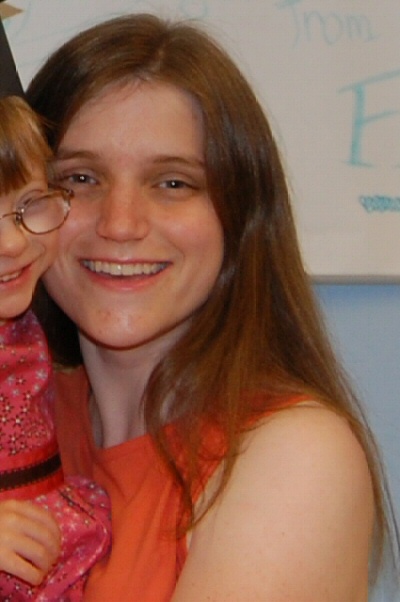
And hanging off my right arm in both pictures is the direct and incontrovertible proof that, at least once about five years ago, I had sex with a man. ~~~~~ *The peanut gallery is the on-line discussion on the Globe and Mail site. I haven't seen such a collection of feminist stereotyping since the days I used to post regularly on the BUST boards. And I haven't had so much fun mocking people in I don't know how long. Far as I'm concerned, if you're going to go on the public record with such outlandish sentiments, then you deserve every bit of flak you get. Posted by Andrea at 7:25 AM | Comments (18) May 30, 2007 This is what you call "laziness"
Plus being strapped for time. But I saw this article linked to on Making Light and thought that many of you would enjoy it, too: "How did more than half the people in the world come out incorrectly? I have spent a good part of my life trying to do that math, and I’m no closer to a viable equation. And I have yet to find a culture that doesn’t buy into it. Women’s inferiority – in fact, their malevolence -- is as ingrained in American popular culture as it is anywhere they’re sporting burkhas. I find it in movies, I hear it in the jokes of colleagues, I see it plastered on billboards, and not just the ones for horror movies. Women are weak. Women are manipulative. Women are somehow morally unfinished. (Objectification: another tangential rant avoided.) And the logical extension of this line of thinking is that women are, at the very least, expendable. "I try to think how we got here. The theory I developed in college (shared by many I’m sure) is one I have yet to beat: Womb Envy. Biology: women are generally smaller and weaker than men. But they’re also much tougher. Put simply, men are strong enough to overpower a woman and propagate. Women are tough enough to have and nurture children, with or without the aid of a man. Oh, and they’ve also got the equipment to do that, to be part of the life cycle, to create and bond in a way no man ever really will. Somewhere a long time ago a bunch of men got together and said, “If all we do is hunt and gather, let’s make hunting and gathering the awesomest achievement, and let’s make childbirth kinda weak and shameful.” It’s a rather silly simplification, but I believe on a mass, unconscious level, it’s entirely true. How else to explain the fact that cultures who would die to eradicate each other have always agreed on one issue? That every popular religion puts restrictions on women’s behavior that are practically untenable? That the act of being a free, attractive, self-assertive woman is punishable by torture and death? In the case of this upcoming torture-porn, fictional. In the case of Dua Khalil, mundanely, unthinkably real. And both available for your viewing pleasure." Unlike most of my friends, I've never been a fan of Buffy or Whedon's other projects. But I can see why so many of my fellow feminists are. Posted by Andrea at 6:09 AM | Comments (9) March 21, 2007 Control
My mother was an aerobics instructor before I was born and until I was nine years old. You might think that this would make you healthy; you'd be wrong. When she was twelve years old, her doctor told her that if she didn't lose weight, she'd end up with diabetes. I've seen photos of my mom at that age. She was a beautiful girl, not a smidgen overweight; but she believed that doctor and she has spent the last forty-plus years of her life with that echo bouncing in her head. At times, this has led to behaviour that is only bizarre. At other times, she was anorexic. When she was an aerobics instructor, she was at 5'4" approximately 135 lbs, and believed she needed to lose weight for her health. So, in addition to teaching two daily aerobics classes, working out with weights, and running a few miles every day, she restricted her calories as follows: Sunday: no food. Following this program faithfully--to the point of double-checking garbage cans in the morning in case she had binged in her sleep and refusing to buy or use toothpaste containing sugar--she got down to 120 lbs. Slim, but not skinny. You'd never have guessed looking at her that she was anorexic. But she was. The body cannot be controlled. It is not a wild creature which can be brought to an arena and broken. You can break yourself, trying. ~~~~~ I am a diabetic. As you all know. Type 1. This means that my pancreas is a broken, hollow shell, producing nothing; it means that without constant injections of insulin, I can die. The dominant message of type 1 diabetes treatment is control. Control your diet. Control your medications. Control your exercise. If you waver, you will get sick. You will die. And you will deserve it, because you can control your body, and you should. I count my carbohydrates--most of the time. I count my units of insulin and I watch the daily totals for substantial fluctuations or trends. I measure my blood sugars. I report for mandated doctor's appointments and medical tests. This I can do, within reason--there are days when the mountain of diabetes maintenance is too steep to climb. But my body? An incipient cold kicks the blood sugar higher even when I don't eat. Monthly fluctuations in progesterone levels change the amount of insulin I need for a given unit of food. Control? The best I can hope for is influence. A focus on control would keep me in a never-ending depression as the futility of every effort would confront me at every turn. ~~~~~ I've written before of my eating disorder, of how my desperate need to control my body and my blood sugars created a never-ending spiral of starving and bingeing, that was broken only when I admitted that my body cannot be controlled. I remember resisting that message. I remember walking into therapy with my talking points arrayed in my mind: "I can't keep getting bigger. If I do, I'll need new clothes, and I'm a student. I can't afford new clothes. It isn't good for me. I'm diabetic." And so on. But in the end, the body cannot be negotiated with. It does not listen to reason. It listens to hormones, electrochemical pulses, appetites, neurotransmitters, a thousand careening actors that have evolved over millions of years expressly to keep us alive. Reason itself is a creation of those same actors; our consciousness is a product of our animal selves. Mind and body cannot be separated. Mind cannot control the body. They can only dance together. Sometimes awkwardly, sometimes beautifully. Once I let my body go, once I stopped trying to control it, stopped treating it as a separate and antagonistic entity that was destroying my chances for earthly happiness, the bingeing disappeared overnight. I did not gain one pound. ~~~~~ Does this strike you as completely out of character? It's true that control over myself takes up a fair chunk of my mental processing space--keep the anger on a tight leash, pummel the fear into the ground, refuse to cry where people can see, keep my voice even. It's also true that I work to recognize those areas where control is inappropriate or harmful, and let it go. Granted, my choice of such areas may seem unorthodox, and when it comes to emotions is more punitive than it should be. I can control my behaviour; I cannot control what results from my behaviour. I can work out six days a week and count my carbohydrates and measure my insulin doses carefully and get a few servings of vegetables each day. I cannot make myself 135 lbs again; I cannot make my blood sugar a perfect 4-6 mmol before every meal. It is tempting to try, sometimes, when some other aspect of my life is spinning out of control and I feel a need to reestablish my own agency. But it is always an impulse best resisted. I am revolted whenever someone says that parents need to control their children. Have you ever been in a relationship where you were controlled? What did it take? What did someone else have to do to you, to control you? Is that what parents should be doing to their children? We can control the way we treat our children (most of the time), but we cannot control what our children do with this, the people they become. Or: we can control our behaviour, but not theirs. Control results from pain and fear, whether imposed externally or internally. Our kids don't deserve it. And neither do we. Posted by Andrea at 7:05 AM | Comments (18) March 14, 2007 Privacy: The Cost of Free Speech
I meant to post this last week for International Women's Day, but got distracted by my similarities to a fictional TV character. Priorities, I know. Chances are you've heard Audre Lorde's quote, "My silence did not protect me. Your silence will not protect you." But have you read the speech it came from? It's called "The Transformation of Silence into Language and Action," and I think it's a particularly pithy and apt conclusion to all those posts about honesty, privacy and the public sphere from the last month: "In becoming forcibly and essentially aware of my mortality, and of what I wished and wanted for my life, however short it might be, priorities and omissions became strongly etched in a merciless light, and what I most regretted were my silences. Of what had I ever been afraid? To question or to speak as I believed could have meant pain, or death. But we all hurt in so many different ways, all the time, and pain will either change or end. Death, on the other hand, is the final silence. And that might be coming quickly now, without regard for whether I had ever spoken what needed to be said, or had only betrayed myself into small silences, while I planned someday to speak, or waited for someone else's words.... What are the words you do not yet have? What do you need to say? What are the tyrannies you swallow day by day and attempt to make your own, until you will sicken and die of them, still in silence?... And that visibility which makes us most vulnerable is that which also is the source of our greatest strength. Because the machine will try to grind you into dust anyway, whether or not we speak. We can sit in our corners mute forever while our sisters and our selves are wasted, while our children are distorted and destroyed, while our earth is poisoned; we can sit in our safe corners mute as bottles, and we will still be no less afraid." (off-topic language-geek aside: mute as bottles! What a beautiful metaphor.) Free Speech has never been and will never be free. Whether or not you choose to exercise that right, there is a cost. Posted by Andrea at 6:46 AM | Comments (10) February 7, 2007 Mad Notes Part II: Anger Management
People are frequently surprised when I tell them how I'm feeling. Actually, they are most often disbelieving. I have one hell of a poker face. I know there is more than one reader who can atest to this, having interacted with me either in person or electronically without a clue that anything was amiss, only to find out later that in fact I was deeply depressed or furious about something. I'm not defending or (gods forbid) applauding this; simply noting that the experience of emotion says nothing of its expression. How an emotion translates into an action (or whether or not it translates into an action) is a choice. Yet people pathologize negative emotions--especially anger, and especially anger for women. Anger is an involuntary response to something in the environment, like pain; like pain, it can't make you do anything, it can't tell you what the problem is, it can't tell you what you should do. All it can do is say, "There's something going on here that you don't like." And I would suggest that if the correct response to anger is almost never "I'm going to beat the shit out of you" then it is also almost never "anger is destructive; I shouldn't feel this way." If the first response is associated with men and men's anger, the second is associated with women. The pressure to be nice begins at birth and never ends. "You catch more flies with honey then vinegar" is only one of the sayings routinely presented to women (and almost never to men); that it is often true does not mean it isn't sexist, because why does it work? Is it because people expect women to behave politely and sweetly, to smile and ask rather than frown and demand, and so reward women for complying? Despite promised rewards, this pattern of behaviour has costs--costs which are more visible in some circumstances than others, as this story from Chewing the Fat (found via the Disability Carnival) makes clear. Not only is vinegar sometimes healthy and productive--sometimes you need industrial-grade battery acid. Not because it works. Not because other people like it. Not because it meets with approval. But because it respects the integrity of our own persons. Because we deserve it. ~~~~~ You're wondering if I have any idea what I'm talking about. Indeed I do. I was born with one hell of a temper--to the point where my parents threatened to give me up to a foster family when I was ten years old if I didn't get it under control. I do know rage--the swelling pressure in the chest and the head, the clamping down of the senses, the heat, the brain turning in on itself as if inverting the human and prehuman portions, the thundering heart, the drawn shoulders, the black at the edges of one's vision, the stomach clenched tight, forcing bile back up the esophagus. Many people assume that the reason I have my emotions on such a short leash is because they are the psychological equivalent of toy terriers--all bark, no bite, and about five pounds apiece. But my anger is more like a rottweiler--strong, vicious, with large jaws. So I hope you will trust and believe me when I say this: Your anger is your friend. It is a guardian and a protector. It is not a monster that will devour you or those you love whole if you give it a chance. It is not a creature so loathsome that it must be left in the basement when you leave the house. It is a strong dog with good hunting instincts. It can save your life, and it can save your soul. But only if it is kept in a good leash at your right hand and well-trained. And you can do this. You can train it. Learn how to let the anger snap and bark and bite and growl inside while your reason--the leash-holder--sits down to think it over. Is there something dangerous lurking in the bushes? Is the smiling stranger less kindly than he appears? Is his offer less than advertised? Are you being threatened? When its hackles rise and the growl begins deep in the back of its throat--it's trying to tell you something. Maybe it's wrong, but you won't know if you don't listen. Maybe it's right but there's nothing you can do--but at least then you've respected yourself and your needs. It's ok to be angry about something that's out of your control, something you can't change. You would not ask someone living in a totalitarian regime that they alone cannot overthrow to learn how not to be angry about the daily intrusions upon their basic human rights. Rage is terrifying and learning how to control it is hard work; it might seem easier to chuck the whole business and pretend it isn't there. But sometimes honey brings more flies than you can handle. Sometimes vinegar isn't enough. Sometimes you need a nuclear warhead. Don't amputate the only part of yourself that can provide it. Posted by Andrea at 7:11 AM | Comments (10) February 6, 2007 Interpretation
According to the BBC's gender test and the Bem Sex Role Inventory, I am a man.* Those of you who have met me will vigorously protest this: after all, I've gestated and born a child, not to mention the long hair, high voice, and larger-than-average bra size. I scrapbook, and bake, and make presents for people, and sew. I present as female; indeed, there has never been a time in my life when I felt myself to be male, or wished to lose the breasts and grow a penis. But for as long as I've been aware of the possibility, I have always experienced myself as masculine. I'll hammer an opponent into the ground during a debate, if I can. I can't talk about feelings. I suck at small talk. I spend many hours playing computer strategy games. Here is the odd thing: No one else ever agrees with me. I should qualify that: no one else I meet in real life, who gets to see the long hair and frontal assets and scrapbooks and cross-stitched pieces on the wall and home-made chocolate chip cookies in the kitchen, ever agrees with me. Instead, my motivations and feelings are reinterpreted in a feminine way. This is an important distinction. My interests are largely feminine, though by no means exclusively--my guess is just over fifty per cent. But my motivations are not. I like crafts because I was introduced to them by adult women, and I was good at them. I avoided sports because I was bad at them. I liked fishing and hiking and camping because I didn't mind missing a bath or shower for a few days and enjoyed getting away from the city. It was a point of pride that I always speared my own worm with the hook. I sent my Barbie dolls off with my brother's G.I. Joes on world-saving adventures on other planets. The first novel I ever wrote--at age seven--was about a trio of girls in an orphanage who were thrust out into the cold world after the orphanage burned to the ground, and needed to find their way to a new home. On the surface, there is little to marr the girliness--the purse, the heels, the nights spent cropping with friends, the collection of cookbooks, and so on. Because the motivations were invisible, they didn't count--and thus I've been aware now for several decades of having impulses and drives projected on to me by reason of my sex that I have never felt. For instance, when I was a teenager, and every bit as reticent and taciturn as I currently am, boyfriends would accuse me of being "coy." Whereupon I would vomit. I even manifest depression in a masculine way. Weepy? Sad? Emotional? Not so much. Irritable? Lashes out? Loses sleep? Bingo! (And although this post isn't about children and gender-typing, I have seen adults--parents included--re-interpret the behaviour of children in more conformist and acceptable ways; for instance, a young girl running amok and breaking things will be considered girly as long as she's wearing a pink dress, a boy who doesn't like frogs and worms will be considered fastidious instead of squeamish, and so on. So that even when a child isn't behaving according to type, their behaviour is re-interpreted as being typical as long as they *look* like a girl or a boy.) And I ask you: what is the point of having these experiences if I can't use them to support a pet political issue? Having my behaviour consistently misinterpreted because of my sex has convinced me that the words "masculine" and "feminine" are, at best, unnecessary; and at worst, harmful. The set of traits considered typical of an adult woman would tell you absolutely nothing useful about me (unnecessary). Worse, it would lead a medical pracitioner to assume that I'm not depressed when I actually am because the symptoms I show are not typical for my sex (harmful).** Of what use are the words "masculine" and "feminine"? Does it tell you anything about any particular person that you couldn't learn or describe more accurately some other way? "Masculine" and "feminine" are no more than pass/fail grades assigned to a human being based on their ability to conform. For some people, passing is easy, and they never question this system because it never occurs to them that failure is possible. What does "feminine" mean? It means "a woman who is behaving the way she is supposed to." That's it. That's all it adds. I use neither word to describe myself. I am a woman; therefore, everything I do is done the way a woman does things, by definition. I throw like a girl, run like a girl, fight like a girl, read like a girl, write like a girl, shop like a girl, play like a girl, talk like a girl, and so on, even though out of all of the previous examples the only thing I do the way people expect girls to do things is "throw." I'd rather we learned to do without them. Any person you meet could land at any point on any given spectrum; and the only thing that the expectations encoded in "masculine" and "feminine" will do is get in the way of your ability to see them for who they really are. ~~~~~ *I can't cut and paste them here, but I got a 50 on the masculine side on the BBC test--solidly, averagely male--and a 5.7 on the masculine portion of the Bem Sex Role Inventory (opposed to 4.5 for feminine and 4.55 for androgynous, with 4.9 being considered the threshold for scoring positive). **My head explodes whenever I read an article describing how new symptoms, tests or treatments for particular syndromes or illnesses based on sex will reduce or eliminate problems with diagnosis or treatment. Actually, it will only redefine which people will fall through the cracks. General Caveat: This post is not in response to anyone else's. IT's one of those bizarre alchemical processes of the blogosphere where something from one place mixed with something from another place combines and becomes something quite different. Please don't take it personally. Posted by Andrea at 6:34 AM | Comments (16) December 17, 2006 The Nuclear Family: Or, if nuclear's bad for the environment, why is it good for people?
In general, you can assume that whenever society declares some state or institution to be "natural," not only is it completely artificial but harmful as well, both in its assumed universality as well as in the particulars of its implementation. So, for instance: gender is not only not "natural" as currently understood (what is considered masculine in one culture is often considered feminine in another) but the assumption that certain traits are "naturally" masculine or feminine does tremendous damage to whoever does not or cannot meet the mold. You're a girl and you like to study, do math, achieve? We'll attack your fertility and femininity and call you vicious names, maybe rape you. You're a boy and you like to knit or wear tutus? We'll call you a sissy and beat you up. Of course, if it were actually "natural"--the policing wouldn't be necessary, as no one would transgress the norm. Think about it. Breathing is natural; thus, almost everyone breathes with no reminders or punishments necessary, except for a few unfortunate persons with biological illnesses, on whom reminders and punishments would be utterly ineffective. Thus, marriage and the nuclear family. You knew it was coming. ~~~~~ In 2001, there were 8,371,020 families in Canada. Of them, 3,469,700 were families with married parents and children at home. That's approximately forty-one per cent. One might expect that something natural might be somewhat closer to universal. Like breathing. Canvas your friends, and I'm pretty sure all of them will be breathing at this very moment. And that is without any laws or governance whatsoever. Imagine. There is a distressingly large gap between our society's participation in breathing and its participation in the nuclear family, and that is without any effort whatsoever at encouraging our participation in breathing and extensive, one might say breathless, encouragement to marry and procreate. Could it be that the marriage and the nuclear family are not natural? Sadly, anthropology would support that position as, despite the best efforts of legions of (mostly male) anthropologists to define the nuclear family as near-universal among human cultures, one sees time and time again how there is so much more variation than similarity. For instance, in some cultures the role of father is taken by the mother's brother--the person who inseminates the mother has no particular role at all--and in others, while pair-bonding between a man and woman who reproduce takes place, it takes place within an extended family network that is as important as the pair-bond, or the pair-bond is assumed to be temporary. In order to avoid repeating myself more than is strictly necessary, I did write about marriage before, and here are the links: Mom & Pop: Sex differences and parenting. Mom & Pop, Part II: Patriarchy: THE BIG P-WORD and parenting. Mastadon-hunters vs. rabbit-baggers and the role of grandmothers in human evolution. Mom & Pop, Part III: Isolation: The role of the modern economy in the creation of the nuclear family and the isolation of SAHMs. My favourite alternative is partible paternity, in which every man who might conceivably have impregnated a woman is considered to be the resulting child's father, the theory apparently being that many inadequate fathers are better than one. Imagine the possibilities. I can't be the only straight woman who finds the concept of a society in which a mature and responsible mother ensures that she has as many sexual partners as possible to be ... well ... interesting? I did a smidgen of research and found some quotes that I'll, uh, share with you. Because sharing is what friends do and it sounds much nicer than what I am probably doing: And: William J. Goode added to the Functionalist view in a study of family trends throughout the world entitled World Revolution and Family Patterns, 1963. His basic thesis was that there is a worldwide trend towards a monogamous nuclear family structure. In response to claims that there is a diversity of family forms including polygamy, clan and extended families, social rather than biological fatherhood’s. Goode argued that there was a universal trend towards the Western model of the nuclear family because like Parsons, he saw this an integral part of the global expansion of industrialization." I haven't done a poll, so I can't and won't say how common this perspective is--though the knowledge appears to be widespread not only among anthropologists but also among economists that a modern industrialized economy is antithetical to extended kin networks--but let it stew in your craw a bit. We have adopted a family form that is restrictive and tremendously costly particularly to the women who now must single-handedly perform what a whole extended family network would have helped us do even a hundred years ago, not because of romantic love, not because it is natural, not because it is good for us and not even because it is good for our kids, but because it is good for the economy. Does it shift, even a millimetre, the way in which you view the so-called modern dissolution of the family? ~~~~~ Just because something isn't natural doesn't mean it isn't good, of course. My insulin pump is arguably not natural, but it keeps me alive and I like it. (Though Margaret Sommerville argues in her book The Ethical Imagination both that the nuclear family is natural and that we ought to have a "shared ethical presumption in favour of the natural," which she appears to define as "stuff that I'm used to." And if you're looking for someone to blame for this post, try her.) If a person (or a group of persons) can happily live within a nuclear family or a facsimile thereof for the duration, then good. In no way would I want any of this construed to mean that those who enjoy that lifestyle should be prevented from doing so. However, the presumption that this is "the" natural family structure does a lot of damage to those who can't or don't live in one. Unhappily married couples are the first to come to mind, for obvious reasons. I've always found it odd that so many people seem to believe that for two people to endure twenty years of misery in the pursuit of "working things out" and "staying together" in order to achieve five years of happiness at the end is in any way rational. I read the other day a divorce lawyer advising that people who are married for two years ought to stay together another two before divorcing, and people married for four years ought to stay together another four before calling it quits, and so on. I reacted with horror--you're married for two, you give it another two, then you're at four and you have to give it another four, so when does it actually end? Similarly, I find it odd that nearly half of all married people admit to having affairs--mind, that's only the ones who admit to it--and yet monogamy remains a universally shared value. Certainly the reasonable thing to do would be to modify the nuclear family concept to be more ... well, honest? But let's examine what I think are the real victims of the nuclear family myth: kids. Every day you hear another study about how kids need two-parent opposite-sex families in order to develop healthfully and appropriately. Every one of them makes me want to gouge out my eyeballs with a knitting needle. Here's why: 1. If nuclear families were absolutely required for healthy human development, they would indeed be 'natural' in the sense of inevitable. All human societies would practice this, or go extinct. That healthy human beings reach adulthood in societies with no nuclear families whatsoever would indicate that nuclear families are not required. 2. The studies from the hypothesis to the conclusions are absolutely riddled with an unexamined bias for the nuclear family. For instance, a study that compares educational attainment between children living with their mother only vs. children living with both parents, and finds that children of single mothers do slightly less well at school. They will control for the obvious variables (income, time spent with parent, quality of parenting) but have never, to my knowledge, considered the impact of the stigma of being the child of a 'broken home.' (At least, not as the studies are reported in the newspapers, which opens up a whole other kettle of fish re: competent scientific reporting.) Whereas a study about the different educational attainments of, say, boys vs. girls would at least consider the impact of sexism or different expectations on achievement, whenever children of divorce are studied any effects are considered to be entirely the result of the lack of a second parent, even though children of widows or widowers do not experience those negative impacts, and even though the negative impacts of divorce on children are lessening over time--that is, the impacts of divorce have been steadily decreasing since divorce was made more accessible in the 1960s. Go figure. So: we have a "natural" institution of nuclear families which are absolutely required for achieving real intimacy for adults and for rearing healthy and well-adjusted children, yet it is inexplicably vulnerable to attacks by malcontents. Although the institution is relatively recent, prior family forms are considered inadequate and unnatural and the concurrent rise of advanced industrial economies and the nuclear family in its current form is merely coincidental, even though industrial economies could never function without small and highly mobile family units with built-in free domestic labour. Although the nuclear family is essential to happiness for both adult men and women, women become angrier with the addition of each child to their family. Despite increasing evidence that the entire work of a nuclear family unit cannot be healthfully performed by a single isolated woman in a suburban house, the party line continues to be that nuclear families are "natural." I suppose, then, that would mean the psychological and physical needs of women are "unnatural." The penultimate evidence of this is the increased mental functioning and happiness of children in two-parent families, despite the contradictory evidence of published research to date, the continued existence of other family forms worldwide, and the tendency of divorce's negative effects on children to be lessened as divorce becomes more common and less stigmatized. ? Or: Nuclear families and the nuclear family form, while conducive to happiness for a significant number of people, are not "natural," are in fact recent inventions created predominantly to serve the needs of modern industrial economies for a globally mobile workforce, and imprison large numbers of people (not all, not even most, just a lot) both within unsatisfying nuclear family relationships and within the expectations of happiness that these relationships were intended to fulfill. They grind mothers to smithereens by either isolating them within large suburban houses that require constant maintenance along with the childrearing responsibilities that are all theirs without any assistance because the modern industrial economy has isolated them from their extended kin, or by requiring them to both work full-time in the industrial economy while also maintaining the large suburban house and undertaking primary childrearing responsibilities. Because the modern industrial economy requires a flexible, adaptable and creative employee, the related tasks of parenthood have also increased dramatically while the time available to complete them has decreased to almost nothing, requiring parents to hire expensive assistance to develop their children appropriately. The pressure to remain in these relationships is immense, and consists not only of the appearance of either failing or succeeding at being an adult human being (since all adult human beings will naturally wish to be in and will succeed at such a "natural" human relationship) but also of failing or succeeding at being a parent, because healthy children need to grow up in a nuclear family. Thus being a successful parent is dependent on being a successful wife or husband, even though it is quite possibly that very expectation that creates the negative impacts of marriage dissolution on kids in the first place. All so that Coca Cola can decide next Tuesday to relocate its headquarters to a low-tax environment. And I wonder, actually, if feminism doesn't get the blame not because it encourages women to consider their own happiness and leave an abusive asshole before he kills her, but because by creating two-earner nuclear families the portability of the unit as a whole has been compromised. The 1950s nuclear family ideal was perfect for industrial economies precisely because the wife's primary loyalty was to her husband, and his primary loyalty was to his employer, and thus the entire family could pick up and move whenever the husband's job did. Nuclear families serve individual children, women and men very well--much as its alternatives serve other individual children, women and men very well--but the primary beneficiaries of the insitution aren't the children, the women or even the men. The primary beneficiaries are GM and Exxon-Mobil. The aim of the modern nuclear family isn't the happiness of its members; the goal of the tremendous propaganda (Valentine's Day, bridal magazines, sitcoms, movies, fairy-tales, magazines and advice columnists) hasn't a whit to do with our individual happiness. Nuclear families are primarily economic units, producing goods and services, consuming goods and services, and producing future workers and consumers. The loss of those tasty bits of consumer/producer goodness would be excruciating for the economy--and that the desire of each individual company to maximize its own access to those economic units both as producers and consumers directly conflicts with each company's desire not to pay for the creation of those economic units itself (either through adequate salaries and benefits, childcare assistance, flexible family leave, health care, education, taxes or what-have-you) more than it can be forced to is causing the spontaneous combustion of the nuclear family society-wide ... well, it's very interesting. But somehow, "Stay together for the sake of the shareholders" just doesn't have the same ring to it. ~~~~~ *I hope that it goes without saying that the nuclear family organization--two adults of opposite sex who are involved sexually, with limits on sexual activity defined by the relationship, for both economic production and reproduction--is separate from the particular assumptions and expectations that revolve around the division of labour within those nuclear families; therefore, even when nuclear families exist within another culture, it is a mistake to assume that it would follow the western male breadwinner/female homemaker model. The nuclear family as practiced by some forager societies does not have much in common with the Leave it to Beaver model that pops into most of our heads. Posted by Andrea at 6:43 AM | Comments (9) November 7, 2006 Frances's First Friends
As I write this, it is Hallowe'en, and I have just returned to the office from Frances's daycare costume parade. I arrived to see my wee girl crumpled on the floor from heat; her costume is a thick, outdoor-appropriate fleece lion ensemble, and too much for inside. When I picked her up (she didn't even see me) and put her on my lap, she piteously asked, "Can you take it off, Mummy?" "Not yet," I said. "But I'll undo it so you can cool off; and when the parade is over, I will take it off and bring it home with me." I sang a few Hallowe'en songs with the kids and tickled Frances's back, on her request, and it aired her out so it was a good idea regardless. Then it was time to go. A slim, tall ballerina with a neat brown bun approached us; "Can little Frances be my partner?" she asked. "I think so," I said. "What's your name?" "S." "S! Frances has told me so much about you. Yes, I think that would be fine." S grabbed her hand and they stood in line together. "Can I hold you, Mummy?" asked Frances. I leaned down and gave her a hug and promised that when the parade was over, we would take off the costume and have a good snuggle before I went back to work. Meanwhile, S was busy fending off other claimants to be little Frances's parade partner, namely the protector I've mentioned in previous posts. S, incidentally, is a girl Frances talks a lot about at home, normally with the "my best friend" or "my special friend" prefix. "My best friend S" takes Frances on bike rides around the playground, and "my special friend S" plays with her, and the protector is "my other best friend" who "picks me up." Literally. S did a great job of being Frances's partner; they held hands while parading around the building, while the building's employees stood on the side of the hallway and grinned. Mini moments I don't want to lose: #1: "Frances, are you a lion?" I asked. "Yeah." "What do lions say?" The entire senior class roared in unison. "Oh my!" I said. "How frightening!" #2: After the parade ended, all the children got a small treat for their efforts. Frances accepted her small red package with wide-eyed wonder. "Mummy, look what I got!" She held it out for my inspection. "Wow, did you get a candy?" I said. "So did I!" The entire senior class brandished their red plastic packages. "I see!" I said. ~~~~~ "Look at the little lion!" I heard many of the on-lookers say. "She's so cute. Is she yours? Oh, how adorable." Afterwards, I took off her costume and packed it away, gave her a hug and told her I would be back in a few hours, and we would go trick-or-treating. A slightly teary Frances walkedoff hand-in-hand with her special friend S. Now I am in my office, looking at the dozen photos I took of them together. Frances and her first girlfriend, gripping each other's hands, smiling at the camera. (And you know that's going in the scrapbook.) ~~~~~ The social occasions surrounding the Motherlode talk were at least as much fun and as stimulating as the panel. At the Mother-Talk Lite over dinner on Friday, the conversation turned to the Mean Girls phenomenon. I said very little, because I normally say very little; but also because I've never understood the Mean Girls thing. In Negotiating with the Dead, Margaret Atwood discusses her upbringing briefly, where she spent most of her earliest years in the bush with her parents while they studied bugs. It wasn't a particularly girly sort of thing to do, and as a result, she writes, she didn't understand the culture of girls when they returned to city living and she started school. I didn't spend the first several years of my life in seclusion from girl society, but I empathize. I don't know how girls work. I never have. I take people at face value; if they say something nice, I'll believe they mean well. The mechanics of female conversations when the participants don't like each other make my head ache. When so-and-so said such-and-such, did she mean such-and-such, or did she mean such-and-so; and if she meant such-and-so, why didn't she just say so? I can't figure it out; I can't keep up. This has two downsides: 1. I am transparent. Anyone can see right through me. If I don't like you, you'll know. If I seem to like you, then I do. (And oh gods, how much it irritates me when people try to 'interpret' me, as if I didn't say exactly what I mean. When I say you don't need to buy me a present, I mean you don't need to buy me a damned present. If I ask for feedback and constructive criticism, that means you can tell me you didn't like something, and I won't dissolve in tears and conclude that you hate me; on the other hand, if you tell me you like something when you don't, that will piss me off. It means if you ask me for constructive criticism, I will indeed provide you with constructive criticism, and I will assume you can handle it. The question, "What did you really mean, Andrea?" will never do anything but provoke me; and when girlfriends ask me "So-and-so said x, but did she mean y, or maybe z? What do you think? How should I find out?" my answer is nearly always a polite variant of "just ask her, for crying out loud," which is apparently the wrong thing to say.) 2. Other women are, sometimes, utterly opaque to me. I have been blindsided more than once when someone who seemed to like me, because they smiled and said friendly things, turned out to despise me. I can never see it coming. I remember one person in highschool who was always telling me (helpfully) about what Other People were saying about me. What was written in which bathrooms; who said I didn't wear underwear to school; who else was saying I stuffed my bra, and so on. I dealt with this by writing a letter about it and letting it get passed around--"Leave me alone" was the essence of the missive. I don't think it worked; but the point is, I preferred to deal with such things head-on. It wasn't until my senior year, when I found out what she'd written about me in someone else's yearbook, that things started to fall into place. Until that moment I thought of her as a friend. She smiled at me, so she liked me, right? Ever since, whenever I've run into her, I have been unable to treat her pleasantly. She smiles at me still, but I can't ever trust her again. I noticed some of these dynamics at the actual conference; after the talks were over, rather than heave myself into the lion(ness)'s den I kept back and busied myself in tidying up and speaking only to small groups of people who I know I like and who I know like me. If I saw someone I even just wasn't sure of, I avoided them; the alternative would have been conflict, because I just can't master it. I can't smile at someone I dislike, and I can't stand anyone who could smile at me if they didn't like me. If I dislike you and, as a result, have said anything negative about you in your absence, then I will say it in your presence too (this has gotten me into trouble more than once). And I would have, which would have ruined the evening for everyone else. I am watching Frances embark on the first of her female friendships with no small measure of trepidation. I'm so happy she has these friends. Right now they bring her nothing but joy. Every day I hear about the kind things they do for her, and how much she likes them. But it won't stay that way, because it can't. And gods help me, I can't do anything for her. I don't understand girl culture. I don't know what to do or say the first time a girl breaks her heart. I don't know how it works, I can't translate for her. It is a substantial weakness for the mother of a daughter. But she's already learned and demonstrated more about making friendships than I've managed to master in thirty-one years, so maybe this will come to her too, without any help from me. (Having written this I'm afraid of it being misinterpreted to mean that I don't like girls or women. That is not true. I just don't understand the typical patterns of social interaction.) Posted by Andrea at 6:48 AM | Comments (20) September 29, 2006 Five Things Feminism Has Done For Me
(And see the bottom of this post for a Blogging Across Boundaries reminder.) From skdadl's post yesterday at pogge, a meme in support of the Status of Women Canada, which recently had their budget slashed 40% ($5m) by the Conservative Government even though there is a $13B surplus: 1. As my mother has told me a million times, when she was young she didn't get to go to college or university, because her dad didn't believe in higher education for girls. When I was nineteen, I went to university. My mother was clearly envious, but no one suggested that developing my brain would cause my womb to shrivel up and die (a popular theory in the nineteenth century) or that it would be a waste as I'd only get married and have babies. 2. When, in my early twenties, birth control failed and I found myself pregnant, I was able to terminate the pregnancy and had only to brave a few mangled-fetus signs in front of the clinic to do so. 3. I've never had to bring a note from my husband to get a prescription for birth control. Or to open a bank account, get a credit card, or get a job. 4. I wear blue jeans to work four days out of five. A few decades ago, not to be seen in a skirt would have been scandalous. 5. How do I summarize "everything"? I work full-time in a professional job. I have a husband who loves me and whose stated values of egalitarianism are met by his behaviour. I have a beautiful little girl who is surrounded by people who support her as a human being with unlimited potential. I have a library full of books by amazing female writers on every subject from science to sociology to science fiction. I have a cd library of female musicians. I have Bitch and BUST. Is there anything that I value in my life today that was not, in some way, at least influenced by feminism? I'm going to expand on this meme, too, because feminism has a lot left to do, and the Status of Women Canada has a long way to go before it should be dismantled. Five things I want feminism to do: 1. Decriminalize prostitution. Making it a crime hurts only the women who practice it. 2. Work on the wages and working conditions of informal/contract/part-time workers in lower-status positions, the vast majority of whom are women. Feminism isn't just about the right of a small minority of women to get law and business degrees. Feminist icons like Emma Goldman fought for decades for the rights of working-class and working-poor women to have wages and working conditions sufficient to human dignity, a reasonable standard of living, and to support enough free hours to have a family life. We need to continue this. 3. Work in partnership with other social justice movements, recognizing that sexism is one piece of a puzzle that can't be solved without cooperation between all groups working to end oppression. 4. Work to increase the status and remuneration of the necessary and currently unpaid work that primarily women do in the home and community. I don't know how it could be done, but we need to. In a world where all the CEOs could be wiped out tomorrow and nothing much would change but if mothers stopped bearing and raising children civilization would end in a matter of decades, it is sheer nonsense that the CEO makes millions while mothers get nothing. 5. Continue to challenge the images of womanhood presented in popular media and culture as destructive to women as individuals and as a group. (Remember--Blogging Across Boundaries Day is Monday! If you can't get on Monday, don't worry about it--a few days to either side won't make a difference. I'll be posting mine over the weekend as a sample of one way to tackle it. But don't feel limited by it, please; you can do something completely different. It's your blog(s), right?) Posted by Andrea at 10:11 AM | Comments (8) | TrackBack September 26, 2006 So.
Aelial asked, "What do you mean, who gets to decide if it's good?" And I know that she meant it rhetorically, but I'm going to take her seriously and answer it because I think it's interesting. A few weeks ago I read an interesting article in The Toronto Star called "Watch your language" by Judy Gerstel about valley girl speech and linguistics. You've probably each read a dozen at least yourselves about how, if you want to be taken seriously in business or at work, you can't ever ever speak that way--no "like," no "soooo," no "you know?" No no no. But this article took a different tack (I'd link directly to it but it's older than 7 days so you'd have to pay for it. Let me know if it seems worth $4 and I'll give you the name and url; in the meantime, here's another article about the same researcher, but much watered down.): ""It's absolutely astounding how much our language tells other people about who we are," [Sali Tagliamonte] says. "We're always judged by how we sound. Always." We can pick up revealing clues about someone's age, place of origin, education, lifestyle, cohorts, socioeconomic class, even aspirations by listening to the person speak just as easily as a dog can identify another canine's sex, age, health, reproductive status and aggressiveness simply by sniffing. In fact, experts say the way we speak - intonation, pronunciation, grammar, vocabulary - communicates more than the content of what we say." The article is discussing speech, but I think this applies just as easily to writing style, as I'll try to demonstrate in a bit. "Noting differences in how women and men speak can be contentious, especially if characteristics of women's speech are deemed unacceptable. Like, for example, like. "Like" has many functions in the conversations of young women, from teenage girls to working women in their 30s, but is considered linguistic litter by people over 40, especially men. Chwat regards repetitive use of the word "like" and using it to replace other words as "intellectual impoverishment." Tagliamonte, too, notes a dramatic increase in the use of like as a quotative verb, in place of "said" - "people constructing dialogue, telling stories, and saying, 'And then, he's, like, "Are you kidding?" And he's, like, "No, I'm not kidding..."'." But unlike Chwat, who is a speech therapist, she is a linguist and defends the trend. "Like" is evolving into a greater role in the English language, she says. As with fashion, changes in language are driven by youth and by women." " This is where it gets interesting: differences in word choice, grammar, style of speaking, can be divided along sex lines; and guess what's considered the better style of speech? Ah, men's. How odd. ""Speech pathologists are getting paid a lot of money for 'de- liking' young women," Tagliamonte says. "And my students tell me this all the time 'Oh, I've tried to stop saying "like" and I just can't.' My response is, 'Why would you try to stop sounding like who you are?'" There's a very good reason - if you want to impress someone who looks down on people who talk in a different way from him or her. And right now, most people who control high-paying jobs don't pepper sentences with the word "like."" And of course, most people who control high-paying jobs are? So, do you suppose they are selecting and rewarding people who sound like them? Not consciously, but still. "If you link a usage with a social group, and that group is undervalued and perceived in a dismissive way, then their characteristic vocabulary or intonation will be scorned. So it's not the rising voice that makes the speaker seem inadequate, it's the expectation that the speaker is inadequate that is reinforced by the rising voice. Put another way, we assume that proper English is spoken in a certain way when in fact all we're doing is identifying those groups who have power." There's the money quote: It isn't that certain groups speak (or write) well and the rest of us don't, it's that powerful groups get to decide what good speaking or writing sounds like, and unsurprisingly, they choose people who sound like themselves. In this case, the characteristic speech of girls and young women is derided not because it is stupid but because it is spoken by girls and young women. (This reminds me of one of the articles I read about blog status, in which the authors discussed why LJ was wholesale dismissed as "not real blogging" (see bottom of page 7 onwards). The authors argues that LJ users are overwhelmingly female, while 'real blogging' is more male, making LJ a lower-status activity, as reflected by the comments on 'real blogs' in discussions about why they don't read LJs: "It always seems to be 12-year-old girls talking about anime." You have to admire that insult's economy: LJ, 12-year-old-girls and Japanese animation in 12 words.) So, like, people who sound like they went to Harvard design the curriculums, right? And then that means they get to decide what books are taught in schools, right, which means like every kid in America is taught that good english sounds like they do, know what I mean? So we are all trained, like, from five years old to think that good english sounds only one way. And anything that sounds like a young girl is, like, automatically bad, which is so. unfair. Are your eyes glazing? Are you already tuning out? Would it sound more impressive or intelligent if I'd said, "The powerful and educated get to design curriculums used to educate every child in the western world, so, from the time of kindergarten onwards, every child is trained to believe that good english is the way the powerful and educated write and speak. Since young girls don't sound powerful or educated--because they're not--their speech and diction are automatically dismissed." The actual content is identical; you are reacting only to the style. In the online communities I've participated in, however, Valley Girl was not despised--it was honed to the level of high art. These communities were almost exclusively dominated by women, so it is not a surprise that a female dialect was practiced. Was it an egalitarian paradise? No. Actuly people realy attacked anyone who could'nt spell or use gramar proprly. It was like if you could'nt spell and did'nt no where the apostrfes go, your'e stupid or something. Like everyone has the same chance too learn how too spell priveledge and jugmental. Eyes grating? Ears bleeding? Yeah, that's what it was like. But come on; it's totally classist. Just because you can't spell and don't know where the apostrophes go, doesn't mean you're stupid and your ideas should be discounted, but that was still the basic idea. You could sound like a Valley Girl; but you had better sound like a Valley Girl who went to Harvard. These aren't the only examples; I imagine the vernacular of black inner-city youth is not considered the height of enlightened discourse, either, though as far as I can gather they have the same chance of having something worthwhile to say. And there can be poetry in any vernacular; Strunk and White don't have a vice grip on the music of language. I wonder if it's more obvious in more obviously classist societies? From all my reading on Britain, it seems universally acknowledged that one of the most important steps to shedding a working-class background and being accepted as a member of the elite is learning to speak with the right accent, using the right words and diction. (Most recently encountered this idea in the Globe and Mail's story on Michael Ignatieff, which discussed his first wife, who was english and of a working-class family. The article made a point of discussing how often her working-class background came up in conversation. For another, less serious take, the novel I Don't Know How She Does It was also about a woman with working-class british roots who, in part, has to learn a different way of speaking to be taken seriously by her elite british colleagues.) And I am not in any way free of this. I know very well that the degree to which I am taken seriously depends on my ability to sound like a college-educated male. No subculture vernacular, no female diction or intonation. And I fully intend to exploit my ability to do so because I want to be taken seriously, even though I know that the playing field is so damned tilted you could put a ball by the goal-post and watch it roll downhill. We live in a world where the words of the ruling classes are automatically considered to be more intelligent and more important than the words of anyone else, and part of that is that the characteristic speech and writing patterns of the ruling classes are considered to be markers of intelligence and class. Writers are trained to use those patterns, especially when communicating subjects of importance; journalists are hired based on their ability to use those patterns; newscasters are hired based on their ability to speak that way; literary prizes are awarded based on it; and each of us is trained, from birth, by the culture around us and the entire educational system, to view the speaking and writing patterns of the upper classes as the primary symbol of intelligence and valuable discourse. When I ask, "Who gets to decide what's good?" I'm asking, who are the taste-shapers? I'm asking, whose opinion is influential? Who decides what the rest of us learn to appreciate? To some extent that's mediated in blogs because each of us is our own gatekeeper--no publishers, no editors--on the other hand, each of us has already been extensively trained to believe that good English is what is spoken by Harvard graduates. That is not without implications. Not everyone has the same opportunity to learn to speak or write this way, and why should they? Why should good english be so narrowly defined? Why shouldn't we instead try to broaden our palates? So, who gets to decide what's good? Even when you are deciding what to enjoy on your own personal space, who got to decide what you would be taught to think of as "good"? Posted by Andrea at 7:17 AM | Comments (23) September 14, 2006 Why Girl-Power is NOT Feminism
Have you seen these?
Have you? Look! Look at this! These are for six-year-olds.* Padded bras for SIX-YEAR-OLDS! I am not normally speechless with rage, but right now, all I can think is--what kind of freak show planet have I brought my little girl into anyway? Courtesy pogge for the tip this morning. According to the article in the Herald Sun, Bratz maintains that these products are for de-emphasizing the breasts of six-year-olds. Sure. Because when I look at that picture, what I see, is something meant to disguise the chest, kind of like a burka: "Bratz distributor Funtastic defended the range. " 'The idea of the padding is for girls to be discreet as they develop,' a spokeswoman said. " 'It is more about hiding what you have got than showing it off. It is certainly not there to make children look like they have breasts.' " No! Perish the thought! How could anyone come to such an unjustified conclusion? And really, so what if six-year-old girls look like they have breasts and dress to advertise it? This is girl-power at its best, right? Just like lipstick and high-heels and miniskirts for their mothers, this is about empowering them through their budding sexuality. Because gods know the only kind of power I need or want is the ability to bring men to heel through fashion choices that, in every other sense, hobble and cripple the wearer. And why wouldn't I want to share that amazing choice with my six-year-old daughter? What makes this even worse, and there is a "worse" in this for me, is that Frances could actually use a product like this. No, not now; but if she stays on her current growth curve, when she is in her early teens and developing, she will be about the size of a six-year-old, so these could actually fit her nicely. But instead of someone making and marketing attractive smaller-sized lingerie for girls and women of an appropriate age who are smaller than average, they are making the exact same product and marketing it to LITTLE GIRLS. Why? Why? There is a huge market out there for women of short stature who might need a similar product. Why not make the same thing and make the same money in an ethical way? What is the added benefit to the company of increasing the sexualization of girls? Is the damage to their self-worth and self-image really that important to their future consumer potential? Excuse me; I have to go cry now. ~~~~~ * The 'bralettes' start in size 6. Posted by Andrea at 8:45 AM | Comments (39) | TrackBack August 31, 2006 I love it when the world gives me a good case study
Women of childbearing age, you'd better take a prenatal vitamin whether you're on birth control or not, because there is still a slim chance you could become pregnant and as we all know, your primary responsibility is not to yourself as a human being but to any and all future person who may or may not issue from your womb. And now that we've got that straightened up, let's really play it up a little by throwing out a lot of terrifying and confusing statistics, shall we? According to one study, almost 1 in 17 babies worldwide is born with "serious birth defects -- a hidden epidemic of global proportions." But let's not mention that a good number of those outside of the Western world are likely due to specific environmental pollutants like depleted uranium and contaminated drinking water, and a prenatal vitamin is going to do dick all for them. "The study, commissioned by the March of Dimes, said that, all told, almost eight million children annually suffer from a birth defect, including 3.3 million who die and another 3.2 million who live with severe mental and physical disabilities that often condemn them to a life of poverty and suffering." We won't mention the other 1.5 million who presumably are living reasonably good lives, or the proportion of the 3.2 million who have serious disabilities but who have not been condemned to a lifetime of poverty and suffering. "Birth defects principally involve deformities of the heart and spine, and blood disorders, but up to 70 per cent of the conditions are preventable with simple public-health measures and basic medical technologies." I'm all for simple public-health measures. By all means, encourage women to take prenatal vitamins, even though expecting women on long-term birth control measures to do so on the off chance that the birth control fails and they decide not to terminate is plain stupid--sure, half of all pregnancies are unplanned, but how many multivitamins would it take exactly among the female population at large to prevent even one case of a serious birth defect? And what if a woman who's not planning on having kids actually needs or wants the additional vitamin A not contained in a prenatal vitamin? She should give it up for good because, you never know, condoms break sometimes? Yet another fabulous example of how a hypothetical fetus is more important than an actual woman. But even ignoring that, what exactly do you suppose is meant by "basic medical technologies?" Surely I am being overly cynical in supposing that this might be doublespeak for termination. Surely? If they had just stopped the article before they started blathering about the untold horrors that await any woman foolish enough to ignore this crucial advice (1/17! Serious birth defects! Death! A life of hardship and poverty!) it might actually have been a decent article. Hey, I'm all for prentatal multivitamins--I'm taking them myself, in fact, with a good extra dose of folic acid for the diabetes--and I think it's fabulous that a simple pill taken daily can prevent birth defects. Wonderful! Great! Let's make it available to every woman who is thinking about or actively trying to conceive (as a public-health measure, sponsored by the government, it would surely pay for itself). But how on earth throwing out a lot of scare-mongering about the terrors of birth defects was intended to add in a positive way to the article at all, I can't fathom. In Canada, the baseline number of congenital anomalies in newborns is 2-3%, not 1/17. Some of them will lead to death in the neonatal period. Others will indeed lead to considerable hardship and poverty. But thanks to the health care system and universal public education, as well as a little something called Human Rights, most birth defects are not actually a lifelong sentence to utter misery, and the most common "basic medical technology" used to "prevent" birth defects is a surgical abortion (in the same time period that surgical terminations of affected fetuses went up over 500%, neonatal deaths from congenital abnormalities when down 21% according to one Canadian study--which seems, if you ask me, like some very slippery accounting to support his recommendation that prenatal testing and access to abortion services be increased in all regions across Canada). Posted by Andrea at 11:15 AM | Comments (3) August 13, 2006 The Ugly Duckling
You all know the fairy-tale: a hideously ugly baby duck endures ages of torment for its unfortunate looks, only to grow up into a swan. Happy Ending. Or not. What do you suppose happened next? "That swan thinks she's better than us because her feathers are so white." "And her neck! She's always flaunting it." "I think she had surgery. No one's neck is that long." "You know I heard she's sleeping with Mary's boyfriend." "No! She's sleeping with Tom, too!" "What a slut." "I hate her." ~~~~~ And yes, I'm willing to claim authority here, because I was an ugly duckling. Hideous in middle school, and just ask the folks I went there with. HBM's story of being called "big nose" resonated with me; though no one ever made fun of my nose, I was teased for having small eyes, no breasts, no fashion sense, wearing makeup, not wearing makeup, having knobby knees. (To be fair, most of those things were true.) "She's so ugly," boys would say when I walked down the hall. Once a group of boys followed me around a shopping mall, saying "Woof woof, sit Booboo, sit." Once I intercepted a caricature drawn by a classmate that had me, straggly flyaway hair, knobby knees, small eyes and all, begging for a date. (When I say kids can be cruel, I know whereof I speak--and yet I love them anyways. Go figure.) So yes. I've been there. Then I cut off the godawful perm, bought some miniskirts and started highschool. I know it sounds like exactly the sort of cheesy Hollywood movie that everyone likes to criticize for its unreality, but, well, It Happened To Me. People started to hit on me. They asked me out sometimes. Some people actually started telling me I was cute--even hot(tt). Misery over! Happiness found! I was gonna make it after all. There's no better training for the belief that beauty=happiness than a brush with ugliness, however imagined; and there's no better cure, in my experience, than the opposite. I expected this to bring me happiness, and it went straight to my head. Wasn't it going to make me popular? Wouldn't boys ask me out? Isn't it exactly what all the teen magazines promised, that once you had the right hair and the right face and got yourself the right makeup and clothes and shoes, that you would be happy? No longer were gangs of boys chasing me through public places telling me how hideous I was; instead, they were chasing me through public places, grabbing my breasts and my ass and telling me what they wanted to do with me, or worse, single middle-aged men were sidling up to me at bus stops telling me how much they liked my miniskirt. No longer was I being tormented with the idea that no boy would ever come within five feet of me; instead, I was being tormented with the idea that I'd already slept with too many of them, even though I was a devout Baptist at the time and intended to stay a virgin until marriage. No longer was I being teased about not having breasts; instead, I was teased for having them and possibly for stuffing my bra or not wearing underwear. No longer were they drawing caricatures parodying my hideousness; instead, they were writing ditties about me on the bathroom walls, and then relaying them to me in explicit detail. Not so much a step up as one might guess. The girls who used to ditch me because I was a social liability (scaring away the boys with my small eyes and flat chest) now ditched me because they'd heard I stole so-and-so's boyfriend, even though I still have no fucking idea how you steal a human being. They're not pots. You don't just pick them up and walk away. Presumably, boys exercise some choice in the matter. HBM says, "In this dream, she never has to give her looks a second thought. In this dream, she never wonders whether or not she is pretty because she is never plagued by the concern that she is ugly. She will be blessed with the luxury of having no need of concern over her looks," when she writes about what she wants for her daughter. But it doesn't work that way. Beautiful girls obsess about their appearance more than any other because they have to; and being beautiful does not spare a girl any pain. I can say this. I've been ugly, I've been hot(tt), I've been average. Average is the place to be, when it comes to appearances. Even though I had consistent affirmation about my looks, I still was terrified that I was ugly. I wore the short shorts that seemed to be required, and worried every step that my thighs were too fat; I wore the snug shirts, but wouldn't tuck them in. There was more to worry about as a pretty girl than an ugly one, becuase other people cared so much. If you look like you could be a cover girl, then not only do people seem to think that you ought to try to look that way most of the time--with the clothes and the makeup and the hair etc.--but there seems to be this unspoken expectation that you will live up to all the headlines always printed around the cover girl's head. Be popular with boys (but not too popular)! Have lots of friends! Be happy all the time! Wear this season's coolest shoes! One is supposed to make every effort to allow other people to project whatever fantasies on to one that they have about pretty girls. You have no one's permission to be yourself. If I could tell you the number of first dates I went on where the evening abruptly terminated when I used a multisyllabic word--well.* What saved me was my history as an ugly girl, ironically; I didn't know I wasn't supposed to be smart, and I had no practice in hiding it, and couldn't manage it at all. I didn't know I was supposed to be a slut (the girl in my middle school class who developed first had a reputation when she was eleven years old, and her friends and classmates placed bets on when she would get pregnant. She was also very pretty. It didn't occur to me at the time that the whole thing was probably invented. What hell that must have been for her). I didn't even try to pretend to be someone else, and while it made things difficult at the time, otherwise I think I would have lost myself. The thing is, when you are The Pretty Girl, a lot of people expect you to justify their beliefs about what prettiness brings you. If the magazines and advertisements say that being a tall slim blond girl with a nice rack means that you'll be happy and popular and utterly manipulative and conniving (and the magazine articles all claimed to know exactly how to connive and manipulate your way to popularity), then you'd better be a living breathing demonstration of it, or else. Happiness started for me with invisibility, with the 35 pounds I started gaining towards the ends of my teens, when people stopped looking at me "like that." I'm now 150 lbs, and you could not pay me to lose the weight again. It's wonderful to be able to wear whatever the fuck I want, and be able to watch people without them noticing me, and be myself, and not worry that someone else is beginning to hate me because I'm not living up to their idea of who I should be, or because I am. No one gives me the stink eye these days if I'm talking to their boyfriend or husband; no one comes up to me and asks, "don't you think that skirt is kind of slutty?" No one's throwing bottlecaps down the front of my shirt. No one's helpfully telling me that they heard people wondering if I wore panties that day. No one is telling me that Sue told Joe told Anne told Carol that Mark dumped me because I wouldn't sleep with him on the first date. No one cares. I'm not pretty enough. Thank god. Average is kind of nice. It's what I want for Frances. I want her to be pretty enough that no one torments her for being plain, but not so pretty that she becomes an object of fascination or fetishization for anyone else. I want her to have the freedom to be herself that only comes from being in the middle. A friend of mine, who I hope is reading this, has an even more harrowing story of being "too pretty," and I don't know if she'll be brave enough to share it. It makes mine look like a walk in the park, which in many respects it was, though I still never want to go there again. But don't wish it on your girls. The idea that beauty brings happiness is an advertising gimmick, a way to make us buy makeup and skin firmers and soaps and lotions and other crap. If we didn't think that by buying them we'd be buying beauty, and that by buying beauty we'd make our lives better, why would be bother? (My experiences certainly helped in this, anyway; I can't be bothered to buy makeup or lotions or what have you. Whether they do what they promise or not, they won't improve my quality of life, and I'd rather buy craft supplies.) I don't want to minimize the pain of believing you are ugly. It was one of the worst times of my life. Every day at school was torment. I didn't know what about me or my body would be unacceptable. I didn't know how to make people leave me alone. I'm sure it contributed to the depression that led to my suicide attempt in grade 8. But let's remember--that bottle of pills and the scalpel stayed in my closet all through highschool. I believed that being pretty would make me popular and happy, but it didn't. I can't even say that it was that much better than being ugly. How I looked was just fine, but nothing else about me was ok anymore. I had more friends, who sometimes treated me worse than my old enemies did. People would passionately hate me before they'd even talked to me. There was one girl I worked with at McDonald's who wasn't even subtle about it. Whenever she saw me, she'd say (loudly), "I hate her." I'd never even talked to her. I didn't know her name. I didn't know any of her friends. But she hated me. And I understood that it was my job to pretend I couldn't hear her, and go about my business. I'm aware as I type this that I am breaking a taboo. It is not permissible to talk about pain if you are pretty. Part of the fantasy is that you are happy all the time (and so if someone else manages to buy themselves that prettiness, they too will be happy all the time). So I have to spill ten times as many bytes to convey the same message as I did about ugliness. Being ugly hurts. So does being pretty, in my experiece. You just can't win. ~~~~~ Leora Tanenbaum's book Slut explores the reasons why girls end up with a reputation. She found that there are two factors: 1. Breasts. If you've got them, you're a slut, and especially if you developed early. 2. Boys. If they like you, you're a slut. It doesn't matter whether you like them. It doesn't even matter whether you've ever kissed someone. Sexual history has no correlation with reputation at all. (If there was someone in your highschool who was labelled this way, and there probably was, you may want to consider that they probably were no more active than you were, and possibly less.) As she says on p. 199: "slut-bashing likewise is a sad attempt to wield power by those who feel they don't have any. It is a way for a girl who does not attain the beauty ideal (and how many do?) to establish her superior femininity. Her target? Girls whom she fears are prettier and shapelier. ... When she sees a girl she thinks is prettier than she is, confesses Paula, a white ninth-grader from Manhattan, she says, "She's so pretty, let's kill her." Paula's best friend Samantha volunteers, 'If she's pretty, I laothe her." Paula cites the example of a new and really cute girl in her class. "When my friends and I first met her, we were like, 'Oh great, there's the end of our social life.'" Paula and her friends also assumed that the new girl was "dumb or shallow or obnoxious."" I can't summarize her entire argument as the tagline to this post, but I highly recommend the book. But do ask yourself: do you think the world has changed so much that a very pretty girl no longer has others say about her, "She's so pretty, let's kill her"? In the world we live in, no woman is free from obsessing about her appearance. It doesn't matter how beautiful you are, you can be more beautiful, you have flaws. Manufacturers will still target you with advertisements that appeal to your insecurities, and magnify them. All women are trained to be fearful of being ugly and certain that happiness lies just beyond their grasp (with the potential remedy of a new bottle of lotion), and beauty does not buy you an escape from that. But it locks the door for you, because for so many women still the primary bonding method is by complaining about appearances. Except that if you're perceived as being attractive you're not permitted to be insecure about your looks; expressing insecurity is perceived as fishing for compliments and elicits animosity, not support. I'm not sure what the answer is for our girls as individuals--that is, how we make sure they keep their sanity. On a fundamental level they're fucked no matter what they do or what they look like. But I think the first step is the basic acknowledgement that beauty is not happiness, that it does not guarantee popularity or an easy life, both for the majority of girls for whom this ideal puts happiness and self-worth permanently out of reach, and the pretty ones, who are policed and penalized for seeming to unfairly have something that everyone else is trained to want. As for Ashlee Simpson, she works in Hollywood, where plastic surgery is the equivalent of a university degree. It's a career move. It will buy her fans and record sales and endorsement opportunities. I wouldn't read into it anything about her happiness with herself, her feelings about her appearance, or her endorsement of the beauty status quo. It's entirely possible that she hates the new look and was convinced that it was the only way she could advance her career. It isn't sad to me to think that she disliked her nose and so had it cut off, because I don't know how she felt about her nose, nor do I have any reason to think she cut it off because she wanted to be pretty. What's sad to me is that we still live in a world where success for women is defined by appearances, and where no matter how talented you are, if you are ugly, you're shit; and no matter how successful you are, if you don't strive to look like a cover model, you don't count. The problem is that in the world we live in it is not acceptable for a famous woman to have a big nose. The problem is that in the world we live in we demand that those who have certain advantages (talent, fame, looks) live in a way that allows the rest of us to project onto them our fantasies about their lives, and which in the end makes our fantasies more real than their lived experiences--that insists that a beautiful woman in Hollywood who looks like a temptress must act like one or lose her fans, that a pretty girl with a nice voice can't be successful until she looks the part of a Hollywood starlet. What makes me sad is that the world we live in is still not prepared to treat women as individuals, as human beings. What makes me sad is standing at the news counter and hearing other girls and women trashing the appearances and reputations of the women on the covers of People or Us or In Style--"she's not pretty," "look at her hair! Yick!" "She needs to lose weight." "THAT'S not a six-pack." "Do you think she has implants?" "There's no way she looks that good, she must have had botox." "Yeah, but you know she never eats. God! Have a sandwich!" And lest you be under any illusions, any pretty girl, within whatever circle she is believed to be pretty, will be under the same level of scrutiny and criticism. What makes me sad is that even though those fantasies are destructive to every woman in Western civilization, causing everything from eating disorders to suicide attempts, that when a pretty girl (whether a celebrity or not) steps outside of the role of that fantasy, we demand that she get back in. Look at Britney: we should be falling over ourselves thanking her for not hiring a thousand people to help her look like a perfect mother, with a perfect postpartum body and no embarassing slip-ups. We should be thrilled that she's allowing herself to look like a human being, to look no better than us. And what do we do? Hire a trainer, Britney! Hire a publicist! Get a nanny! You must get back inside our fantasy at once and stay there, our fantasy that demands a certain type of perfection and a certain personality of anyone who looks a certain way. If there actually is a girl somewhere who believes that she looks attractive, do us all a favour and lock her in a room somewhere without a phone or television; she's an endangered species, and if the marketers get their hands on her, they will destroy her self-esteem to sell another $20 bottle of Glamour Cream. None of us are allowed to believe in ourselves. In the end, being pretty doesn't even buy you the privilege of believing in your prettiness. In my experience, it gets you nothing but the unwanted attentions of unethical boys and men who see the hair and face and body you were supposed to want and take it as permission. Who can't even hear you when you say no.** ~~~~~ *For the HSLC: this is mostly based on my experiences among the non-ELC, in case you're offended at my characterization--though if you thought about it you could come up with at least one example of a boy who knew very well that I was smart and was not at all interested in my brain, only in the enhancement that being my boyfriend brought to his sexual reputation. **The link is to a previous post where I outlined some of my creepier encounters with men who interpret a certain body type with promiscuity. Posted by Andrea at 4:24 PM | Comments (12) April 24, 2006 The Duty to Smile
Why is it that men can be bastards and women must wear pearls and smile? ~Lynn Hecht Schafren
If one day you see me, looking grim, and you ask me what's wrong, and I tell you; if I say that I'm tired, or scared about something, or a problem of mine is wearing me down; and if your goal is to make me feel worse, there is only one thing you can do: Tell me to cheer up. I don't know how common this is for men, though I'm willing to bet a substantial sum that it is more rare for men than women, but it is not an uncommon occurence (especially when younger) to be lost in thought or unhappy in a public place and have some random strange guy walk by and tell you "It can't be that bad!" or "Smile!" That this is related to a deep-seated and sexist societal inability to tolerate women and anger or any other negative emotion and part of a system that is geared entirely to controlling women right down to the content of their emotional lives I've already written about elsewhere. But there is another related aspect to this, and that is the modern unisex obligation to be happy. It's no longer just a fun thing to do, your inalienable human right to try to achieve it: No. It's now your god-damn duty. A failure to seem happy enough will inevitably be punished. Happiness is a choice: decide to be happy, and you will be. Happiness is a job: Work on being happy, and you will be. Happiness is anything, apparently, but happenstance. This modern definition is, according to this article from The New Yorker, in direct contradiction to the etymology of the word, which means "luck." Happy, happenstance, happens all derive from the same root indicating things that happen (there it is again) for no discernable reason. According to our forebears, happiness happens. Or it doesn't. Pursuing it, chasing it to the ground and wringing its neck, was futile; you'd either get it or you wouldn't. We find this bleak, but at least they had some compassion and sensitivity. At least when someone was sad this was taken as a valid emotion to which they were entitled, and not a failure of their ability to properly manage their lives or emotions. At least when they suffered a loss they could count on being consoled and supported instead of scolded, as my Aunt was at the funeral of her five-year-old daughter by an elderly man who stopped by to say, "What are you crying for? You still have two beautiful children!" You've gasped. I'm not there listening to you as you read this; but I know you read that and gasped. But how uncommon is his attitude? And does it come from the sort of people that a rational and caring person ought to listen to? I remember once a woman telling me that she would like me except that I was just "so negative" about motherhood; but considering the source I found it impossible to be concerned, as the woman in question had felt it was immoral and improperly grateful to grieve the loss of one of her twins in utero. Note that it's not that she didn't grieve or feel unhappy, but that she felt it was wrong to grieve or feel unhappy, and so castigated herself for this unfortunate lapse in her character. Joan Didion explores this in her book The Year of Magical Thinking, in which she documents her experience of grief in the year after she lost her husband. In part, she recounts how our reactions to grief and our expectations of the bereaved have changed in the past hundred years. Previously, the bereaved were enfolded; people brought them food, cleaned their houses, and expected them to wear black for a year. It was ok to be devastated. Now? You have three days off, and go back to work after the funeral. Wearing black for a year would simply be strange. Happiness is a choice! Don't you know that there are billions of people worse off than you are? Since when has guilt ever made anyone feel better? No; don't answer that question. Here's a better one: Don't you know that circumstances make no difference in happiness once the necessities of life are met? Studies have shown frequently that once a person has enough material resources to be adequately fed and sheltered and be relatively healthy and free of coercion or abuse, they are as happy as they are ever going to be. Getting more money and spending a portion of it on self-help books is simply not going to make a difference. One study found that while lottery winners showed a temporary gain in happiness and victims of serious accidents who ended up as quadriplegics showed a temporary loss in happiness, after about a year both groups had returned to their approximate baseline levels of happiness. In What is Going On In There, a book on infant brain development, it was shown that the temperament of infants and how much time they spent happy as opposed to unhappy was directly correlated to the relative levels of activity in the right and left frontal lobes, a characteristic that seems to be genetically based: ...the conscious appreciation of feelings takes place in the frontal lobes, and the two sides of the brain process fundamentally different types of emotion. Feelings of fear, distress, and anxiety, which serve as the basis of withdrawal, generally involve heavier activitiy on the right side of the brain. The left frontal lobe, by contrast, is where feelings of joy, interest, and affection take place .... Recent studies have confirmed that inhibited children exhibit greater activity on the right side, while highly uninhibited children experience greater left-sided activation. Four-year-olds who seem happy and readily play and talk with their peers show greater activation of the left frontal cortex, whereas those who are very reserved socially, who tend to isolate themselves and look on while others play, show relatively greater activation of the right frontal area. A child's tendency to be left- or right-dominated appears as early as ten months of age--that is, front the very outset of frontal limbic function. This difference was noticed during EEG experiments used to measure frontal-lobe activation during maternal separation. While nearly all the babies were upset to see their mothers leave and had a correspondingly active right frontal lobe, their brains differed during the "resting" period at the beginning of the experiment, recorded while the mother sat quietly smiling in front of her child. Babies whose baseline activity was higher on the left side were much less likely to cry when their mother left the room, while right-dominated babies put up the greatest protest. In other words, it looks as though babies are already wired to be more or less anxious, even at an age when their frontal lobes are only beginning to participate in emotional processing.
She explains that, of course, by ten months of age, child-rearing may have had enough of an impact to explain these differences, and so describes experiments that look at babies even younger than ten months of age: Four-month-olds who cry, fuss, or fret a good deal and who show a strong motor response--pumping their limbs or arching their backs--in response to a brightly colored mobile or a whiff of an alcohol swab, are more likely to end up being fearful toddlers. Irritable four-month-olds who aren't very physically reactive to stimuli like these don't turn out to be inhibited children. And four-month-olds who are physically quite reactive but not irritable--that is, who are more prone to smiling or vocalizing--are likelier to end up on the bolder end of the spectrum. The relationship between early motor reactivity and later fearfulness may seem surprising, but it fits with the idea that an inhibited child is one whose amygdala has an especially low threshold for activation. The amygdala is known to influence nerual pathways that control movement, especially in young babies whose motor cortex has yet to take over voluntary control of the limbs and torso. The amygdala also connects to lower brain circuits responsible for crying and distress vocalization. The combination of high motor reactivity and lots of crying may therefore mark babies whose amygdala is espcially easily aroused. Then, once the cortex gets involved, this arousal translates into greater fearfulness. Indeed, researchers have found that by nine months of age, babies who exhibited both of these characterisics at four months were already right-frontal dominant, whereas babies who at four months were very active but prone to positive emotions showed greater activity in the left frontal cortex. The fact that early behavioural patterns can predict later temperament suggests that the basic tendency for approach or withdrawal is genetically based.
Happiness, by and large, is not a choice: as the New Yorker article above also summarizes, one's level of happiness can be predicted by adding together one's baseline happiness tendency, one's immediate life circumstances and one's volunteer work (understood by some to indicate social connections or connectedness--and probably a major reason, IMO, why new mothers often undergo such a devastating period of unhappiness after the baby comes home). But you'll notice that "personal determination to be happy," "pursuit of happiness," and "constant comparison of one's own situation with that of the suffering hordes" are not accounted for--and for good reason. They don't make a difference. Surely most people understand this. It's like those scientific studies you read about every so often, "study determines that ice cream sales go up in July!" or "darkness correlated with depression, scientists say," that make you scratch your head and wonder that someone actually got money to study the thing. Temperament + life circumstances + relationships = happiness. Put that in your headline and smoke it. Someone who responds to your unhappiness with an imperative statement to cheer up, or smile, or remind yourself of everything you have to be grateful for, is simply not on your side. Their exhortations have nothing to do with improving your mental state; they only wish you to appear happier so that you no longer cause them discomfort. Being around unhappy people is hard work; it's hard work to be sensitive and caring and supportive, especially when their problems don't seem all that monumental. But, of course, that's exactly what a friend would do. Be there. Listen. Support. Offer advice when asked for, commisseration when not. Under no circumstances to say, "But don't you know there are starving children in Darfur?" Where does such a comment leave us, anyway? Is there then only one person on this planet, one soul who has such a tragic story that no one is quantitatively worse off, who is entitled to be unhappy? If you respond to the person who missed their bus with, "But what if there was no bus?" And then found a place with no bus, and there's someone who doesn't have a job. "But it could be worse! You have your health!" Then you find someone with no bus, no job, who is also sick. "But at least you're not dying! Did you think of that?" OK, so then we find someone with no bus, no job, who is dying: "Yes, but you have your family! You have love. Isn't that worth something?" Now we're off to find someone with no bus, no job, dying, with no family: "Well at least you've got friends! It could be worse." Then you find the one person on earth who has no bus, no job, is dying, and is dying utterly alone in the wilderness, and? "At least it isn't raining! Be grateful for the sunshine." The entire premise of boiling down the right to be unhappy to one achieved a state where no one is quantitatively less fortunate than you is a denial of the right to be unhappy, period, because such a state will never be obtained (or at least not by more than one person). It is also a misplaced belief in the objectivity of emotions: emotions are subjective. They do not make sense. They are rooted in biological responses that can be modified but not controlled by thought. Cognitive behaviourists would note that changes to thought patterns can modify emotions, and that is true; but such modifications are not meant to eliminate appropriate negative emotions nor are they meant to be birch switches used to chasten the unhappy. There is room in the world for more than one unhappy person, and more than one kind of unhappiness. If you have a job that I love, what does it cost me if you are unhappy about the house that you hate? If you are single and I am married, and you want to be married, am I obliged to never have a complaint about my husband? It doesn't make sense. I have many, many non-diabetic friends and relatives and I have no problem listening to them complain about food and diets. It doesn't make me more diabetic to hear it, it doesn't increase my workload if they are struggling with food, I don't think they are unappreciative of their good fortune in having a working pancreas. It would make no sense for me to judge them for their issues with food simply because their issues strike me as less serious than mine. Similarly, I have a friend who has suffered through infertility for more than three agonizing years. She sent me a shower present for Frances, and has never been anything but supportive through all my difficulties with her, and for the difficulties other mother friends of ours have had with their children. She's never said, "Cheer up! At least you HAVE a baby!" Not once. And now she's pregnant with triplets and we all couldn't be happier. (She was not, of course, my first resource for such discussions. That would have been insensitive.) Maybe one lesson to be drawn is that it's easier to be happy at someone else's happiness when they don't scorn your unhappiness. When I was first diagnosed with diabetes, I took it well. It was only after several months that I began to be angry. My response was irrational but sincere: I was angry that I was not to die. I was angry that insulin had been discovered, and I was expected to use it. It was too much work. It was too hard. I had no support and I was burning out and I was already being blamed for my difficulties by my parents. I wrote a short story about going back in time to kill Banting and Best. I have never forgiven the aquaintance who greeted my diagnosis and the life expectancy I'd been given at the time (55) who said cheerfully, "You can do everything you want to do by then!" I am a Type A personality by nature: I like to be able to control my environment. Anyone with diabetes reading this will know that it is both a blessing and a curse. It is easier to do all the things you need to do to manage the illness, but harder to take it when it doesn't work. I alternated between periods of denial or avoidance and periods of hyper-vigillance; during the latter, if my blood sugars would not behave, I would become angry. Unreasonably so. One day, after Erik and I had been together for a while, we were in the car about to drive home from my university, and I tested my sugars. It was high; I can't remember the number but it was high, very high. I hurled my meter and all of its paraphernalia at the parking lot. Very quietly, Erik picked it up again and put it in the car, and we drove home. He didn't say anything. If he had chosen that moment to tell me that I ought to be grateful for the advance of blood sugar meters because they enabled a longer and healthier life for me, we would not be together today. It would have been such a failure of compassion that I could never have respected him. Yet people like that exist; and their concerns have nothing to do with the well-being of others. No. If they wanted others to be happy or better off, they would actually do something. They would volunteer somewhere, give some money away, write a letter, give a gift, make a casserole. Something. Instead they only lecture. "You ought to already be happy, and if you are not, it is your fault." ~~~~~ Essentially, this adds up to one indisputable fact: You do not have to meet a certain criteria on the suffering scale to earn the right to be unhappy. Your feelings do not have to make sense or be justifiable to anyone but yourself. Unhappiness just is. If you feel your unhappiness is unreasonable or is interfering in your life in intolerable ways, there are certainly many ways of approaching this and many known therapies for alleviating it, but having a stranger or aquaintance tell you to "just cheer up" has never, to my knowledge, helped someone to end a depression. And being sad--even for what might seem to others to be insignificant causes--is not depression. Some people are capable of carrying immense burdens with a smile on their face. Such a trait is deserving of admiration. But it should not be the standard to which everyone else is compared, just as we should not all be compared to the person who can run a four-minute-mile or the person who needs only four hours of sleep per night. Humans are different, we have different strengths and capabilities, and for some of us, our unique strength or capability is to look on the bright side and remain positive in dark circumstances. Others don't have that, and never will. They deserve the same love and support that any other human does. It is not a moral failing; it is not even a mental health problem. It is just normal human variation. ~~~~~ (This took me about halfway to where I wanted to ultimately get to, but it's already so long I think I'd better leave the second half for another day.) Posted by Andrea at 7:55 AM | Comments (10) | TrackBack March 29, 2006 The Only Moral Abortion is My Abortion
Courtesy Girlbomb, I discovered this article on the phenomenon of anti-choice activists having abortions. Apparently, the situation is not as rare as one might expect, with approximately one quarter of all abortion procedures in the US being performed on women who identify as evangelical or fundamentalist, or anti-choice, sometimes even calling the providers who give them the procedure a murderer. Charming, no? Since nearly half of all women in the US will have at least one abortion, one quarter being evangelical or fundamentalist--that's a lot of women. That's almost 13% of all American women being fundamentalist anti-choice activists who have themselves had abortions. Planned Parenthood estimates that as many as half of all abortions in the US are performed on someone who feels the procedure is immoral. Go figure. Next time you see that picket line outside of the abortion clinic--and if you've never had the opportunity to witness one, I envy you; but it is a spectacle--wonder how many of those women have themselves exercised the option that they would deny you. Posted by Andrea at 2:47 PM | Comments (2) | TrackBack March 8, 2006 Happy International Women's Day
The media, both local and otherwise, has been engaged lately in a collective fit of fetishization of the incredibly slim proportion of women who are interested in and pursuing positions on the top of our societal hierarchy. I would like to present information instead on the other 98% of our nation's women. One and a half million Canadian women were living in poverty in 2003. Among adults, women account for 54% of those living in poverty. Almost 19% of adult women are poor. Single mothers are particularly affected, with the average income of a lone-parent household being $6,300 below the low-income cut-off: it remains true that for many women, economic security depends on a relationship with a man. Thirty per cent of women currently or previously married in Canada have experienced physical or sexual violence at the hands of a marital partner. Twenty-one per cent of women so abused report being assaulted during pregnancy; 40% of them report that the abuse began when they became pregnant. Women are almost 8 times more likely than men to be assaulted by a spouse. One-third of women who were assaulted by a spouse feared for their lives during the relationship. In 2001, there were 86 cases of spousal homicides in Canada. In sixty-nine of them, the accused were men. Fifty-two per cent of all female homicide victims in Canada in 2001 were killed by someone with whom they had had an intimate relationship. In 2003, Canadian women earned 63.6% of what men did, annually. Women working full-time earned 70.5% of what men working full-time earned. Men spend 8 hours on paid work and 3.2 hours on unpaid work in the home each day, leaving them with 6.1 hours of free time. Women spend 7.9 hours on paid work and 4.6 hours on unpaid work in the home, leaving them with with 5.7 hours of free time on average. You'll notice that the number's don't quite add up. My guess is men get more sleep, since necessary unpaid activities such as sleep and showering are not accounted for. In 2003, the average employment insurance benefit to persons in Canada was $13,361. The average provincial social assistance income (welfare) was $6,679. Twenty-nine per cent of welfare cases in Canada are single parents; 91% of them are single mothers. Single mothers are the group most reliant on welfare in Canada with the exception of the disabled. Because of qualifying programs that discriminate against part-time workers, the majority of EI recipients are male and men earn higher benefits because they are calculated on average earnings. Because fewer women work overall and more women work part-time, the majority of welfare recipients are female. Both groups are unemployed, though it may be significant to note that welfare recipients are often required to work (workfare) and EI recipients are required to be looking for work. We've got a long way to go. Posted by Andrea at 12:43 PM | Comments (6) | TrackBack March 2, 2006 Another Crack in the Glass Ceiling (but you have to squint really hard to see it)
Catalyst released another report on the progress women have been making into the upper echelons of Canada's business elite. Overall, the news is not surprising: there are slightly more women on corporate boards now than there were in 2003, up 0.8 per cent, with most of the growth occuring in the public sector and crown corporations. They specifically note that there has been an exponential increase in the number of highly skilled and qualified female candidates, leading to the obvious conclusion that bias still exists in the old-boy's network. Fancy that. In the press release, they also point out that the female representation on corporate boards in Canada is only marginally behind that in the US: 12 per cent vs. 13.6 per cent. Catalyst was so kind to release this hot on the heels of that atrocious Newsweek story contending that lengthy maternity leaves will decimate women's professional success. If there is a penalty, it appears to be slight. And as more proof that Catalyst loves me, they recently published another report called Women "Take care," Men "Take Charge:" Stereotyping of US Business Leaders Exposed, which details the real barriers to women's professional success. From the fact-sheet: Men consider women to be less skilled at problem-solving, one of the qualities most associated with effective leadership.
Since men far outnumber women in top management positions, this male-held stereotype dominates current corporate thinking. Exposure to women leaders isn't sufficient; often people with the most exposure to women leaders hold even more stereotyped views. Both men and women considered more women to be superior to men at "take care" behaviours such as supporting and rewarding. Both women and men considered significantly more men superior to women at "take charge" behaviours such as delegating and influencing upward. Fascinating, isn't it? Maternity leave and family-friendly programs aren't even mentioned. ~~~~~ I take this all with a salt-mine's worth of salt. Not because it isn't true but because, not being a woman-in-business, my stake in the infiltration of women into the upper ranks of business seems tenuous at best, and my personal bias as an anarchist makes me suspicious of anything that reinforces our current hierarchical set-up. Of course, a society in which power and privilege are split equally between men and women is more equitable than one in which men get all the goodies and women get to cheer them on from the sidelines and hope that one of them decides to share with her. But such a society is still one in which vast numbers of women and men must suffer to support the outlandishly wealthy lifestyles of a few people who somehow manage to convince themselves that they "worked" for it--as if a person with three minimum-wage jobs and no at-home help with children and housework isn't "really working." In the long run, more women will benefit if we focus on the needs of women at the bottom of the ladder--on the homeless and unofficially homeless, the Suddenly Single at 50 without marketable skills, the young mothers working over 40 hours a week at a workfare job who feel desperate over the quality of their children's care, and even those of us with comfortable middle-class low-level professional jobs who haven't the scantest smidgen of interest in corporate board positions. This constant fetishistic focus on the tiny numbers of women who have the interest and ability to work on a corporate board is not a benefit to most of us (though it does highlight existing sexist stereotypes in a way that will actually generate some interest unlike, say, a similar report on the treatment of welfare mothers). But then again, a hierarchical society will always twist any social movement into a way to reinforce the hierarchy if it is at all possible. Posted by Andrea at 11:01 AM | Comments (3) | TrackBack August 4, 2005 Is Beauty Truth, or is it An Oppressive Tool of Patriarchal Mind Control?
Strictly: Both. Beauty has about as many meanings as "love" and "have," so either statement is accurate, depending on context. The problem is that the second definition rests on an assumption that the cultural definition of feminine beauty (nordic, tall, slim, symmetrical, young, in good health, fit, wealthy, etc.) is beauty. But it's not. Beauty: The quality that gives pleasure to the mind or senses and is associated with such properties as harmony of form or color, excellence of artistry, truthfulness, and originality. I know, I know. No one else in the blogosphere knows how to do a topic to death like I do. Just like a dog with a bone, if that dog gnawed that bone so hard it disintegrated into its constintuent atomic particles. But Twisty's Tail II really bothered me, moreso than perhaps it would have if I hadn't just read Emily's post on beauty and T21. And, like a kid who just can't stop scratching that mosquito bite, I can't stop picking at this argument until I figure out just what exactly it is that bothered me so--and why. There's a few things, and my oh my, am I ever going to be long-winded (or, as Marla would more kindly say, "prolific") about this one. The truth is that when it comes to feminine beauty standards (and I'll get to why I feel it's so important to distinguish this carefully from "beauty" writ large), only normal is considered beautiful. "Abnormal" and "not normal" are pejorative terms--something that is crystal clear if they are ever applied to you or someone you love. Beauty is in fact tremendously common--witness sunsets, wildflowers, gardens, babies, poetry, drama, music, a good apple pie, and a young puppy; beauty is everywhere. Feminine beauty standards have indeed been defined to something unattainable to almost every woman alive--but this doesn't mean that they aren't normal. Evidence: There are a number of studies and reports available on the internet; the theory that beauty is (counter-intuitively) average is now a widely-held assumption backed by extensive research. The problem isn't that "what is normal can never be beautiful"; as suggested in the second article, the problem is that repeated exposure to media images of feminine beauty standards skews our perceptions of what a normal woman looks like. I remember reading a study several years ago where people were presented with images of a number of different sizes and heights of women and girls and asked to select which one was "average." They consistently selected images that were taller and thinner than the actual average of 5'4" and 145lbs. The obvious conclusion is that constant exposure to images of tall, thin women in the media is altering our idea of what a normal woman looks like--it isn't that normal isn't beautiful. It's that "normal" has been redefined not to include the vast majority of women. This isn't just semantics. For those of us who live with difference, either personally or through loved ones, and who deal every day with the consequences of being truly "not normal," it is not only inaccurate but insulting to hear that "normal can never be beautiful"--when in fact the reason we or our loved ones are told we or they are ugly is entirely because we or they are not normal. This is my first problem with Twisty's post. The second is that she reduces beauty to "current feminine beauty standards." Beauty is much, much bigger than the bra-and-jean-size-du-jour. Beautiful: Having qualities that delight the senses, especially the sense of sight.
Excellent; wonderful. Mathematicians and physicists constantly search for and praise "beautiful" theorems and equations; this isn't meant metaphorically, either, but refers to theorems and equations that are simple and symmetrical (i.e. e=mc^2). Ideas that are beautiful in this way are intuitively felt to be true, or at least moreso than their predecessors; and in fact, such ideas typically do stand up better to experimentation and evidence. Similarly with literature, we often respond to a "beautiful" novel or story that more accurately represents reality (in an aesthetically pleasing way, of course). Again, "beauty" is something true and symmetrical in presentation. In poetry, it typically refers to excellence in form and emotional resonance. I could go on ad nauseum (I know, shut up, I already have) about the visual arts, dance, music, nature, architecture, and so on--and about what a tragic reduction of a universal and tremendous concept it is to conflate "beauty" with "Glamour Magazine," and then to argue that "beauty" is a patriarchal mind-control technique that should be abolished. This isn't so much throwing the baby out with the bathwater as it is ditching the entire bathroom into the dumpster because of a leaky faucet. Beauty isn't even just something greater than Madison Avenue, or a nice-to-have frill that makes us feel good (though it is both of those things); in many of its meanings, it also indicates an intuitive sense of Truth; hence Keats' famous lines: "Beauty is truth, truth beauty--that is all When we argue about beauty as if it truly meant "trying to look as much like Gisele Bundchen as you can," when we use "beauty" to mean only those specific sets of female characteristics currently endorsed by media and advertising, patriarchy wins. It doesn't matter at that point whether we accept their definition or throw in the towel on the whole business; they have successfully redefined a term that is basic to human existence to one that serves their own narrow interests and we cannot let them get away with this. But, even above and beyond offending my philosphical sensibilities (which I accept are at least partially unique to me--though I hear artists of various stripes worldwide cringing at the directive to forget about beauty) is the concept that the desire for and pursuit of beauty is something unique to patriarchy, and that without it, we would stop caring about what women look like. This is conflating adornment and a personal aesthetic sense (another meaning of beauty) with current societal feminine beauty standards; and it is demonstrably, factually wrong:
The desire for and pursuit of beauty not only predate patriarchy in human societies, but exist commonly in the animal kingdom; peahens shamelessly chase the biggest and most colourful peacock tails they can find, and it has nothing to do with which boy can sell the most featherspray. Living creatures like pretty things. They want to have and be around pretty things. They want to be pretty things. Humans differ in their ability to consciously modify what they appreciate as "beautiful," but in every society we have evidence for, humans have modified their environments and themselves to be more attractive by the standards of their own day. They painted their caves, made huge sculptures of earth, built pyramids and statues, carved rocks into figurines, braided and feathered their hair, painted their faces, removed body hair, tattoed and pierced themselves, embroidered and dyed their clothing, dug up and kept pretty rocks as jewelry, and so on. Beauty and the pursuit of beauty is most definitely not a patriarchal invention. It's been twisted to suit the profit motive, but that's an entirely different thing. Patriarchy didn't invent this; it just raped it to suit its own purposes. But the desire for and pursuit of beauty in every sense is an innate human characteristic that must be embraced in any political movement, or it will fail. People are not willing to give up beauty. Even those who say they are, aren't; they may be willing to give up trying to attain the current feminine beauty standard, but they will still modify themselves and their environments to be more aesthetically pleasing, however they understand that. Someone once said, If I can't dance, it's not my revolution. To which I add: If I can't wear my sequined shoes, my magenta lipstick, my hair bobbles and pendants, it's not my feminism. I don't do these things to look more like someone who sells butt cream for a living; it generally accomplishes the opposite. I do it because I like colour, in my environment and on myself. When I see the Dove ads Twisty referred to, I see an attempt to sell butt cream. When I look at the responses women have to those ads, I see a realization that maybe, just maybe, the definition of "normal" will be skewed back to the actual average; where most of us intuitively understand it to be anyway. The possibility that maybe 75% of average-wieght and healthy-weight women will no longer think of themselves as overweight. A relaxation of shame of the body. Their "new" aesthetic has a long way to go to actually be average, to be sure, and a soap company is not going to be the one to accomplish this. But when women respond to such gestures with happiness, it is just possible that it's because they see a healthier and happier future for themselves--and it's not fair for them to be dismissed as dupes of the patriarchy. Gee, Andrea, why are your panties so knotted up over this? Becauase when I took Frances to the geneticist when she was six months old, after having our family doctor tell me there was something "wrong" about the appearance of her eyes, and I listened to the geneticist tell me about how she thought she had Crouzon or Pfeiffer syndrome due to her appearance, and how someday she might "need" plastic surgery to make her features more "normal" so she wouldn't be hazed throughout her life--it not only broke my heart, it was the only education I'll ever need into the bullshit that is "normal can never be beautiful." In our society, normal is the only thing that is acknowledged as beautiful. Posted by Andrea at 2:42 PM | Comments (10) | TrackBack August 3, 2005 Beauty
Dear Readers, I've tried half a dozen times today to write this entry, and I am stumped. Yesterday I read Twisty's post about patriarchy and beauty standards and Emily's post about disability and beauty and difference, and they started mixing in that wonderful alchemy the blogosphere fosters. There's something in there I'm trying to get out, but I can't quite get at it. Help me out a bit? It seems to me, reading Twisty, that she's right in what she says but she leaves a lot out. It's true that what our culture has done with the idea of beauty is destructive and sexist and horrible and wrong on a lot of levels. But I don't think that this *is* beauty; I think it's what beauty is being sold to us as. It's possible that this isn't what she meant anyway, but I've read her post a dozen times at least and I still have that little nagging itch that says--No, not exactly. But I am having one hell of a time putting it into words. Confusing the idea of beauty and the pursuit of beauty with current standards of phsyical beauty for women? Dismissing beauty altogether and what that does to art, literature, photography, gardening, landscape, faith, philosophy? Ode on a Grecian Urn? "'Beauty is truth, truth beauty,—that is all Something about how much bigger beauty is than the use the word is currently being put to, to encourage women to feel so awful about themselves that they impoverish themselves willingly to come marginally closer to an unattainable ideal. Something about how all peoples that have been known to anthropology have decorated themselves and their environments, have striven for beauty. Something about how even newborn babies are attracted to beauty, before they've had a chance to learn it or anything about butt cream. Poetry, music, art, architecture? The way we innately appreciate so many different forms of human beauty, even when we're told not to? How just about every woman and man has at least one person in the world who finds them beautiful just the way they are? I don't know. At heart I'm an artist and a romantic; beauty is crucially important. And this doesn't mean the extent to which I measure up to cover model standards. Dear Readers, except for a brief period in my teen years, this was never an option and I am quite frankly glad of it. But to my mind, beauty is so much bigger and so much more important than Gisele's airbrushed poses. And I'm just not willing to throw it away, or agree that it was all a big patriarchal scam. Unless we think that the peahen has also been brainwashed into going gaga for big, colourful tails. Beauty doesn't have to be rare or exceptional. Every baby I've met has been beautiful. Every woman I know is beautiful to me in some way, and not just in the ways they approximate supermodels. And I don't mean "inner beauty" either--I mean physically beautiful. When women go nuts over something like the Dove Real Beauty campaign, part of it is probably wanting a piece of the Beauty=Power pie, even if it is a lie. But most of it, I think, is a desperate wish to see a public acknowledgement that beauty isn't practically nowhere--it's everywhere. It's a deep desire to wrest beauty out of the hands of the ones who are breaking it to make a profit off of it, and put it back in our hands, where it belongs. No, a soap company is not going to be the one to accomplish this; but the women who admire it are not just dupes of the patriarchy. Beauty is a much bigger thing than the cover of Vogue will ever admit. Arguing for its virtues or vices on the basis of that definition is, IMHO, giving in. They've already won the most important battle, which is to convince you that what they say is beauty really IS beauty. Plus, the idea of a world without beauty and the pursuit of the beautiful makes my heart ache. I don't know. What do you think? Am I missing something? Am I dead wrong? What do you make of it? Posted by Andrea at 2:52 PM | Comments (5) July 22, 2005 You knew it was coming: Kids Television and the Isms
Frances watches a bit more television than I'd really like. Being her father's daughter, this is inevitable--not because she's inherited the TV gene (though she may have) but because he watches TV. A lot. Contantly. To him, it's background noise, and a room without TV babble on somewhere is empty and bereft. To me, it's peace and quiet, but difference is the spice of life. I find television a distraction and it's practically impossible for me not to watch it when it's on. Even if it's a program I hate and I have a book in my hands. If it's in my field of vision, I watch. It sucks. So this means that whenever Frances and her beloved Daddy are together in the family room, the TV is on. We had some disagreements about this when she was younger, partly because I don't want her growing up to be a couch potato (but I'm trying to realize that this is only marginally under my control) and partly because I don't want her becoming desensitized to violence before she can even pronounce it. Our compromise is that if Frances is in the room and the TV is on, except for rare instances, it's on Treehouse, a toddler's adless channel. So Erik gets his background noise and Frances watches lots of the mental and emotional pablum that passes for Kid Safe TV programming these days. Which is much, much better than watching news reports of civil war in the Sudan. As long as she doesn't seem to need or crave TV, I'm trying to relax about it. Of course, this doesn't mean I have no complaints. I do. While the violence-and-sex factor is much reduced, the racism-and-sexism factor is not. And I hate that Frances is exposed to this stuff. What is a modern, progressive mama to do? Things are clearly better than when I was a kid, watching inappropriate amounts of TV. There are more children of colour and expanded roles for girls and women in kids' cartoon programming today. Corduroy* and Dora the Explorer are both good examples. And there's the ever-popular let's-duck-the-race-question option of starring animals or space aliens in your cartoon (Backyardigans, Little Bear, Bearenstein Bears, etc.), which while I'm sure wasn't racially motivated does allow young people from a variety of backgrounds to identify with whoever they please. All to the good. So it's better, but it's still dismal. Actually representing the real world demographically continues to be a hurdle for these shows, with a marked and continuing preference for middle-class white boys and middle-class white men. Backyardigans--nice suburban setting with large yards. Three boys, two girls, and most of the episodes only have one female character participating, so it's not unusual to have shows with 25% female participation. They're all critters, so there's no race bias apparent, but there certainly is class bias. Bear in the Big Blue House--yes, even Frances's favourite TV show. There's OJ, the little girl bear; and there's Luna and Shadow, both female. And then there's Bear, the otthers, the little green one, Tutter the Mouse, Jeremiah the General Store Keeper, the mailman, the doctor, and just about every other character--all men. Occasionally a female adult character will make a peripheral appearance as someone's mom. Dragon--it's such a cute show, it hurts me to criticize it--but Dragon is a boy. Alligator is a boy. Ostrich is a boy. I'm not sure about the pet cat, and Mailmouse is a girl. But again--25% female participation, and it's peripheral, too. Little Bear--Little Bear is a boy. Cat and Owl are boys. Emily, Duck and Hen are girls. So far so good. But Little Bear lives in a cabin in the woods with the most traditional family arrangement I've seen since Father Knows Best. Father Bear is always off on fishing trips, and always wears a suit and tie. He never helps around the house. Mother Bear is home with Little Bear and is always cooking, cleaning, and serving her two men. I love the show, the dialogue is amazing, but the family structure! So annoying. I'll leave out This is Daniel Cook, which has got to be the most annoying children's TV show on today, even including Barney. Who is this kid? Why do we care that he helped pour a sidewalk yesterday? Amazing Animals--narrator and the main character are both male. I worry about what Frances is going to learn about herself and her place in the world from watching all this crap. I worry that she'll learn that most people are white, that people who aren't white are usually peripheral or at least markedly different in some way, that most people are middle-class and live in the suburbs with big backyards (Corduroy is the only kids' show I've seen with an urban setting), and that most people are men, with adult women being practically invisible and, when they're doing something, almost always doing something for children or their husbands. I worry that she'll decide gay and lesbian families are exotic or unusual. I worry that she'll believe that this is how most people really act--that people are so rarely petty or cruel that the way real children really behave will come as a shock when she goes to school. I Am Mother, Hear Me Worry. I have no power to change this. She loves her shows (every day she watches Little Bear and whatever show is after that, either Backyardigans or Bear in the Big Blue House, while she enjoys her bedtime milk bottle), and it's so much better than the alternatives on other channels. They're nicely written and god knows they're Wholesome, except for the way they portray the world. Except that her adult self is nowhere to be seen in them, and in fact the adult and child selves of most people are nowhere to be seen in them. Which is exactly how it's going to be until TV executives and producers figure out that people do, in fact, watch shows not featuring middle-class white boys/men. I remember reading a few years ago how publishers believe that while anyone will read a book about a white boy, white boys will not read books about other people, so most of the kids' books accepted for publication are about white boys. Which becomes a self-perpetuating cycle wherein middle-class white boys are led to believe they really are 'the norm,' and so does everyone else, which makes a book about middle-class white boys a book about "everybody/the norm," and everything else some kind of niche book that has no relevance to a wider audience. It frustrates me. And I can see exactly the same dynamic with kids' TV (and TV for adults, for that matter, but that's another subject entirely). What I want to do is find some way to counter-balance this. Expose her to enough alternatives through her daily life and through books, if possible, that she does not believe that this world she sees on TV every day is the real one. But it's hard, because the sexism and racism are so firmly entangled in all parts of society that alternatives are hard to come by. I remember reading in Sandra Lipsitz Bem's book about anti-sexist parenting (I can't remember the title, but I can look it up for anyone who's curious), how she'd go through her kids' books and draw breasts and long hair on random adult male characters and change the pronouns, and not let them watch TV until they were several years old. I don't think I fully understood the impulse behind those actions until I started watching so much kids' TV. I'm not normally one for defacing books, but Winnie the Pooh may be undergoing a sex change operation very soon. Either that, or I'm about to make a trip to an Independent Bookstore with a decent kids' section to see what's out there, and spend way too much money on books made of cardboard. *I tried to link to the show sites; alas, the links on Treehouse TV aren't working today. Posted by Andrea at 8:56 AM | Comments (13) June 1, 2005 Heads I post; tails I put my hands over my ears and sing loudly
Heads it is, then. Dammit. Christina and PK, thank you for keeping your comments largely respectful. I have been called a baby-killer and a murderer in similar discussions before, so it's possible that I'm a bit touchy. Regardless, the title of that post was intended to be facetious. I was not seriously soliciting hatemail. I like to think if I was, I would have done a better job of being inflammatory. "Every woman should have an abortion! It is an invigorating experience, not to be missed!" That would have been far more effective. Untrue, but effective. However, there are some misconceptions in your comments that I feel I need to clear up: Frances's birth has nothing to do with the abortion. I do not approach her life as a tit-for-tat, win-some-lose-some proposition. She is herself, utterly unique and irreplaceable. Her birth did not make the abortion "right," because it was already right. I did the ethical, the responsible thing in ending that pregnancy. I made a moral decision. If there is one thing that bothers me about the pro-life or, I suppose today it would be the culture-of-life side (as if those on the other side are against life!), it's their utter monopoly of the discussion of morals. They are for morals, they are for values, and so of course their opponents must be against those things. Against morals. Amoral. Making choices based on convenience and lifestyle, I suppose. That is not true. The choice I made was the moral choice. It was the right thing to do. Another woman in that situation may very well have made a different choice. For her that may have been the right, the moral thing to do. It does not negate the morality and the rightness of my actions. At that point in my life, I was not ready to be a mother. And I don't mean strictly in finances--as if I approached that decision solely in terms of credit ratings and my ability to sustain a certain lifestyle. If I cared about money, believe me, I would not have become a professional environmentalist. It is not a particularly lucrative career choice. I would not give so much of my money away to causes I believe in. I was not ready to be a mother, psychologically and emotionally. The demons from my past were alive and well and haunting me on a regular basis; I was struggling not only with difficult aspects from my childhood but with a serious eating disorder which would have made it impossible to control my blood sugars, and essential part of caring for a diabetic pregnancy. I could not have been the mother that my children deserve at that point in my life. It is entirely likely that with my blood sugars being what they were, my child would have been born severely disabled (if it lived), and given my mental state at the time, I would not have had the patience or strength to deal with that situation. I could have abandoned it to the adoption system, yes; and we all know how well disabled children fare there. Furthermore, with a child at that point in my life, I could not have done a very good job of caring for myself. I could not have faced down and dealt with those aspects of my history; I could not have faced down and resolved my eating disorder; I could not have graduated with my degree, married my husband (who is my soul-mate), or pursued my calling. Ah, yes; that's hubris, isn't it? I mean, isn't it my job as a woman to care for others before myself? Including small bean-shaped clumps of cells that might become a baby one day? No. It's not. I have felt very strongly since I was a young girl that I was put on this earth to do something, and I knew at the time that whatever that something was, I could not have done it if I had that child. There is very little of my early christian upbringing that remains; but the Parable of the Talents is one of those. "From one to whom much has been given, much will also be expected"; I mangled it, I know, I'm paraphrasing. But a lot has been given to me; and my deepest ethical responsibility is to give back. My point is: I did the right thing. I am a person of strong ethics and values (though they are unquestionably very different from yours) and I made the moral decision. Not for one second, then or since, have I ever doubted that I did the right thing. I mourned it, yes; I mourned the baby that would have been born if my life had been different. I did not feel guilt, remorse or shame. I DID THE RIGHT THING. My comment regarding how I could no longer mourn the abortion once Frances was born is just that: I could not MOURN it. I could no longer grieve for the baby who would have been, because Frances was real and here and wouldn't have been either of those things if my pregnancy hadn't been terminated. It has nothing to do with guilt, shame or remorse, because I never felt guilt, shame or remorse. I felt grief. Completely different. In any case: This topic is now closed. This blog isn't about the baby I didn't have, it's about the baby I did. I won't speak on it again. My intent was not to engage people in a debate over the ethics of abortion, but to put a human face on a procedure that is often presented publicly as the face of a selfish, or simple-minded, or amoral person. If you see that in me, then you are not seeing me; you are seeing your preconception of That Type of Woman (who has an abortion). This entry and the previous ones are not justifications; I have nothing to justify. This is simply my story, and you can take from it what you want. But I challenge you to read what's here, and not see what you think you are supposed to see; which is the only way I can think of that someone would translate "mourn" into "feel guilty about." Posted by Andrea at 8:07 AM | Comments (7) May 30, 2005 If this doesn't entitle me to a little hate mail, I don't know what will
I was going to post a review of Necessary Dreams, but Phantom Scribbler is talking about abortion today. And so will I: but from a different vantage point. About a decade ago, I had an abortion. This isn't something I talk about much, if only because several people I care about deeply have struggled with fertility issues and don't need to hear about my problems in the opposite regard. I was one of the very lucky few who got knocked up on the pill. I was in university; I was living on my own; I did not have the money to raise a child; and I have diabetes, which at the time was very poorly controlled, leading to vastly increased chances of all sorts of negative health outcomes for me and for any potential baby. I had an abortion. It made me terribly sad. You understand: I didn't want to. I didn't find out I was pregnant, blink stupidly, and then say, well hallelujah, I'll just nip out to the clinic for a quick d&c. If my health had been better, if my finances had been better, if my personal life had been more stable, I might have kept that baby. But that wasn't the way my life had gone, and I chose to terminate my pregnancy. The decision took weeks of agonizing between me and my partner (who shall remain anonymous). I cried. I seesawed. I cried some more. I let my work slip. I also threw up a lot--the morning sickness was swift and terrible and there was no food I could eat twice. I made an appointment. I told the counsellor at the clinic I was sure. I told the nurses who helped me get ready that I did not want anesthetic. Except for my partner, no one knew of my pregnancy and I wanted to keep it that way. Being woozy and out of it would have been difficult to explain. I chose to feel the pain. I was about twelve weeks along. It hurt about as much as you would think it would hurt when someone opens you out and scrapes you raw with a knife. Anyone who tells you that women will have abortions for "convenience" is missing a huge fucking piece of the puzzle: Abortion is not CONVENIENT. It hurts; it's difficult to get, you have to talk about your personal life with a lot of strangers, you have to take time off work or school and make travel arrangements to reach a clinic where you have to walk through a line of protesters shoving pictures of mangled fetuses in your face, and it HURTS. Not that this will make a difference to anyone who is already convinced that abortion is wrong. Ironically, until the point where I got myself "in trouble," I thought I didn't want to have kids. I thought I would be happy adopting someday, if I changed my mind. It wasn't until I found myself pregnant accidentally that I realized I wanted to have children someday. So if I hadn't become pregnant then and had an abortion, Frances would not be here today. It means I can't mourn it. And I don't. I regret terribly the circumstances in my life that made that the right decision to make, but not for one second do I think that it wasn't the right decision. I will never forget the baby or person that little seed might have become. I am not unaware of the potential ethical consequences of my choice. I am not a child. The reality of being a woman is that you make decisions of life and death. I made a choice. I chose my life and the lives of my future children. But I keep the positive pregnancy test in my nightstand, to remember. Several years later and I became pregnant intentionally, and carried that child to give birth to it and raise it. That child was Frances. She was desperately wanted and if I had lost that pregnancy, I would have mourned it with every part of myself. And when she was born, I knew her for the miracle and the amazing and wonderful little person that she is. But not for a second did this experience make me rethink my previous decision. I did the right thing. I made the right choice, for myself. Other women make other choices, and I respect them for that. But pregnancy and motherhood did not convert me to the pro-life position. In fact, the opposite. No woman should be forced to endure the difficulties of pregnancy and childbirth against her will. A woman I know once said that she supported a woman having an abortion for any reason at all, including that she felt the baby would clash with her shoes. I agree with that. Mind you, if I met such a woman I doubt we would be friends. I would not make that decision myself. But I support her legal right to make that decision. What would I have done in that situation if abortion hadn't been legal? I don't know. It's impossible to say. Maybe I would have found a back-street practitioner. Maybe I would have overdosed on something terribly dangerous, hoping to induce a miscarriage, tried some old wives' tale remedy. Maybe I would have attempted giving up the baby for adoption, but I don't think I could have. Maybe I would have kept it--but if I had, Frances would not be here, I would not have this good marriage, this good life, good job; given my sugar control at the time it very likely would have been sick, I would have been unable to finish my degree, and I would be unemployed or underemployed now, and struggling. Likely that would have been my only child, if I had kept it. How would I ever have dug myself out enough from the mountain of financial burden to have another? Ironic, that the pro-life position would have led to less life, since 3-M diagnosis or no Erik and I will probably end up having another child someday. Frances would not be here, though, and any decision that would have created a Frances-less world is unthinkable. Do you hate me? Am I a murderer in your eyes, or a child, or both? Have your preconceptions of That Kind of Woman come out of your mind and plastered themselves over who you think I am? I am an environmentalist; I work full-time to make the world a cleaner and healthier place. I am a mother who loves her little girl more than every other person I've cared about all put together times ten. I have no criminal record. I feel guilty when I smoosh up an ant on the countertop. I cry at hallmark commercials and I donated about five times what I could afford to the tsunami relief effort. I aim to give 5% of my after-tax salary to charities. I have volunteered with the Big Sisters. I scrapbook (shh, don't tell my husband) and cross-stitch, make most of my christmas gifts by hand. I have never been drunk, have never done drugs. The phrase "culture of life" turns my stomach; but I believe in life, deeply. I did the right thing. I made an ethical decision. Make of it what you will; I don't actually care what you think, as long as I and the women I love have control over their reproductive lives. Say the ugly things you think, write your little tracts. It doesn't matter. Being a woman means making decisions over life and death, and no piece of legislation can ever change that. Posted by Andrea at 12:53 PM | Comments (11) May 12, 2005 Silence and Fear
Why do women rip into each other so much? Why do we reserve the worst of ourselves for each other? Is it like domestic violence? It's argued that many men who beat their wives do so because it's safe: They are powerless in other areas of their lives. They can't express their anger to their boss, their parents, or anyone else. But their wives are even more powerless than they are, and safe targets for all their anger and frustration. Too often it turns out to be true. These men attack their wives because it's the one person they can lay into without facing any serious consequences. Is that why we treat each other like shit? Because it's safe to attack other women? Because we've seen and swallowed the line that women are less important and less powerful--because we believe it is too risky to take on the real powers, the systems and structures that rule our lives? I'm not arguing for a Sisterhood. Women are people and, like any other group of people, we are not always going to get along. We will have differences of opinion and values. We will have conflicts and enemies. But is it too much to treat each other with respect and courtesy? Can't we be open and honest even with people we don't like? I see it in the media all the time. One of my pre-site-crash entries had a letter to BUST magazine from a female divorce lawyer about how SAHMs are not "independent". Naomi Wolf is routinely pilloried by women who read her books and say, "I already knew that" even though they remain on the bestseller's lists, so obviously someone is enjoying them. Judith Warner was raked over the coals (primarily by other women) for writing a book which didn't properly take into account the experiences of non-upper-middle-class women. Ayelet Waldman was criticized all over the mom-blogosphere for saying that she loves her husband more than her kids. (Please note: I agree that some of these criticisms are valid, but the way some people expressed them--as personal attacks and an excuse to judge them as women and people--was very upsetting to me to read. It's possible to say, "That's an interesting book, and I agree with a-b-&-c, but on the whole I thought you forgot to take x into accont." Instead, we got, "How dare you? Don't you know how privileged you are? You shouldn't be writing about this at all! You should be writing about z!") Jen is feeling silenced because her experience of early motherhood doesn't meet the expectations of others. Marla has been waylaid by an old "friend" who thought she didn't project housewifely happiness the right way. And I've been taken to task, too, for expressing things here on my blog that other people thought I wasn't supposed to. Ever since, I've been struggling to recover my old sense of freedom in my writing here. I've been criticized for having rules of behaviour for other people on my blog (now, the criticism that those rules were never expressed so no one knew what they were; that's valid. The criticism that on my own space, which I've paid for and built and maintain all by myself, I'm not allowed to have those rules, or I'm "small": That's not valid). I've been scared to even talk about that experience here, so negative was my last experience in talking about it. But in a nutshell, this pre-site-crash entry was a response to some of that (which I tried to take as an opportunity to try to think about why it is so hard to talk about the bad parts), and it was not popular. So not popular it was (and comments following it, which I have deleted), that I found out several months later that several women I cared about discussed it rather extensively behind my back, decided they didn't like me anymore, and decided not to tell me that, but instead to do that "I'm really nice to you but I hate your guts thing" that women perfect as teenagers and sometimes carry throughout their lives. It was very painful, as I waffled for months (before finding out what had happened) between knowing that they no longer liked me and I should just leave, and thinking I was just being paranoid and that they wouldn't treat me that way. But as a result of that experience, I've been absolutely paranoid writing here. Paranoid that someone I know is reading this and forming judgements of me, my mothering or my character which they will then keep to themselves until they can gather enough allies at some future time to jump on me all together. I've been counting positive vs. negative entries, trying to make sure I'm saying "enough" good stuff. Instead of saying what I really think, I try to find something "acceptable" to talk about instead. I've never done that before, and I hate it. I believe, deep in my gut, that saying the truth is way more important. And if it turns out to be more bad than good, at least for some stretches, that's ok. That's better than pretending otherwise, because if you can't pinpoint a problem, you can't solve it. This trying to appear as something or someone "good enough" is worse than uncomfortable and unpleasant: it's dishonest and anti-feminist. Yes, anti-feminist. One of the main tools the patriarchy (oh no! I said patriarchy!) uses/used to keep women in their place is the Big Lie that a woman's place is a good place to be, and the right place to be, and women are happy in it. As long as we all pretend that that's true, nothing changes. It takes women being brave enough to share their unhappiness or dissatisfaction or pain; this is the seed from which change grows. Every stage of the development of women's rights has required some women to be public about their unhappiness. We didn't get the right to vote because Nice Girls wrote Nice Letters to Nice Men who saw their point and granted it in some painless struggle. Women had to be vocal about the pain that their disenfranchisement caused them; they had to be willing to be called names and disliked and made outcasts (and jailed and tortured). Then the women who participated in the name-calling and denigration started voting (that unnatural activity!) without even one thank you to the women who made the sacrifice. Women who wanted the right to go to school or earn a living without male approval and be able to keep the proceeds of their labour had to face similar hurdles. They had to be willing to be publicly unhappy about the lot of housewife/spinster. They had to take all of the flak that came their way for that. A lot of it included being ostracized and ridiculed by other women for being "unnatural" or "man-hating" or ugly or all the other epithets routinely hurled at feminists. And then when the unnatural, man-hating, ugly feminists won these rights, those women just went right out and took advantage of them all the while continuing to ridicule and insult the women who won those rights for them. It's still happening. Feminist is still an insult in many quarters, and many of the people who use it with the greatest vitriol are other women who have no problem taking advantage of the rights won them by those awful, ugly feminists. But if, as women, we pretend to be satisfied with our lot when we're not, nothing will ever change. The entire process depends on the willingness of at least some women to be public with the unhappiness and pain our current social structure causes them. And I think it's happening last for mothers because it's hardest for mothers to do. Our critics have a much bigger weapon to use against us now: The happiness of our children, our competency as mothers. It's one thing to take your own happiness into your hands, to risk being lonely or ostractized or called names (or assaulted or jailed or raped or killed) to fight the good fight. It's something else entirely when someone tells you that doing so will compromise your children's happiness and their mental and emotional health. How could a good mother risk it? And admit it: Everyone reading this who has ever found themselves in such a place, when you encounter such criticism, it strikes you with fear, doesn't it? Because-- What if they're right? What if by allowing your children to witness your unhappiness and anger, you wound them? What if it's only by experiencing joy in every stage of motherhood that we can be good, competent moms? What if all the other mothers--the Good ones--are out there baking chocolate chip cookies, worrying about their weight, driving minivans and using crest whitening strips because they want their perma-smiles to sparkle? What if the only way to be a good mother is to love every minute of it, always? I know it keeps me up at night, sometimes. I know that just typing it here made my hands shake. By some fortunate fluke, most of the women I have in mind while I write this have daughters, so this will be an easy argument to make: Look at her. Think about your little girl. Think about what you want for her when she has children, if she has them. Is this the kind of motherhood you want her to experience? I know this isn't what I want for Frances. When she is having children (if she has children) I want society to be supportive of mothers. I want housework and childcare to be split 50/50 between partners routinely. I want flexibility in maternity leave so she can decide for herself what she needs to be a good mother to her family. I want daycare to be a societal responsibility so that, if she is a SAHM, she can get a break sometimes, and if she works, she can be confident of good, affordable care. I want there to be places for mothers to go, to talk about mothering, and about other things too--to be people, full people, not just mothers. If she has a baby with reflux someday, I want there to be a place she can go or someone who can come to her to hold the baby while she goes to the bathroom and gets something to eat. I want it to be recognized that babies are people, and mothers are people, and people make the public, so that ALL public spaces should be welcoming of mothers and babies. That it's not right and it's not fair to restrict them to homes, parks, and shopping malls. Oh, and the occasional gym. But if I'm not willing to take the risk to share the truth of my experience, how is that going to happen? Will Other People do it for me? Should I leave it to the magical and ubiquitous "They"? So as scary as it is, I believe that it is because I'm willing to do this, to take this risk, that I am a Good Mother. She doesn't need to see only a smiling face on me. She doesn't need to see me happily "adjust" to a deranged world. She doesn't need to see me chop off any parts of my personality that don't fit within the cultural confines of Good Woman, Good Wife or Good Mother. She doesn't need me to love early infancy or potty training or fighting with her to eat some vegetables. She needs me to be ME. And she needs me to love her; she needs to believe that I love her and will always do my best to care for her. That's all she needs. She needs to see how an adult woman handles anger and sadness. How will she learn that if she never sees me angry or sad? She needs to see how an adult woman handles making a mistake. And how will she learn that if she never sees me make a mistake? She needs to see how an adult woman negotiates being herself, staying true to herself. How will she learn that if I am not myself around her? And most of all, she needs a more equal world. For her whole life, including when she is an adult and possibly a mother herself. And how is that world to come to be, if I am not willing to fight for it for her? She does not need me to be a cut-out Parenting mom. She needs me to be me, and to love her. And to do that, I have to be willing to tell the truth--my truth--even if there are people who would tell me that I am failing her for doing so. It is the opposite. Frances needs me to tell the truth. I know that this journal will come off oddly for most people reading it, wondering why I share so much of myself in a journal I always claim is meant as a gift for her. But this is a conscious decision. I am not a perfect person; Frances doesn't need me to be perfect. She needs to learn that it's ok not to be perfect. She doesn't need to see some sweet, sanitized version of our lives together; she'll know well enough that it's a fake. She doesn't need me to present myself as Ubermom; I know full well she'll be my harshest critic in a few years. Regardless of what I do, in her eyes, it's guaranteed to be the wrong thing sooner or later. So that's it. No more fear or paranoia. If someone is going to read what I write here and take the small bit that's negative and use it to form their entire opinion of me, that's their problem. If they're going to criticize and judge me behind my back, that's their problem. If they're going to be catty and petty and passive-aggressive about it, that's their problem. I can't afford to let it keep me quiet. Frances needs me to speak. Posted by Andrea at 10:27 AM | Comments (8) | TrackBack April 18, 2005 What kind of feminist are you, anyway?
Should it scare me that my tea mug is humming? I read a few interesting posts over at Bitch PhD this morning, and I was going to put this in her comments section--but it's way, way too long. But read the comments section and post there (or here, or on your own blog)--what kind of feminist are you? (Note: I am presupposing that you are some kind of feminist which, if you will consult the dictionary, means nothing more or less than believing that women are entitled to full human rights, as men are.) I've been a lot of different kinds of feminist over my life, from my early childhood when my mom once told me that I'd have to grow up to marry a wealthy man so I could hire a maid (because I was a slob--I wanted to know why he couldn't do the picking up, and why he had to be the wealthy one) to the present, and I can't imagine a future self that has abandoned feminism. It's intrinsic to myself and my understanding of the world in a way that any other belief system, including religious faith, has never been. When I was a child, I was an "it's not fair!" kind of feminist that wanted to be able to do all the things the boys got to do, didn't want to wear skirts or have to sit still and be quiet or be told I was "cute." When I was a pre-teen, I was a liberal feminist, trying to understand why I had to make a choice between being pretty and being intelligent; trying to understand why, when I looked pretty, I was assumed to be stupid; and why, when I was intelligent, I was called ugly. When I was a teenager, I was a third-wave feminist, trying to claim my sexuality bravely in a world that told me it was inherently dangerous--a lie that would have been easy to believe, when I was often harassed and sexually assaulted. I refused to believe the lie that I had to stay at home and surround myself with male-protectors in order to be safe from male-violence, and went out anytime time I damned well please wherever I wanted wearing what I felt like wearing, instead. Ironically, those were the times that no one bothered me. It was when I was doing what I was supposed to be doing--walking to work in my McDonald's uniform, for instance--when I was attacked. In my university days, I flirted with equality feminism, difference feminism, anarchafeminism, green feminism, and a host of others, as I took advantage of the university library to read everything I could on the subject. Equality feminism never quite fit; I was more comfortable with the others by far, probably because I was also coming to terms with being wiccan and what that meant. Post graduation, I became once again primarily a liberal feminist as I, shell-shocked after the radical and progressive values of my university program, tried to navigate a satisfying career path within a very traditional and anachronistic institution (the railroad and engineering companies I worked with during my first few years post-graduation). As I became more interested in social justice issues, I veered more and more closely to radical feminism--never quite reaching it, but finally realizing what they were getting at. I integrated anti-classist, anti-racist, anti-heterosexist and other anti-oppressive ideas into my core feminism. What kind of feminist am I now? Beats me. None of the labels quite fit. I sympathize with most of them, but feel truly at home in none of them. Being the mother of a daughter now, I both have less time to devote to activism but care more deeply than before, realizing the tremendous hard work that needs to be done before this world can be one that I want to pass on to her. I've learned that there are a lot of people out there who are deeply uncomfortable with angry mothers--forget about angry women in general, this is far more threatening to them. I AM an angry mother--I'm angry on my behalf, and on hers, and I'm not going to squealch the anger out of some misguided belief that my daughter's primary need is to see me as a two-dimensional drone who is only capable of upbeat emotions. I believe she needs my full humanity, as a guide to find her own and value it; I believe, in a sexist world, that she needs my feminism, to learn to value herself and her choices and her own intrinsic needs. Maybe my inability to define a "kind" of feminist that I am is a good thing. I've moved through all the labels, bringing with me the parts that I value and agree with, leaving behind the parts I don't. I'm ok with being complicated and with people disagreeing with or disapproving of my attitude or choices. I can handle being disliked or stereotyped because of my feminism. If people are surprised to hear me call myself a feminist, that's a good thing. Maybe their stereotypes will be challenged a little. Maybe they will rethink what feminism means. All of the feminists I know are fun-loving, intelligent, attractive, funny, spirited, courageous, caring, generous, honest women; most of whom have been or are in a long-term relationship with a man, many of which have resulted in children. The stereotype of an ugly hairy-legged anti-fashion angry woman who hates men but only because she couldn't get laid if she walked naked into a frat house with a case of beer is simply so untrue, it's ridiculous (and before anyone thinks to comment, yes, I have run into people who think I can't be a feminist because I don't fit that stereotype--but this is an aside. Anyway). I look at the world and see that women have reduced expectations and entitlements because of their sex. That their bodies, minds, spirits and voices must be constrained and molded to something smaller, supposedly to gain male approval, which in too many parts of the world is still essential for female survival. I see that women have to do twice as well to be considered half as good, and even then, she will be considered an anomaly. I see that women's literature, women's music, women's art, are considered a peripheral subset to literature, music and art in general--which are still primarily done by men. I see that where discrimination and inequality still exist it is too easily described as a result of women making poor choices. And I see that there is a substantial and growing number of people who view the progress that women have made towards equality as unethical and unnatural, who would gladly put me back in chains in the kitchen--who freely advocate for my enslavement; and that this viewpoint is treated as rational discourse and given a respectful hearing under the banner of "tolerance." I see that all of this is not even supposed to make me angry. What I don't see is where I can happily exist as myself without adjusting my demeanour or aspect to conform to others' expectations of femininity; without self-censoring in order to avoid saying something that "the men won't like" or want to hear, as Virginia Woolf and Ursula le Guin put it. What I don't see, is where the language is to describe my actual lived experience, without using words that capitulate in small or large ways to a construction of my life that I don't even recognize. What I don't see is a free space for my daughter. What I don't see is how I can mother my girl without caring about women's issues--vigorously, publicly, forcefully. Posted by Andrea at 10:16 AM | Comments (1) April 1, 2005 Mad Notes
I don't think it's a coincidence that the dual meanings of "mad" are "angry" and "insane." Admit it: When you think of a "madwoman" you are imagining a woman who is out of her mind--with rage. Anger is a very difficult emotion for most women to navigate. The popular ideal of adult feminine identity is still one that is passive, submissive, pleasant, friendly and smiling. "Rage" doesn't really figure into it. An angry woman is assumed to be unattractive, socially clumsy, bitter, resentful--repellant. As Deborah Ruth Bierschwale puts it in her article, "Toward healthy acceptance and expression of anger: A women's therapy group" published in Dissertation Abstracts International: Section B: The Sciencies & Engineering. Vol 59(8-B) p. 4455: "The vast majority of psychological study and intervention on the topic of anger has centered on its overexpression, disregarding the fact that inhibition against the experience and expression of anger are problematic and worthy of investigation, as well. Our society has a long history of denying females the freedom to feel and communicate anger." (Emphasis mine.) I remember reading a study a few years ago where a boy and a girl were asked to sit on a bench in a public place and not smile. At different times. The reactions of people passing by to the non-smiling children were recorded. The boy received no reactions. The girl was instructed by passers-by to smile. She was told it made her unattractive. She was told that "whatever it was couldn't be that bad." One boy threatened to hit her if she didn't smile. Our culture has a huge problem with women who do not appear to be happy every hour of the day and night. I believe this is magnified with mothers, who are not only supposed to be Happy Smiling People constantly by virtue of their gender but also by virtue of their glorious state, the role of mother, which is supposed to be JOY. Right? Unhappy mother=bad mother. Unfortunately this does not reflect reality, as Bernadine P Healy says in the Journal of Women's Health, Vol 7(4), pp. 393-394: ".... studies have shown that within family life, women with or without children are actually angrier than men. As children arrive, and their numbers increase, women's anger increases even more.... Anger management strategies for women are suggested including biological and rational responses to anger stimuli and turning free-floating anger to constructive purposes." Yes, you read that right. Women are angrier than men. Women with children are angrier than women without children. And the more children a woman has, the angrier she is. Conclusion: Being a mom makes a woman mad. Yet, at the same time this is happening, a woman is made to feel worse for her anger than she ever has before. Sicker. Psychologically less healthy. And as other research suggests, there is a possible link between anger unexpressed and depression: "A growing body of literature supports the link between anger suppression and depression, and females' greater likelihood of demonstrating both. Anger suppression has been asserted to be involved in gender socialization for girls. ... Results supported the hypothesis that girls suppress anger at higher rates than boys, but not the related hypothesis that such suppression relates to higher levels of depression in girls than in boys. ... However, qualitative interview data revealed girls' gender-specific behaviors and beliefs with regard to anger, including withdrawal and expectations of diminishment by significant adults." From Dissertation Abstracts International: Section B: The Sciences & Engineering. Vol 57(12-B), Jun 1997, pp. 7756, Cox, Deborah Lynn Of course being angry for women and girls is not sanctioned, in the way being depressed or anxious is, as Sandra P Thomas discusses in Perspectives in Psychiatric Care. Vol 37(4), Oct-Dec 2001, pp. 137-139: "First, the author discusses the small number of researchers of women's anger in contrast to the legions of researchers of anxiety and depression. Second, pejorative media depictions of angry women are addressed. Neither suppression nor ventilation promotes resolution of problems. ..." In other words, neither keeping it in nor talking it out will resolve anger. I actually did some research on this one because I think most people are so uncomfortable with the idea of angry women that my own beliefs would be inadequate to pursuade or mollify. I mean, what is the number one criticism levelled at feminists? They're angry. Unfortunately this one is true: "Past literatures had suggested bivariate links between feminist identity development and psychological distress, feminist identity and anger, feminist identity and interpersonal conflict, plus anger and psychological distress. Putting the pieces together, the authors hypothesized that anger would mediate the associations between feminist identity and distress. Path analyses using data from 191 women indicated consistent links with distress only for the revelation dimension of feminist identity attitudes. All 9 links were mediated by anger, as predicted, while holding social desirability constant. The authors encourage continued attention to both the positive and painful effects of politicized consciousness." OK, so, yes, feminists are angry. So what? What's the problem? All women are angry, whether they admit it or beat it down or talk it out with their girlfriends or take it out on dishes and punching bags. In a sexist culture, all women are angry. Not all the time, no. But more than men. As the very wise Ms. Di Franco put it: "If you're not angry, then you're just stupid or you don't care. Anger is fine. It's healthy. It's like pain; it tells us when something's wrong and needs fixing. Anger is only a problem when it isn't handled right, when it becomes depression or violence or apathy (I think apathy is a flip-side to anger: Something angers you so much but you are powerless to change it so you just shut down completely). Here is my confession: I am an angry woman. Or, if you'd prefer: Yes, I'm quite mad. A thousand things make me angry. That dumbass Dr. Smith who put parents in jail for the deaths of their children through malevolence or sheer incompetence. That most of our legislators are still wealthy white men. Most advertising. Advice columns in parenting magazines. How we can have a world where people die from over-eating and under-eating on a daily basis. The track record of the IMF and World Bank. And don't even get me started on the Iraq War. Even people who tell me I'm a very angry person get me angry. For one thing: they think it's an insult! There is nothing wrong with being angry, and I would suggest that never being angry or never being aware of one's anger is at least as pathological as violent acting-out (which I don't do). For another: I'm not. I am very comfortable with my anger. I have no problem holding it in my hands, turning it over, examining it; I admit to it, I talk about it, I try to get others to participate in it when it's an issue that I care about deeply; I use it as a fuel, as a motivator to get me off my ass and act in the world for positive change. Anger can be hard to handle, but it can also be a very good friend. It sure beats apathy and depression. But perhaps my comfort with being angry and admitting to it publicly makes me seem angrier than the average woman. I'd be surprised if I were, though. And as some of the abstracts I've tagged onto the end of this essay reveal, women who are comfortable with their anger are more likely to be psychologically healthy than women who aren't. So there! I stick my tongue out at you. I earnestly encourage you to be angry. Try it out for a while. Shout. Yell. Shake your fists in the air, if you feel like it. Bang your hand on the table. Scowl. Anger can accomplish wonders. Those people who tell you anger "isn't healthy," who say you should be happy all the time--they're not your friends. They don't really want you to be happy. They just want you to look happy so they can be comfortable with their lives on top of the heap in the status quo. They just want you to be submissive, passive, to play out your role in the Great Hierarchy of Life. Don't. I tell you from experience, it is possible to live a full, healthy, even happy life with anger riding more or less permanently in one's shirt pocket. It doesn't consume me, it doesn't make me bitter, I'm not violent, I'm not even sad. I shout a lot. Well, not even that, really. I make sarcastic comments to the TV on a regular basis, but otherwise, I think if you met me you would quickly see I'm a shockingly normal person. And I'm angry. Mad as hell. ~~~~~ Abstracts:
Health Care for Women International. Vol 25(9), Oct 2004, pp. 813-834 This within-gender study compared anger profiles and sex roles among three groups of women: nonclinical women, women in counseling and women in outpatient treatment for abuse of alcohol and other drugs. Testing the hypotheses that alcohol-abusing women were significantly angrier and more undifferentiated in sex role than non-alcohol-abusing women, the State-Trait Anger Inventory and the Bem Sex Role Inventory were administered to 263 women, The women, aged 18-72, a diverse socioeconomic and ethnic population from Central New Jersey, were compared in three groups: 85 women in treatment for alcohol and drug abuse, 87 women in counseling, and 91 nonclinical women, Administration of the Short Michigan Alcoholism Screening Test screened for alcohol abuse for everyone other than those specifically in treatment for that diagnosis. Discriminant Function Analysis on suppressed anger, expressed anger, trait anger and masculine and feminine sex role scores showed significant differences among the groups for suppressed anger, trait anger, and masculine scores but not for expressed anger or feminine scores, ANOVAs for impulsive and sensitive anger showed significant differences among the groups for impulsive anger but not sensitive anger. Results supported the hypotheses that alcohol-abusing women had significantly more impulsive anger and trait anger than other women. Both clinical groups (alcohol-abusing women and women in counseling), however, suppressed their anger more than nonclinical women did. In terms of sex role, results supported the hypothesis that alcohol-abusing women were significantly more undifferentiated than nonclinical women, but not women in counseling. Nonclinical women were significantly more androgynous and masculine in sex role typing than both clinical groups. Results resolved the apparent discrepancy between theory and research in anger and gender and point to the need for skill training in the reduction of impulsive anger for alcohol-abusing women, as (PsycINFO Database Record (c) 2004 APA, all rights reserved) Dissertation Abstracts International: Section B: The Sciences & Engineering. Vol 57(6-B), Dec 1996, pp. 4035 From the jacket ) [This book confronts] rage head-on, explaining why it is epidemic among women, why women need to acknowledge it, and how they can use it to empower their lives. Drawing on examples from mythology . . . , literature, and film, as well as interviews with women and psychotherapists, Valentis and Devane let readers know that rage is a part of every woman's experience. The authors discuss the all-too-common dependency among women that leads to victimization in relationships. And they explain how innocence and gullibility sow the seeds of rage. The authors also discuss the physical and emotional problems, such as depression, anorexia, and bulimia, that result when rage is turned inward. They talk about the tendency to label enraged women as hysterical or crazy, about how women tend to direct their rage toward other women, and about the rage experienced by older women against a culture that deifies youth. (PsycINFO Database Record (c) 2004 APA, all rights reserved) Female rage: Unlocking its secrets, claiming its power Posted by Andrea at 10:45 AM | Comments (11) | TrackBack March 11, 2005 You get the car, I get the kids
Half Changed World had an interesting perspective on custody standards in divorce today. (I know, so much for a light post day!) This was in response to Ampersand's post on the same topic, which was in response to yet another, and you know how it goes. Unfortunately the initial article makes my browser crash so I can't open it or post it here. The thrust of the original argument is: Currently divorce and custody arrangements, especially the "best interests of the child" standard for joint custody presumption, benefit men and are essentially a thin disguise for "father's rights". Half Changed World argues on the other hand that a "primary caretaker standard" would simply encourage women not to seek sex equality in their relationships, as it would reduce their chances of custody on divorce, and would penalize women in reverse-traditional arrangements (SAHD and mom-breadwinner) who are already scared enough of the possibility of losing custody, thanks. This is interesting. I can see where they both are coming from, but I have to say I'm coming down with Ampersand here. I mean--the ultimate goal of feminist parenting is two parents (where available) who are equally involved in the rearing of their own child, isn't it? It's great that traditional arrangements and reverse-traditional arrangements are available for those who wish or need to pursue them, but ultimately our goal isn't to encourage more mom-breadwinners to balance out the dad-breadwinners, is it? Even when there is a primary-breadwinner and a primary-caregiver--is it impossible for the breadwinner to be involved "enough" in the care of their child not to worry about losing custody, should the marriage end? Not having joint custody doesn't mean not having access or visitation rights. As it is, men are awarded joint custody frequently when their only parenting-related function was being present for the act of conception. They didn't change the diapers, feed the baby, arrange for doctor's visits, bandadge the bobos, sign the school forms, read the parenting books or magazines, take them to swimming lessons, learn the names of all their friends and their friends' parents--and not because they couldn't. NOt because their job responsibilities were so onerous that this was impossible for them. Because they chose not to. Even in families where both parents work, most of the childcare functions are taken on by women. Even in most families where the father is unemployed, most of the childcare functions are taken on by women. Whatever "motivation" women currently have to change this situation, men certainly don't seem "motivated" to change it. Maybe if custody was given to the primary caregiver, or awarded based on caregiving responsibilities, men would be motivated to be more involved in the care of their own kids. Now that would be a real benefit to mothers and to kids, who would actually have involved dads right from the start, and not only after the divorce. (Please note, I understand these are generalizations, and there are men out there who are great, involved dads and women who are horrible, uninvolved moms. Granted. But the statistical average for men's involvement in house and child related duties is 30%--even when the father is unemployed and the mom is working full-time.) We call the current bias towards joint custody the "best interests of the child," presumably because we feel that it is best for a child to have both parents involved in their lives, but in what sense is it best for children to be cared for on a regular basis by someone who was never a committed or involved parent? How is it best for the child to spend half of their formative years living with someone who never bothered to learn their teacher's name? Who doesn't know who to call for a doctor's appointment? Is the idea that this forces them to step up to the plate somehow? I doubt it. Frankly, it stinks far more to me of a presumed right OF THE FATHER to have "access" to their children, which frequently gives abusive and controlling men the wherewithal to determine the details of their ex-wife's living arrangements. And while I sympathize with the few, brave reverse-traditional moms who are scared to death of judgements based on primary caregiver status--I think the tragic reality is that in the courts today the "best interests of the child" would not likely work in their favour anyway. There was recently a case in Toronto, which many are probably familiar with, in which a divorced father with court-mandated visitation and access rights tried to murder his five-year-old daughter by throwing her off of a highway overpass into oncoming traffic (she survived somehow) in order to punish his ex-wife for her presumed sins in the marriage. She attempted to sue for custody and was denied, even though she claimed he had a history of mental illness and suicide attempts, and was afraid for her daughter's safety. A Toronto Star article describing the history of the case states: "Since her birth on Nov. 2, 1999, Inara has lived primarily with her mother, who repeatedly told the courts, children's aid society employees and police that she believed Amarsi was mentally unstable. "...Last June, a judge granted a temporary restraining order because of her concerns over Amarsi's mental health. "I am fearful for the safety of my daughter and myself," she told the court. Both claimed their daughter was subjected to vulgar language and name-calling by the other parent." Now this mother is sitting by the hospital bedside of her little girl, who is in a coma. Is this an extreme case? Yes. But I know too many women whose exes have joint custody, visitation rights, or what have you, when they have clear histories of abuse and no history of parental involvement. And these men use the custody and access to control the lives of their ex-wives, creating an unbearable strain. Who yank their chains and drag them back to court for years to fight for increased custody of children that, in some cases, they never wanted. Maybe a primary caretaker standard would prevent this from happening. Maybe it would get dads off their asses and involved with their kids from the start. It would definitely be in the best interests of children, who would remain with the parent who has most consistently cared for them. Would there be new problems and loopholes? Yes. Would women and children die in those loopholes? Probably not. Posted by Andrea at 1:17 PM | Comments (4) | TrackBack |
About Me This blog is an archive. Comments and individual entry archives will not work. Thanks for reading. Subscribe
Change is God (Octavia Butler, Parable Series) "When in doubt, make a fool of yourself. There is a microscopically thin line between being brilliantly creative and acting like the most gigantic idiot on earth. So what the hell, leap." Cynthia Heimel Email Frances! frances AT andreamcdowell DOT com You can email her mother too (that's me):
The Best of Beanie Baby
Recent Entries
Categories Monthly Archives The WHOYCBE Not So Secret Spoilers These links open in a new browser window. Random Writer's Quote Be daring, be different, be impractical, be anything that will assert integrity of purpose and imaginative vision against the play-it-safers, the creatures of the commonplace, the slaves of the ordinary. ~ Cecil Beaton
Dwarfism Resources:
Blogs I'm Reading
Other Mom Sites: Green Family Library
The title of this blog was taken from the short story "The Language of Nna Mmoy" by Ursula le Guin in her collection, Changing Planes. I won't tell you why or how, because I want you to read the story and figure it out for yourself.
|