|
|
|
November 18, 2008 a portrait of book addiction 
Hello. My name is Andrea. I think. I seem to have left my brain somewhere outside of Spadina station this afternoon. It's probably still gibbering about the cold. We went to the Santa Claus Parade ("we" being I, Frances, Greg, Dad, SIL, Giant Baby Nephew). Adults adored it. Frances solemnly worshipped it. Giant Baby Nephew stroller-danced to the marching bands but did not much care for Santa. Have I mentioned it was cold? High holy hell, it was fucking cold. Pardon the language. You will by now have deduced that I wrote this on Sunday 16th, regardless of when I end up posting it. Hopefully by then, whenever it is, I will have been reunited with my grey matter. As it is, I write this post while the water boils for my tea. Tea will fix me. I will drink some hot caffeine and be returned to some semblance of consciousness. (Meandering pointless introduction now gracelessly hauled to a full stop. Blog post, here we come!) I'd like you all to answer a question for me about reading: am I a lunatic? I see you asking for background. Here it comes: Last week I read in one sitting a book of Margaret Atwood interviews. In addition to being annoyed by her younger self and enthralled by her older self, I also internally marked every reference she made to two books as major inspirations for her as a writer: Grimm's fairy tales, and The Gift: Imagination and the Erotic Life of Property by Lewis Hyde (postscript: the interviews referred to this 1983 edition, but I see it was re-released with a two new subtitles last year). According to Atwood, the former is her primary artistic inspiration and the latter told her everything she ever needed to know about art and its value (paraphrasing. They came up in a lot of interviews). I tracked down my old copy of Grimm's that afternoon and began reading fairy-tales (inspring a few blog posts, and possibly a few stories, but you'll have to wait for them I'm afraid) and added The Gift to my very long list of Books I Want To Read and Do Not Yet Own. This list is kept in a hardcover green faux-leather notebook, along with subjects I want to research and write about, brainstorming, and market notes. Gwendolyn MacEwen, the poet I quoted on Saturday, was in fact a discovery of this kind: Margaret Atwood quoted her work extensively in her book on writing, Negotiating with the Dead, so I hunted MacEwen's poetry down and now own three of her collected works. I also put several quotes in my quotes notebook. It's bright green plastic-covered with a bright orange flower on the front, and used to be a school notebook but I had space left after the course ended and so ripped out the notes and started keeping quotes in it instead. Sometimes, Dear Readers, you know you read the perfect pithy saying to make a killing point and you can't remember where or who said it! A quotes notebook makes this all a thing of the past. (Water has boiled. Time for steeping.) I also read two of Charles Baxter's books on fiction writing, which made me want to corral several of you in real life, force you to read them, fill you all up with caffeine tablets and get you to start talking. How I'd love to have your opinions. Lovely, beautiful, contrarian books. Essays defending the pathetic fallacy, stripping conflict from narrative, promoting repetition in prose, and proposing several ways of developing fiction's subtext (or as he says, saying the unthinkable). If you're interested, they were Burning Down the House: Essays on Fiction and The Art of Subtext: Beyond Plot, and if you get them and read them and don't tell me my ghost will haunt you. Someday. Anyway, he refers in his books to several authors I've never heard of to make his points, and I put bright pink highlighter asterisks in the margins beside each one (because I read my pleasure books with highlighters) so that I could go through it later and add them all to my List. I read a chapter on interviewing for my periodicals class, which isn't meeting right now because the two sides of the strike are still mired in posturing mode (i.e.: "HE STARTED IT!"). But I read it anyway. And two of the journalists referred to apparently had textbooks on interviewing published and I think interviewing is one of my weak points (it involves speaking) so I hunted them up in the library catalogue and they are currently sitting on my coffee table. Underneath them is my Library Notebook, where I write detailed notes with bibliographical reference info on library books. Each subject gets its own little section, index-tabbed, and there's a table of contents including page number up front so I know exactly what's in it and where it can be found. None of the books included in my Library Book were ever for schoolwork of any kind. But if I don't take notes on my library books, I can't bear to give them back. I need to know that I can go back and find that crucial bit of information that my memory will tease me with five years from now when I'm working on something unrelated. It's happened. When I come across a book I know I'll want to read someday, I'll add it either to my amazon wishlist or the visual bookshelf on facebook. In addition to the List. This is my failsafe: the only way I can persuade myself not to buy a book I want to read thisverysecond is to placate myself with the thought that, when I need to read it later, I'll remember. By writing it down. In multiple places. I wonder if I should be alarmed at how much of my brain exists in external flammable storage devices? Beside the pile of books I am currently reading (Seeing, A Fraction of the Whole, The World Without Us, A Bird in the House, How to Interview, The Tale-Tellers), on the coffee table, is a pile of magazines I am currently reading (prairiefire, Granta, Seed, Geist, Maisonneuve, Scientific American, The Walrus, some excerpts from a report on the environmental movement's future, The Believer, Bitch). Beside the coffee table, on the floor, is another pile of books: ones which I will begin to read as soon as I clear off a few of the ones I am currently reading. Beside me, on the couch, are the notebooks, as well as My Name is Red because I can't give up the idea of writing a review for it. There's more. It's worse if I enter the bedroom. You don't want to hear it. More importantly, I don't want to admit to it. So: Am I a lunatic? Does anyone else on earth read in this way? (Tea is ready. Time for the novel.) Posted by Andrea at 9:03 AM | Comments (12) October 24, 2008 Book Brain Bribery
I have not enjoyed studying for rhetoric. This is a shame; rhetoric and philosophy both fascinate me, and I can see from the readings and the assignments that a writer could learn a great deal that would be relevant and useful, theoretically, if only the professor were halfway competent. Instead, she stands at the head of the classroom, deluges us with an endless stream of terms without definition or context, digresses for thirty minutes at a time about the nature of the society that the authors of these texts lived in (I now can tell you all about the quadrivium. But you don't want me to, trust me), and forbids her teaching assistants from putting comments on the assignments handed back. As a result, if I learn anything from this course, it will be because I determined to teach it to myself by noting what's useful and paying attention to it. (I can tell you all about the importance of humility in the salutations of medieval letters, and about how the five parts of a letter can be rearranged and which parts can be ommited under what circumstances, and what the Enumeration of a speech is. All skills with immediately apparent relevance and applicability, as anyone can see.) So I had to bribe myself. Test this morning. Thirty-two pages of handwritten colour-coded notes. Brain in rebellion. No more, no more! it cried. If I have to read one more time about the uses of the Corresponding Ideas topoi I will blind you, I swear! (I'd be glad to tell you: if you can prove that what follows from or corresponds to an idea is true, then the statement it follows from/corresponds to is also true, as in: If it's ok for a john to buy sex, then it's ok for a prostitute to sell it. Or, if I haven't got a clue what is about to be covered on the rhetoric midterm despite faithfully attending every class and tutorial and reading every text, then the professor must be nearly incoherent. See?) I bribed my brain with a book: Margaret Laurence's near-autobiographical volume of short stories, A Bird in the House. This might be thought of as an odd choice. Margaret Laurence has been dead for twenty years and most Canadian highschool students bitterly protest being required to read The Stone Angel (which, yes, was made into a movie recently. I didn't see it. Was it any good?). And yet, it worked. Brain said: No more! Please no! I cannot bear to read again about the syllogism, enthymeme and example, including the use of actual and invented past facts! Brain, said I: if you can get through these notes just one more time, I will take you to Chapters and give you A Bird in the House. This is why: in my research class, we were assigned to complete an annotated bibliography of sources that could be useful when writing an article for the "Books" section of The Globe and Mail about the greatest canadian novelist. This seemed to me a ridiculous assignment, not because it wouldn't teach relevant research skills, but because the Globe would never publish such an article. It's too divisive; it would alienate whatever readers disagreed with the chosen author. The Globe is much more likely to publish a top ten (in fact, a fifty greatest books series is currently underway). Nevertheless, I had to choose a greatest canadian novelist and compose a list of sources that could be used when writing such an article. Not that I think Margaret Laurence is necessarily the greatest canadian novelist, but she has several advantages: 1) Lots and lots of source material in academic journals (we needed to include at least two, tricky with newer or younger authors), 2) That movie, and 3) Not only was she one of the first Canadian writers to make a mark internationally and thus begin the great CanLit tradition, but she also was involved throughout her life in establishing Canadian literature and mentoring younger writers, giving me something more interesting to discuss than "boy, her books were good!" and "the characters of Hagar and Murray Lees explored gendered norms and the possibilities of change," which isn't useful for anything but a toss-off sentence or two in a newspaper article. I took out a couple of biographies on Margaret Laurence from the library--online biographies and academic journals were not much use on this point--and found, much to my surprise, that I couldn't put them down. Here's why: "In fact, Peggy was attempting an impossible task. Like most women of her generation, she lived in a world that had very specific and widely accepted expectations for wives and mothers. Such expectations were also given prominence in magazines, films, and television. It is not surprising, therefore, that at the time Peggy was struggling to become a fine writer, she was also making diligent efforts to be the 'perfect wife and mom.' She dieted rigorously to look attractive for her husband and spent time in the kitchen making home-baked bread and cookies for the children. But the days were not long enough for her to do everything. When she tried, ineffectually, to be supermom, she was anxious about the lack of time for writing. When she immersed herself in a manuscript, she felt guilty about taking time away from the children."* She had a horrible childhood. She married a man who was critical of her writing and not supportive of her aspirations. She had two young children and wrote her most successful novels while trying to juggle writing, mothering, housework and wifing; then she and her husband separated and she got to do all of that on her own, in England. While trying to write and publish her stories and novels she also insisted on sewing new quilts for her children by hand although she could afford to buy them. So I'm adopting her. She's been dead for twenty years but, goddammit, she's going to be my mentor whether she wants me or not. My first project is to read and reread her book of semi-autobiographical short stories, rip them apart and put them back together again, and maybe swoon a little. (I do like her a lot.) The other thing I had to do before I would allow myself to buy the book was finish Orhan Pamuk's My Name is Red, which I am planning to review shortly. The only downside of the bribe, really, was that in order to carry it out I had to enter a bookstore, and somehow or other a number of other novels found themselves in my bag on the way home. I swear I don't know how it happens. They jump in my hands and look at me with such big pleading eyes and, well. Here I am. This time around, mostly straightforward fiction to appease my poor beleaguered brain. Unless you want me to talk about the Issue of Quality in Accusation and Defence. (Please say no.) ~~~~~ *Quoted from Margaret Laurence: The Making of a Writer by Donez Xiques. Posted by Andrea at 2:43 PM | Comments (4) October 10, 2008 levity

After this week's posts, I couldn't resist posting the new cover of Now (especially for those of you not in Toronto). Click through for the full version but you'll have to read fast. Enjoy, and happy Thanksgiving to the Canadians. Posted by Andrea at 6:24 PM | Comments (3) October 3, 2008 Designer Selves
"Even [Mary Choy's] appearance is in flux. Since 2044, she has been a transform, increasing her height by a foot, customizing her bone structure and facial features, and turning her skin to a satin ebony. But now she is reversing much of this transform. Her skin is slowly demelanizing to a light nut brown; for now, she is mahogany. The satiny texture remains, but will in a few months dull to ordinary skin matte. She retains her height, but her facial features are flattening, becoming more those of her birth self. She never liked the looks she was born with, but since her mind has undergone changes--difficulties she calls them--she feels it only right to assume a less striking appearance." This quote comes from Slant, a sci-fi novel by Greg Bear. It supposes that we have the ability to alter our appearance by taking a pill. It's not colouring your hair or wearing heels, it's being actually taller, having hair that actually grows black. And it's reversible, or alterable. The thread that emerged in the comments to my last post, about how often our outter selves don't match the way we think the person we really are should look, reminded me of it. I think if I were to take such a pill, I'd want skin a little paler--if that's possible, hair a little darker, a body that's more androgynous. I've never identified with the implicit femininity of the body I have now. But there were times in my teens I might have chosen to be blonder, with bigger eyes; more like the girl on the cover of the magazines who, back then, I was sure was happy. Isn't that what the magazines said? Wasn't that the whole point? "Look like this girl and the fabulous life within these covers will be yours!" There were times in my twenties I would have wanted fire-engine-red hair. Even when I was a young child, I can remember praying in church that I be given brown hair and matching brown eyes. Which never happened, obviously. My outside has never matched my inside, though the source and type of mismatch often changed. If you could take a pill that would make you look the way you think you should look, would you take it? What would you choose? What self would you project to the world if you could? Posted by Andrea at 8:44 AM | Comments (3017) September 23, 2008 Blindsight Review and Discussion
(this was supposed to publish this morning. And then it didn't. Sorry it's late.) (Happy Belated Mabon! and please forgive the incoherence of this post as I am drafting it after a full day of classes, three nights of short sleep and a lengthy discussion of the possible meanings of Life of Pi in tutorial while reading Ways of Seeing in the breaks between classes--if you're wondering what being a mom at school is like, there's part of your answer.) I've been directed to fetch a glass of water with ice in it. Just a second. So. Blindsight is a novel about the connection between sentience or consciousness and intelligence. The question it asks is: what good is awareness? Watts was a bit slow to develop the themes, I found, and so the novel itself got off to a fairly slow start (or maybe that's because I was reading it in fifteen-page chunks over several weeks while reading several other things and getting ready to go back to school). But once it got going, it did exactly what hard science fiction is supposed to do: use a gripping adventure story to explore the ramifications of a scientific development or theory. In this case, every character in the story in some way reflects the themes of sentience and intelligence. (I sound like an english major already.) There's Sarasti, an actual vampire (the novel posits a race of humans, the vampires, who were cannibals and who went extinct around the time of the neanderthals). Vampires, in order to be able to deal with their cannibalism, are as it turns out not sentient or aware in the same way as other humans. Sarasti is a predator constantly surrounded by prey and forbidden to act on that impulse, and it rules much of what he does throughout the novel. There's Susan James, a linguist who deliberately inflicted multiple personality disorder on herself partially in order to increase her processing efficiency, but also because she believed that communication was the answer to all problems and wanted to have communication within her as well as without. So she has multiple consciousnesses within herself, all of whom passionately believe in the value and necessity of sentience. There's Amanda Bates, a marine with an interesting history whose job is to direct a number of fighting robots without sentience. There's Szpindel and, later, Cunningham, doctors who have been extensively modified to be able to practice the medicine of the future. They can extend their consciousness into the medical machines of the ship in order to direct and control them, and they both experience debilitating complications of these modifications to one extent or another. There's the Ship, an artificial intelligence. And there's Siri, a man who was born with a severe form of epilepsy that required the removal of one brain hemisphere while he was growing up. His mother then had the remaining hemisphere modified so that he could learn to fake empathy by figuring out what people were feeling and how to react by the visual and oral cues they gave him. Then there's the Alien, the ship Rorschach, which is not sentient at all. But does it matter? Is it intelligent just the same? Spoiler in brackets: (Of course it's not only intelligent, but far more intelligent than humans--as Cunningham put it, their retarded children can rewire humans on the fly. Their lack of sentience makes them terrifying because there is no common ground on which to approach them or communicate, but it does not make them stupid.) So without giving away the ending.... The central metaphor of the novel is, well, blindsight, a condition where a person has a functioning visual system but is not aware of being able to see. (Early on, one of the characters develops blindsight under the influence of Rorschach, giving him a handy excuse to describe the condition for curious readers.) This, as well as the other conditions and experiences described in the book and a slew of scientific experiments, is used to prove the point that even in humans, consciousness is not the same thing as intelligence. Consciousness instead seems to be a kind of story we make up to explain the whys of what we've done after we've already decided to do it. The electric impulse to move a limb is already almost all of the way to the limb before we consciously decide to move it; a person with blindsight will not be aware of being able to see but will be able to respond to visual stimuli; we're not capable of seeing things that don't make sense to us; when scientists induce behaviours by using electromagnetics, subjects believe they did it on purpose; and so on. So, the novel asks, if consciousness isn't the source of our behaviours but only a way of responding to and explaining them--if we can make decisions and respond intelligently to our environments and all the rest of it without sentience--then what good does it serve? The novel's answer is "not much" to "none." The humans are thoroughly and humiliatingly trounced. However, the book does make the tantalizing point that sentience takes up so much of our mental real estate and consumes so much energy that it has to be good for something, even if we haven't figured out what yet. The only answer the characters can come up with is aesthetics--art. Which strikes me as an unsatisfying answer. What, we're sentient so we can paint pictures of what we see and write books about the paintings and sell them on markets and hang them above our fireplaces? We're sentient so we can write poems about sunsets and share poems in cafes and collect them into chapbooks and do chapbook signings at bookstores and write theses about poetry? I can't see natural selection caring a good god damn about art. Still, what is it good for? My answer is altruism. I don't know if it would stand up under scientific scrutiny, but would a creature that is not sentient or conscious be able to put aside its own genetic interests for something like Patriotism or Religious Faith or Democracy or Human Rights or Science, as concepts? What do you think? Add a link to a post of your own on Blindsight, post a comment on the book, or just respond if you feel like participating and haven't read it. Posted by Andrea at 7:27 AM | Comments (11) September 8, 2008 A Couple of Books about Kids and Divorce
So. I'd read one book about the effect of divorce on kids when I first separated, but recently decided that I need to know more, so I went out and read another three plus the first one again. On the one hand, I now have new lines in my forehead and a deep appreciation for lamaze breathing. On the other, I can at least compare and contrast them in the finest tradition of english undergrads everywhere. (Wait a minute. I am an english undergrad! Crap.) Hopefully you don't need one of these. But if you do, now you can benefit from my obsessive researching, you lucky devils. At the bottom I'll summarize the main points that all the authors agreed on. If you feel like trusting me, you won't have to read the books at all. The first: The Truth About Kids and Divorce Robert Emery is a divorced dad (currently remarried) with one child from the first marriage and four (!) from the second. He is also a therapist and researcher in the area of the effects of divorce on kids. Pros: Generally positive and upbeat. Lots of emphasis on the importance for separating parents to avoid conflict, especially in front of the kids, and some suggestions for how to coparent in a high-conflict situation. Speeches and scripts for what to tell the kids and suggestions for custody schedules depending on age, developmental stage, and level of parental conflict. I don't mind telling you that Frances's schedule with her Dad is lifted right out of this book. Also focuses on how important it is for parents to deal with their emotions on their own so they can continue to be available and stable when parenting, so that the children can focus on being kids and growing up. Cons: Not a whole lot of statistical information or research on the actual effects of divorce on kids, so if you're looking for that kind of data you're best off looking elsewhere. Also, the number of times "punishment" was mentioned in the parenting section made me cringe. You may want to skip that part. Unless "punishment" gives you warm fuzzies. I don't know. The Second: Child Friendly Divorce: A Divorce(d) Therapist's Guide Diane Berry is another therapist who deals with kids and families undergoing divorce and who has been through a divorce herself with her own children. She also developed and administers a mandated post-divorce parenting programme in her state. The Pros: The book is divided thematically into various issues and topics that divorced parents will have to deal with. Blessedly, she leaves out parenting advice. It's based on a mandatory parental education programme in Wisconsin for divorcing couples. The book is basically the course in written form. While sharing what is ideal in terms of children's adjustment to divorced families, she emphasizes how far her own situation was from it and how it was resolved positively for all concerned, including her child. The Cons: From what I can tell the book is self-published and is fairly ridden with typos. It could have used a good editor. The Third: We're Still Family: What Grown Children Have to Say About their Parents' Divorce Constance Ahrons is a therapist and researcher possibly best known for her previous books, including The Good Divorce. One of those studies has followed a group of children whose parents divorced from the late-70s/early-80s onward. The Pros: The book is based on a study of approximately 100 young people beginning when their parents separated in the 1980s and continuing up to 25 years post-divorce. She includes both statistics from this sample and from other studies and interviews with the Adult Children of Divorce (a term she's not fond of). The book is divided thematically, and each chapter deals with some particular issue that divorcing parents need to deal with: communication with the other parent, visitation schedules, new relationships, step families, and so on. She is also positive and upbeat and focuses on the resilience that children show in the situation and the strengths it develops in addition to the harm or damage that may be caused. I found it very useful to 'hear' the voices of the kids affected themselves, rather than filtered through an interpreter (much as I find it so helpful to hear from my bloggy friends whose parents are divorced). The Cons: The sample size is small. Her conclusions are very and perhaps unwarrantedly positive; she tries hard to find positive messages within the data and unabashedly asks her interviewees for what good came out of their parents' divorces. On the whole, though, I don't have many criticisms. The Last: The Unexpected Legacy of Divorce Judith Wallerstein is another therapist and researcher and either helped found or is strongly affiliated with the Center for the Family in Transition. The Pros: Wallerstein also based her book (and a whole previous series of books like it) on a study of approximately 100 young people beginning when their parents separated in the 1970s and continuing up to 25 years post-divorce. She includes statistics based on this sample as well as interviews with the ACOD. She also collected interviews from a "control sample" of children who grew up in families with similar issues in the same neighbourhoods at the same time to try to tease out the effects of the divorce itself. The book is divided by storyline: each section deals with a different 'kind' of family (unhappy, violent, etc.) and contrasts one family that ended in divorce with one that did not. The issues that the divorcing family in each section faced are then subsumed under the heading of that particular kind of family. The Cons: I have serious doubts about her methodology, not least because her "best case" divorce scenario is of a family where the father left the mother for his mistress and then the mother lived the rest of her life unhappy, lonely and bitter. Then the adult daughter's discomfort with intimacy and difficulty with relationships is laid solely at the feet of the divorce without considering the circumstances under which it occured, the torn loyalties she must have felt, and the obvious role of caretaker she assumed towards her mother. Frankly it felt like manipulating the data to achieve a certain result, since even from my own acquaintance I know full well that this story is not the best possible outcome of a divorce. Becsuse of the book's division into kinds of stories rather than issues, it's not quite as user-friendly. And it is by far the most dire of all four of the books. Whether intentionally or not, she presents the message that no matter what parents do, their divorce will irrevocably damage their kids and all of their future relationships. I don't doubt the veracity of this message (to a point), but the other three authors managed to portray it in far less discouraging terms, to wit: the divorce is undeniably traumatic for kids and they will not be the same people they would have been if you stayed together, but there are things you can do to mitigate the impact on your children, promote their resilience, and continue to be a good parent. Ms. Wallerstein prefers to focus on the many ways the people in her study sample are damaged by her parents' divorce. In her concluding section including advice for divorcing parents, the advice consists almost entirely of the many reasons not to get divorced in the first place and then follows up with an admonition to try as hard as you can to remain a stay-at-home mom if you have been one previously and to fund your child's college education if you are a father. Her advice for society is to fund various programs to strengthen the institution of marriage and contains not one suggestion for assisting families who do ultimately divorce. This advice may be entirely accurate and true but for a divorcing parent it is not helpful, and at many times I felt like thwacking her over the head with her own book. ~~~~~ What pleasantly surprised me about all of the books--even Wallerstein's--is how much the experts agree on what parents can and should do. If you've spent any time reading general parenting manuals, you'll know this isn't to be taken for granted. I find it reassuring. 1. Don't fight in front of the kids. 2. Don't put the kids in the middle. Don't ask them to choose sides, blackball the other parent, share inappropriate details with them, or force them to carry messages between you. 3. Similarly, allow and support your children in their relationship with the other parent (unless you have reason to believe it is dangerous or damaging). 4. Create the most stable environment possible as quickly as possible. Minimize the changes to your child's environment and routine and space out major changes so they don't hit all at once. (I wasn't able to do much of this w/ Frances b/c she started school at the same time and we could not afford our house after the divorce, and she adapted fairly well, but it is still good advice to follow if you can.) 5. Explain what is happening to your kids. Don't let them find out when Daddy packs his bags and goes to a motel. Say over and over again that it isn't their fault and that you and their other parent will always love them. Give them as much information as you have about how their lives will change after the separation or divorce--where they will live, when they will be with each parent, school and friends and activities, and all the rest. 6. Educate yourself about and be aware of the behavioural changes associated with separation and divorce for the age and developmental stage of your children. Get help when necessary. 7. Get help for yourself so that you are able to be present to your kids and continue to take care of their needs. 8. Understand that your children will have a very different view of the divorce than you do. That even in abusive situations, your children may not understand why you had to leave. That good news for you (new jobs, new friends, new relationships) is not necessarily going to be good news for them. That your happiness does not necessarily lead to their happiness. 9. Take new relationships slowly and give your kids time to adjust to them. Remember that children become attached to new people quickly, and if they continually lose new adults in their lives it will be like going through a series of mini-divorces. Also remember that a new partner (and their kids, if any) is another huge transition for your child and they may need space and time to adjust. Divorce is hard on kids. Make no mistake. You can do everything perfectly and follow all nine rules to the letter and your kids will still be sad and cry and miss their parent/s and the way their family used to be. You can't make it so that your children aren't hurt or affected by the divorce; you can't make it so that they will still be the person they otherwise would have been (and maybe you wouldn't want to--maybe that's why you left in the first place). But you can do a lot to make it easier on them. As Emery put it, if you do your own part of the work and try your best, you can avoid making them grow up faster than they should have to, let your kids stay kids. Posted by Andrea at 7:05 PM | Comments (9) September 7, 2008 Blindsight Discussion?
A few of you mentioned wanting to talk over Blindsight, which seems only fair since I talked it up and everything; so I thought I'd float the idea of having a discussion on Sept 23. I'll put up a post and you can either put up a post too (and I'll link to them here) or comment or whatever--I figure we can keep it informal and see what happens. For those of you who have either inexplicably missed all of my raving about sci-fi author Peter Watts or Blindsight, here's a refresher: Here's the Publisher's Weekly review: "Canadian author Watts (Starfish) explores the nature of consciousness in this stimulating hard SF novel, which combines riveting action with a fascinating alien environment. In the late 21st century, when something alien is discovered beyond the edge of the solar system, the spaceship Theseus sets out to make contact. Led by an enigmatic AI and a genetically engineered vampire, the crew includes a biologist who's more machine than human, a linguist with surgically induced multiple personality disorder, a professional soldier who's a pacifist, and Siri Keeton, a man with only half a brain. Keeton is virtually incapable of empathy, but he has a savant's ability to model and predict the actions of others without understanding them. Once the Theseus arrives at the gigantic and hideously dangerous alien artifact (which has tellingly self-named itself Rorschach), the crew must deal with beings who speak English fluently but who may, paradoxically, not even be sentient, at least as we understand the term. Watts puts a terrifying and original spin on the familiar alien contact story." As one of the Amazon reviewers put it, you have to love a novel that comes with footnotes and a bibliography. I loved it. It wasn't as dark or disturbing as his Rifter's saga, which I'll admit I haven't finished reading although now I'm going to have to. As the PW review put it, he explored the connection between sentience and intelligence by engineering a first-contact story between a thoroughly enigmatic alien and a shipful of people so modified they're barely human themselves. On the 23rd--just in case a few of you have been tantalized but haven't had a chance to read it yet--I'll post a review and then we'll see what happens. Sound good? Posted by Andrea at 9:50 AM | Comments (3) June 4, 2008 House of Dreams
Once upon a time, I had a comfort zone. It was a cramped tiny thing, tightly circumscribed by class, language, church, family and culture. I lived there; surrounded by other little white girls and their nuclear families in suburban detached homes, with no idea that some of them didn't go to church on Sundays. It was a long time ago and I don't remember it very well anymore, as distant and unreal as any story beginning with "once upon a time." Once upon a time, I was a princess in a castle surrounded by a moat, only I didn't know it yet. Nowadays I don't have a clue. Two years ago, I was a married mom living in the big detached suburban house, driving to a government job every day, who was sedentary, rarely wrote (though she wanted to), and felt constantly like everything was wrong somehow but she didn't know what. In a few months, I will be a divorced mom living in a rented townhouse-thingie on a subway line, taking classes at a nearby university, who works out nearly every day, rides her bike all over the place, has written almost a hundred thousand words towards a novel (but split that in two halves, so I'm not nearly done), living off savings, and wearing clothes a few sizes smaller than before. The daughter has remained the same, but not much else. Maybe nothing else. And it's not the first time. Once upon a time, I was a little fundamentalist girl who grew into a fundamentalist teenager. I believed in the rights of the unborn, the sanctity of the family, the resurrection of Christ, the coming Rapture, and that slang was a sin. I was, in short, a sanctimonious brat. Then one day, I found the meaning of the dream I'd been having regularly for five years. Hey, Andrea? You're a witch. Ouch. It took two whole years--that's 730 days plus or minus, depending on whether or not one of them was a leap year--to begin to entertain the thought that I might not be evil. I can still remember the shock of that moment, the sensation of walls falling away. The old comfort zone looked suddenly like a prison cell. It's happened more than once. Actually, it's happened repeatedly, more often than I can recount. It was a very small box at the beginning and now if there is a box anymore it's pretty damned big. A lot of those moultings have been recorded here over the past several years (marriage and parenting and difference and, now, work), so you're either already aware of them or you could be with a bit of dedicated browsing. But here's one I have never shared before: The Story of Andrea's Critical Reading Skills. Just before my last year of undergrad, a friend gave me a book for my birthday. They didn't know it, and neither did I, but it was a classic piece of brownlash literature*, arguing for the unimportance of acid rain, the temporality of the ozone layer depletion, the arrogance of global warming concerns and the mathematical silliness of worries over deforestation. The only valid environmental issue according to that author was extinction. Three years of undergraduate education in environmental studies had left me utterly unprepared for these arguments. I was convinced. The three years of undergraduate education in environmental studies had, instead, taken the basic environmental arguments for granted and worked to transform students into effective environmental investigators and activists. Three years of undergraduate environmental education and it was the first time I had encountered the arguments of the skeptics. Three years of undergraduate environmental education: I did not know how to evaluate the skeptics' claims or evidence, or take apart their reasoning. We had been taught many things, but critical reading and reasoning skills were not among them. I grew up very closed-minded but by then that legacy had been long gone. There was no defence or barrier I could muster to that one book. I'm afraid that during my last year of undergraduate environmental education, I was a bit of a jerk. I wrote papers outlining the skeptics' arguments and challenged every claim my teachers made in class. Shockingly, my grades on those papers were not as high as they had been. I was one angry almost-graduate, convinced that nearly the entirety of the movement to which I'd already dedicated the rest of my life was bunk. (By then, I'd read a few more brownlash books, all making the same claims on the same evidence by talking to the same experts.) I'd been very comfortable in that little green box, and when it was taken away from me, leaving me--I was convinced--exposed to the elements, I was furious. Why hadn't anyone told me? Were they hiding the truth from their students to program them into lives of servile obedience to the cause? How is it I could have learned this from a casual birthday present the term before my last year of university? What I didn't know at the time was that I had simply hopped from one little green box to another little brown one, and that the boxes had more in common than not: Don't question the experts. Trust what you read. If it's in print, it must be true. Hate the other guys, they're morons who don't understand progress/science. I stayed in the little brown box for about two years until, gradually, a more complete picture of the evidence began to penetrate and I stepped out of that box into another green, but larger one. I've been roaming around in this one ever since and have as yet found no cause to leave it. It's changed size and shape now and again, but it's the same very, very big box. The last shreds of my environmental skepticism evaporated on a business trip to a conference on adaptation to climate change, where I saw for myself the effects that climate change is already having in Canada's far north (too far away from the urban centres for our politicians or business leaders to care). In between those two moments--reading the book, attending the conference--I had made important decisions that would affect the rest of my life. After years of thinking I'd like to go into academia or maybe work with non-profits or both, I decided to jettison that nonsense and get a good job that paid well in the corporate sector--which I did, and loathed. I met and decided to marry a guy who wanted a stable middle-class suburban life with all the fixings--and you all know how that worked out. I bought a big detached house in the suburbs with that guy and hated driving everywhere, hated the material excess of it, hated the emptiness of what I was doing. All because a friend gave me a book as a birthday present that I didn't really know how to read, and I assumed that the change of heart it wrought was permanent. But it was only as permanent as snow, which feels eternal in January and by May you can no longer remember it. That, my friends, is an expensive lesson. No book gets in under the gates anymore. No matter its claims or the persuasiveness of its arguments, I check for footnotes and bibliographies. I check the studies they cite, to make sure they exist (you'd be surprised). I read the abstracts at least to make sure they actually support the arguments the book's author is making. I look for book reviews, see if anyone had substantive criticism of the arguments or evidence. I take a look at the opposing side. Do you have any idea how many times since then I've read a book or article that misquotes or misrepresents the work of another author or scientist? Many, many times. The first moral of the story is: Don't Marry the Book. No matter how sweet the courtship is, don't marry it. A book can be a friend or lover; it can also be a trojan horse, and the only way to tell the difference is to take it apart before you let it in. If you don't have time to take it apart, let it sit outside the gate until you do. The second moral of the story is: A small hinge can move a large story. I'm sure you all have your own examples of this principle. The third moral of the story is: Comfort Zones are Not Homes. They are stories; they have less weight and substance than air, and you cannot depend on them for support of any kind. Don't sit on the furniture, hang pictures on the wall, or put food in the cabinets. Treat them as extended and delightful versions of playing house. It's fun, but it's not real; it's good for now, but by tomorrow you may need or want something else. The less attachment you have to that house of dreams, the easier the transition will be when it comes. The only way a comfort zone gets to be permanent is if you refuse to learn or change ever again. That's worse than learning to let it go with grace. Just don't get too comfortable in your comfort zone; if you are always willing to lose it, and can learn to see through the walls, it won't be so hard the next time everything turns upside down. ~~~~~ (This was part of Julie's Hump Day Hmm this week, about comfort zones. There wasn't a spot to stick that in in the body of the post today--sorry, Julie.) *Brownlash literature is the environmental equivalent of backlash literature in feminism, in case you are unfamiliar with the term. Posted by Andrea at 9:16 AM | Comments (14) May 20, 2008 Do as I say, not as I do
I've been reading a lot of books about happiness lately. It's a kick I'm on, what can I say, and who doesn't want to be happier? There's lots of good information and when there isn't it's still usually an interesting read that provides food for thought. But there is something that is really starting to bug me. "I dropped out of a promising science career to become a buddhist monk, and I've never been happier," says one. "What I learned along the way is that it's not the circumstances of your life that make you happy or sad, it's the way you think about them." "I dropped out of a promising career to become an author, and I love it," says another. "And what I've learned is, happiness is a choice you make for yourself!" "I've spent the past thirty years following my intellectual passions and indulging my curiosities," says a third. "You know what I figured out? It's not what you do, it's how you think about it!" Geez Louise, talk about hypocrisy. Where's the book that goes, "I was miserable in this dead-end job that made lousy use of my talents and watched the clock tick by all week so I could put food on the table for my kids who, by the way, I didn't get to see enough; but thanks to some remarkable insights I made after they'd gone to bed one night, I discovered I can be happy with exactly what I have already! Now I love my job and don't miss my kids and sing to my clients and customers all week long!" Is it just me? Yes, I know, life circumstances accounts for only 10% of overall happiness, and 50% is genetic, and the rest of it is your approach to life. Got it. But for a group of people who, by and large, seem to have found remarkable success in altering their 10% to tell the rest of us that we don't need to seems ... well ... insulting. In fact, in the case of the book that the third example was based on, there was a substantial portion of the book devoted to how to think about your current job in such a way that it makes you happy no matter how rote it is, the example given being a hospital orderly who sees himself or herself as integral to the healing process by making positive hospital environments for patients. Which is admirable and lovely so far as it goes, but why is it illegitimate for someone to just decide to get a different job? And how exactly is an academic who has been able to pursue his intellectual interests for the past thirty years in any kind of position to tell a hospital orderly that he ought to be able to find meaning in his work as it is? Besides, if changing circumstances is really so unimportant and makes such a paltry impact, then why bother with challenging institutionalized discrimination of any kind? Why try to alter racism or sexism? Why fight disablism or heterosexism? You'll only get yourself in a tizzy; you'll be happier if you can just learn how to relax and not be bothered by all these destructive emotions. The more I think about it, the more I think that happiness (if defined as "feeling good all or most of the time") can't be the goal. Or it can't be the goal if the only way to achieve it is to follow the advice of the happiness gurus and not worry about changing circumstances, only attitudes. Why can't it be both? Posted by Andrea at 9:00 AM | Comments (5) March 17, 2008 If you didn't believe I was an addict before, you will now for sure
So on the weekend I bought myself a few books as an early birthday present (because the pile of books I haven't read so far was not quite big enough), and discovered, to my chagrin, that I already owned one of them. In hardcover. And hadn't read it yet. (clearing throat) So, I have two options: 1. Return it. 2. See if any of you would be interested in getting it: Blindsight by Peter Watts, a Canadian science fiction author whose other novels I've really enjoyed (explaining why I bought this one twice): "Sf's best visionaries have played out the ever-popular theme of alien first contact in so many different ways that fresh variations are now in short supply. Yet Watts manages an entirely unique approach in this mind-bending novel. In 2082, with utopia waiting just down the electronic pipeline in a virtual domain called Heaven, Earth experiences the sudden shock of a baffling extraterrestrial visitation in the form of bright probes that surround the globe. Within days, the lights vanish, leaving only a faint signal of outbound communication near the Kuiper belt. Possessing few clues about the aliens' culture or intentions, scientists dispatch an unlikely exploration team that includes a linguist with multiple-personality syndrome, a cyborg biologist, and a spectral captain whose genetic code incorporates vampirism. Watts packs in enough tantalizing ideas for a score of novels while spinning new twists on every cutting-edge genre motif from virtual reality to extraterrestrial biology. Watts' fifth, finest, most-fascinating book." He has a knack for exploring the limitations of both science and human nature in entirely believable ways. More Battlestar Galactica than Star Trek, though truthfully it's likely to be much stranger than either. If you're interested, leave a comment. Posted by Andrea at 9:39 PM | Comments (5) February 12, 2008 Andrea + Books = True Love Forever, Also No Money (Or: the UnShopping Midway Update)
January I did ok. In January, this is what I bought: A birthday present for one of Frances's friends. Still, for a month of no shopping, that's not bad. First weekend of February, do you know what happened? I bought four books. Yes, four. One is Bub and Pie's fault. I saw a comment she left on another blog about The Highly Sensitive Person and decided to read it. There were no copies available in the library system (I checked) so Chapters it was. Two is The Green Family's fault. I am trying to cook more meatless meals, and my current cookbooks aren't cutting it. Sure, they have pasta and dairy dishes, but almost all of them have meat. So I bought a vegetarian cookbook. This, I told myself, was a reasonable compromise that will allow me to make environmental contributions for years to come. I tried the potato-and-cheese frittata on Saturday and not only did I love it, but Frances liked it too. And it had onions in it! (Frances is not keen on the vegetables.) Three is Fun on Friday's fault. I decided it would be Fun to teach myself how to cook indian food on Fridays. This is when I cook for myself, see, and make things I know Frances won't touch. So I bought an indian cookbook, and actually went straight to the grocery store afterwards to get fixings. Ground beef curry, green beans, potatoes and basmati rice later, and I was very happy. Huh. It just occurs to me now that I'm going to blame the blog in one fashion or another for three of my book purchases. Four is not only squarely my fault, but led to more shopping. It's a workout book. I have the elliptical, that's good; I have a few cardio dvds, that's good. I have weights and a few workouts torn out of magazines; I've had them for years and they are getting very boring, not to mention too easy. That's not so good. This one looked like it had enough variety to keep me going for a good long time and it wasn't wimpy. No offence, but I like it when it's hard to go upstairs the next day. That's my aim. And couldn't I have waited until March? Yes ... but no. I got it that same Friday. This then led to the realization that the 15-lb weights I had been using and which were already too easy and had been for a while were going to be really too easy because these workouts use fewer reps and sets, and if you're not a weights person that won't mean anything, but I knew there wasn't going to be any point doing these with 15 lbs, and I tried it on Sunday and I was right. So I went to a used sports equipment store and got new weights--dumbbells that will get me up to 35 lbs and if that doesn't keep me for a while, I'm screwed. But they were used! Does that count? Lesson learned: I can do one month. Second month is a bit tougher. But I'll keep trying. And in the meantime I can make yummy indian and vegetarian meals while contemplating my innate sensitivity and then burn it all off by hurtling around a few chunks of heavy iron. Posted by Andrea at 9:17 AM | Comments (12) February 6, 2008 Scooby Doo and the Witch's Ghost
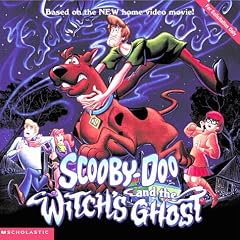
One could write an entire post or even an entire series of posts on everything that is wrong with Scooby Doo. Talking dog. Marijuana references. Preponderance of white characters and boys. Daphne's Damsel in Distress Syndrome, especially in the originals. Formulaic plots. Crappy writing. Pick any one of the above, and presto: blog fodder! But Frances loves Scooby Doo. He's a big friendly talking dog, what's not to love? She loves the mysteries which are never too scary and always come out not scary at all in the end. She laughs at all the stupid jokes and the marijuana references go right over her head. So we read Scooby Doo books, and I keep the groaning and kvetching to myself until I have a sympathetic adult audience. But not for this one, which came as part of a Scooby Doo hardcover storybook collection. Ben saw Velma staring at the picture. 'Sarah was a Wiccan,' Ben explained, 'a kind of medicine woman, like a doctor.' Did you know I don't use ordinary medicine? That's right. My insulin is special. Look, I'm already struggling with how to deal with this. It's not like I'm telling Frances I'm a buddhist or an atheist or a yogic flyer. There's a lot of baggage with the word "witch," and she's already bringing plenty of it home from school and daycare. "Witches can't pee," she tells me; or "witches don't have round heads." And if you think these statements are limited to Hallowe'en, you're mistaken. I don't need one of her favourite entertainment franchises further muddying the waters with stories about "good wiccans" who use herbs to heal people and "bad witches" who die and turn into ghosts and terrify villages. Ben grabbed it. He grinned, but it was an evil grin that darkened his face. 'This isn't a journal,' he growled in a low, threatening voice. 'It's a spellbook. Sarah was a witch!' I read that book to her the first time with a sinking feeling, stumbling through the words with my sweet girl snuggled on my lap gobbling it all up. Isn't that bad enough already? Do you think it can get worse? Let's read the Amazon reviews: "The book contains "real" ghosts and witchcraft. Several nasty-looking girls who practice Wicca are portrayed as good and cool. I don't want my four-year-old to think Wicca is just a cool and different, but acceptable, lifestyle." Heaven forbid. How dare a children's entertainment franchise preach tolerance to youngsters! Don't they know that for hatred and fear to be properly inculcated you need to get them young and never let them forget that different is awful and evil and terrible and will eat you while you're sleeping? "Second, the book is a PR effort for wicca, the religion of witchcraft. Even positive reviews conceed [sic] this point, and the debate has been on whether or not it is OK to preach the benefits of witchcraft to young children. Make up you own mind, but the consistent, overt and in-your-face praise of witchcraft as a path of life (even being encouraged by Scooby's gang) is incredibly inappropriate." Horribly inappropriate. How dare we! In-your-face praise of a religion as a path of life is only appropriate when you're in a traditional, organized, monotheistic religion. Otherwise it's straight-up corruption of youth. But the book of course is not PR because it doesn't even get it right. Not even the smallest, simplest detail of either wicca or witchcraft is properly explained. It would be like a children's book talking about how christians are good people who worship god and cause water to turn into non-alcoholic wine on a regular basis by praying over it, but protestants are evil holy-ghost worshiping people who will come after you when they're dead to poke you with a pitchfork. Shaggy grabbed the witch's spellbook and threw it to Velma. She flipped through the pages, searching for a spell to imprison Sarah. Do you think, if I could do that kind of thing, that I wouldn't have done so a long, long time ago? I mean, by now, wouldn't I be a millionaire with a private island, and also a harem? Normally I have a sense of humour about this stuff. I don't get bent out of shape over the witch costumes and decorations that abound on Hallowe'en. People use witch as a polite alternative slur for bitch, and I laugh. Organizations get all up in arms because Harry Potter is corrupting an entire generation by proselytizing for wicca, and I shake my head. But this. As a foundation for building a positive and meaningful dialogue about my spiritual beliefs and practices with my daughter, this leaves much to be desired. You can imagine I was already cross, then, when I came across Stephanie Conover's story. ""Our board of directors has eliminated her as a judge as tarot card reading and reiki are the occult and is not acceptable by God, Jews, Muslims or Christians. Tarot card reading is witchcraft and is used by witches, spiritists and mediums to consult the dark world." Repent. Defiled! I hope you all know you're defiling yourselves just by reading my blog. ""Some would call me a witch, yes. But we don't believe in the devil. There's no devil in Wicca. We believe whatever you send out, good or bad, comes back to you three times. Ninety per cent of those who practise witchcraft or Wicca do it for the betterment of themselves or others. It's a religion and we're trying to get it recognized by higher-ups in government." A very vindictive person! I give up on humans. I think I'll go have a nap. Posted by Andrea at 6:45 AM | Comments (10) January 10, 2008 It was almost brief.
I've written so much about volunteering and 'enough' and finding time and making babies lately that I'm afraid, if I do it again today, I'll only make you mad ("speaking of ENOUGH, Andrea..."); so I'll use them handy-dandy bullet things to say: 1. Jen and Mad are having their baby shower today. Go have some cake and stick a gift-ribbon on their hair, and see the tremendous pile of shower gifts they're sitting on. 2. I am undergoing Screening Processes, since my volunteering options are the kind where they Screen you, to make sure you aren't a criminal trying to get access to vulnerable populations. So, no details yet, but it's still going to be 24 hours this year. The plan is the Big Sisters--they have group programs for volunteers who can't commit to the full 8 hours a month (the prospect of which makes me faint) and I love kids, and it will be good to work with people instead of trees and dirt, which is more my normal thing. 3. I'm also going to be interviewed about it tonight by the lovely and talented Bon over at Chrib Chronicles, around 9 pm Ontario time, and you do the math elsewhere. The link will be here. Bon and Jen and Mad and I will all be talking about the social justice wedding stuff, or at least we will at the beginning. See? That was short. I can do short. ~~~~~ OK, I can't do short. Hey! It's a day to read! And you're here. Oops. So am I. So I'm going to tell you, first of all, that turning off the computer to read something print-based is a lovely idea. And secondly, since Friday belongs to Frances around these parts, I'm going to blather a bit about books today. I taught myself how to read when I was three, according to my mother; and I see no reason to disbelieve her since my only memory of kindergarten is of sitting in the cloakroom with a grade-five student who volunteered to show me flashcards of words like "telephone" and "dinosaur" while I heard my friends outside drilling the alphabet. Thus I have no memory of a time in which I did not understand what letters are, how they are put together into words and how they connect with each other to form sentences, how the sentences link to make stories. I have no memory of a life before books. This makes it strange to see Frances tottering slowly towards literacy herself as I try to make this process conscious and show her how it all works. Books are magic. I am an addict, and I'll admit this clearly makes me biased, but books are magic. Each one is a potent little package of incremental transformation. It mixes our own mind with someone else's, and when we pull back again, neither one is quite the same for the experience. A book makes a reader, and a reader makes a book. That object you hold in your hands and for which the bookstore charges you (or the library swipes your card) is not, properly speaking, the real book. The real book is what happens in your mind while you read it. That physical object, all those pages with black marks on it, is just the means of transmission. Every book you read is yours and yours alone; it exists for you and because of you. The particular experience you have in your mind while you read it will not be duplicated by anyone else. No one else will see Anne or Gatsby or Huck or Peter Pan the way you did (until they make a movie of it, anyway). The author wrote it and lots of other people worked to get it to where you could pick it up; but you closed that loop and made it a book by letting it into your mind. The internet doesn't do this very well yet, I don't think, because it is difficult to make your mind as open and receptive as it needs to be when your monitor is giving you eyestrain, your mouse is giving you carpal tunnel syndrome and your uncomfortable chair is giving you a backache. It is difficult to resist the temptation to skim, to skip, to click away when it gets difficult or challenging. I don't know if I can think of even five instances where something I read on the internet connected with me in the same place as a really good story or novel does, that left me saying "yes," even though I wasn't quite sure what I was agreeing to, or with, only that in some way I couldn't explain what I had read was the truth, regardless of its lack of factuality. The right book in the hands of the right reader at the right time can do this. It's magic. If I were to even try to list all of the books that have closed this hidden loop in me, while I am closing the loop of that book while reading it, it would take an entire blog's worth of posts, and you would get bored of it long before I would. They change, of course; if you and I never read the same book because the experience in our minds is not the same, then it is also true that you and I never read the same book twice, because the experience on re-reading will not be the same, either. Some books worsen, and some improve. (Some are like comfort food and we re-read them to get the same experience again but I wonder, actually, if that's an illusion and it changes more than we recognize.) Books are teachers and friends, counselors and prophets, therapists and clairvoyants, healers and lovers, magicians and heretics. Nothing else can do what a good book does, because a reader is not a watcher or observer but a participant. The words of a book are an intricate lattice with far more space than substance; space which you, the reader, fill in. That's work, and that's what makes the book yours. I think it was Margaret Atwood who said that no matter what it looks like, writing is a performance art; and she was right, and the audience, too, is up on stage, filling in the scenery, singing the chorus, and supplying the cast. That's what makes books special; and they are special, dammit. They're not just movies on a page. Frances can't read yet. She knows her letters and understands that they make sounds and is beginning to understand that the sounds can be put together to make words. But she's not quite there. She certainly won't be reading "dinosaur" and "telephone" next year. But I don't care. I don't care how or when she learns to read (although I suspect that her teachers at a certain point might begin to hyperventilate). All I care about is that her current delight with books continues. All I want is for her to be able to pick up a new book with the same sense of anticipation and incipient pleasure that I do, looking forward to hours in one sense spent curled up under a blanket on the overstuffed armchair with a snack and drink to hand; and in another, equally real sense, spent in another life, another time, another place, another self. Posted by Andrea at 12:00 PM | Comments (9) November 15, 2007 Structure(d)
One of my favourite things about the alchemy of writing is how forcing something into a rigid shape makes it more itself, not less. The container allows the energy of the work to build; the stronger the shape, the stronger the energy. There is little in life more passionate than a sonnet, though the words it contains are nearly empty of emotion. Don't believe me? Consider: My love is as a fever, longing still (Yes, I memorize poetry. Norman Doidge in The Brain that Changes Itself argues that memorizing poetry makes your brain stronger and improves IQ, which was a nice validation of a trait I previously considered to be something of an embarassing tic.) Back to the poem: The only word in that stanza which refers to an emotion is "love." The rest of it is an extended medical metaphor. As free verse, it would never work: "I love you so much I feel like I'm sick, and I don't want to get well." Doesn't have quite the same punch, does it? The apparent formlessness of free verse is something of a trick, an illusion; the truth is that a really good free verse poem is highly structured, but the structure is unique to that poem, the poem dictates the structure that most suits it. Still, the best free verse rarely whips itself up to the frenzy of a really good sonnet. The form of a sonnet is a cast-iron pot that you can stick on the hottest fire, and keep the water boiling for hours. Most free verse is a plastic bag. Try boiling water in that. (Note: I'm not arguing that all poetry should be this passionate, or that free verse is bad because it's not; only that the rigidity reinforces the passion, rather than killing it.) This applies to blogging, too, I've noticed. My most successful posts (from the point of view of the quality of the writing) are very structured. The structures appear to be my own--or at least I'm not aware of anyone else blogging with them. (Bracketing experiences with quotes is one; I try to use one to set off the other, whether through reinforcement or contrast. It's fun, and it works. Many of the ones I get the most recognition for follow this structure. I'm experimenting with others but most of them are not as set yet.) This in fact is one of the main values of blogging for me right now; it's a chance to experiment and practice with different sorts of structures. What happens if I include five short scenes with consecutive quotes from a piece of popular fiction between them? What happens if I start at the beginning, go all the way to the end, and then back to the beginning again? It doesn't matter if I fall flat on my face here; if the pot isn't strong enough to contain the water and take the heat, it doesn't matter. The same is true in fiction. Really good fiction is highly structured. There is the set-up, rising tension, climax, denouement; and the climax usually takes place about 90% of the way through the book. (Try it with your favourite novel.) There is a certain balance of scenes (where things happen) to exposition (where things are described), a balance between dialogue and action, inclusion of all five senses, a main character who wants something they can't have, and a sense of inevitability. If the author's idea can't be contained within that structure, regardless of the work's other merits, it will fall flat. It will be uninteresting. Authors who have flouted those rules (James Joyce, Virginia Woolf, etc.) have been successful to the extent that they were able to replace elements of the traditional structure with a new structure. It may seem that they are free-forming their open and directionless emotions in a vast and undifferentiated soup all over the page. This is why they are geniuses: the works are highly, tightly structured. They are cast-iron pots. They only look like wickerware. (Making a cast-iron pot look like wickerware is much tougher than just using the cast-iron pot.) That it is the structure that builds the emotion--the level of caring for the characters and their plight, the tension in seeing how it all turns out--and not the words themselves is evident in fiction's most basic rule: Show, Don't Tell. Don't tell us "he was mad." Tell us what his anger looked like, how it felt, whether he snapped or snarled or whined or slammed the door or only thought about it. Emotion without a container, in writing, is just water dripping all over the stove. Turn the heat up as high as you like. It won't boil. And now, in the middle of drafting a novel, in the free-forming stage of flooding the page with soup, I'm beginning to grasp what the structure could be, or should be. It's going to take a lot of work to shove it into that shape when I'm done, but the book will be better for it. (Not necessarily publishable. Let's not go crazy.) ### (Yesterday evening I got home from work and made Frances her dinner while she watched Dora Saves the Mermaids, again. She ate while I heated my soup, cut the bread and cheese for topping, and while it was under the broiler I moved the books from the couch to the bookcase and cleared a spot for drinks on the coffee table, cleared the papers off the kitchen table, returned Frances's toys to their appropriate containers. In between all this I checked emails and replied. The soup was done just before seven, and I ate it while Frances talked to her father on the phone. Then it was Frances's bedtime. Upstairs we went; she took off her clothes while I packed her suitcase for the weekend, then we got on her pyjamas and brushed her teeth. Booktime. Tucked her into bed, and time for a Princess Frances story. Time for a kiss and a hug, then I changed into my workout clothes and went downstairs. A brief respite for reading Julian the Magician, Gwendolyn MacEwen's first novel (I already know I love her poetry). Time for a workout. Oddly, it's energizing: my brain feels cleared and I know I will not be able to sleep for two hours yet at least. Time for dishes, to scrub the kitchen counter. My weekend is fully bracketed already: guests tonight, writing workshop Saturday, Santa Claus Parade on Sunday. Somewhere in there, laundry, groceries, cooking, cleaning, exercising must be done. So this can't be let go. Another few minutes to relax, then it's time to write. I'll get a thousand words done at least before turning in. By then I will be drained, boiled dry. Before bed, a few minutes to light a candle; I'm working on Water. But I can't stay up too late: Frances will wake at 6:30 whether I am ready or not, and there's work to go to, income to be earned.) ### Characters are making friends and falling in love where I hadn't expected them to; it's braiding a few subplots together into a thicker, stronger material, itself suitable for braiding into the main plot. Other characters are falling apart to their own internal stresses, the structure of their lives insufficient to the tasks at hand. Meanwhile I am beginning to see how this scene can click in to that one, that dialogue can knit with that description, to make something seemingly seamless from the outside. Or that's the hope. It still seems magical, though; or is it just me? That the very artificiality, the forcedness, the seeming falseness, makes the story more itself, allows it to build and become stronger. Invention permits truth. It makes no sense; but there it is. Focing something amorphous into a cast-iron pot makes it stronger, deeper, more authentic. It is magic--real magic, not TV magic--the spell or the ritual creates a container for the energy to build within, so that when it is directed at a task, it is equal to it. Meanwhile, I know I said I would be writing here less while working on the novel. Strangely, the more I write my story at night, the more I can think of things to say here, during the day. Who'd have guessed? Posted by Andrea at 12:36 PM | Comments (4) October 30, 2007 Outsider/Insider
I finished this recently:
Because that's just how much fun I am. In it, Ms. Lipsitz-Bem (she of An Unconventional Family, one of my favourite parenting books of all time) proposes a psychological theory of how the culture imposes its lenses (or ways of seeing and structuring reality) on the individual, and how the individual then learns to become an active participant in seeing and structuring reality the same way; she also tries to account for how some people fail to become what she terms "cultural natives." She calls this learning to see the lens, instead of seeing through it. Her description of how this happens is fuzzy. She proposes a biohistorical model of human difference--that while most people are born malleable enough into societies that demand something of them which is in enough accordance with their inborn temperaments that rebellion is unnecessary, some are born stubborn and different enough into societies that demand things of them that they are incapable of providing, and rebelling becomes the only way to maintain psychological integrity, or a sense of self. Beyond this she provides few details for what the mechanism specifically is: her one convincing example in the book is a description of the maturation process for non-heterosexual people. They try to conform; when it becomes apparent that conformance is impossible, that they are incapable of living happily in heterosexual relationships, they rebel; the rebellion is at first intensely distressful and upsetting, but as a community of like-minded souls is found, a new sense of self develops, and the person learns how to see the presumption of heterosexuality as a norm is false, is a lens, and not reality. In my post about Collaborative Narratives, I concluded by saying that the problem arises when you can't fit yourself into the stories your society tells. And now I'm going to suggest that combining these two theories--Lipsitz-Bem's about cultural lens transference and Bruner's about the narrative construction of reality--both highlights important flaws in each and constructs a tidy little theory of social change. (I'm so excited! You can go ahead and say it, BubandPie: I'm such an intj.) Bruner's theory about how stories create social reality fills in the gap about how cultural lenses are created and transferred to the individual. The cultural reality we live in is, in Bruner's view, essentially a collection of stories, the weight of centuries or millennia of narrative accrual. I'm going to suggest that one of the ways, and perhaps the most important way, that cultural lenses are transferred to the individual is when the individual becomes aware of all the stories in the culture and attempts to locate themselves in those stories. According to Bruner, children at very young ages (3 or even 2) use narrative in this way innately, reflexively; use stories to talk about their lives, yes, but also to come to an agreement with someone else about what has just happened, to negotiate reality with other people. So at a very young age children must become aware of all of the relevant stories they hear about social and personal reality: This Is What Good Children Are Like. This is What Good Girls are Like. This is What Good Boys are Like. This is What Good Students Are Like. This is What Good Friends are Like. All composed of stories upon stories. And then children try to locate themselves within these stories, identify the most important components of Goodness as revealed in the stories we tell, and make themselves fit. So Bruner's theory slots very neatly into the hole in Lipsitz-Bem's. But Bruner's theory itself has a hole, in that it presupposes that the social reality thus created by narrative is actually real instead of ideal or preferred. Lipsitz-Bem's arguments about cultural lenses makes clear that the stories so created are still just that, stories, and that there is actual objective biological reality outside of those social stories. The social reality so created is less of a social reality than a socially-negotiated agreement. We all agree to agree, for instance, on what constitutes a Good Friend. We do this by telling stories about particular friendships that, over time, add up to an image of the ideal. I think that social change happens when a person or a group of people realizes that their inner stories about themselves and their own lives are fundamentally incompatible and irreconciliable with the dominant cultural stories about who they are supposed to be or what their lives are supposed to be like. Take The Good Mother. Over millennia, we have told stories about mothers both good and bad that, glued together, present an idealized image of the Good Mother. She is self-sacrificing. She puts her children before herself. She does not want to be separated from her children. She loves her children more than her male partner. She puts her personal ambitions aside to serve her children's needs and desires. She is warm, physically affectionate, playful, and never bored. She revels in tiny hands and squeaky voices. She will not accept less than the best for her children, and will tirelessly work to provide it (within the home). She maintains a spotless environment for her children, provides her children with nutritious foods and somehow coaxes them down the gullet, and encourages them to reach their full potential. All of this gathered together from the stories told in religious texts, novels, stories, TV shows, movies, hallmark cards, magazines, newspaper articles, published studies, gossip, and even jokes. Only a group of people (mothers) are vocally protesting that they cannot locate themselves within the social reality (The Good Mother) constructed by these narratives. Result: social change. Slow, but still. One of the ways in which that social change is happening is through the accrual of new narratives about what Good Mothers are actually like. A new vision of the Good Mother is being actively constructed through the exchange of stories told by the women who cannot locate themselves within the traditional narrative. It also explains the insider/outsider phenomenon in a much more satisfying way (to me) than simply claiming that some people are biologically or inherently incapable of conforming with expectations. Those expectations are transmitted through the stories we tell (even when they don't look like stories--gossip, jokes, slurs, greeting cards and advertisements are also narratives in this sense). Some of us realize one day that we cannot fit ourselves into the socially constructed reality we live in, that the stories we hear reflect nothing about the lives we are living. At first (following Lipsitz-Bem's model) we probably reject our own stories, our own reality. Then we reject the culture's instead. On a personal level, one becomes an outsider when one cannot live out the narrative script of a member of one's demographic group. When one is incapable of conforming to the expectations laid out in the social reality constructed by narrative, and constructs a new personal narrative to explain the gap between one's own actually lived life and the supposed or ideal life proposed by society. On a societal level, when one person or a group of people creates a new narrative to explain the gap between perceived reality and the socially-agreed-upon narrative reality, and then tries to transpose that new narrative on to or over top of the existing cultural narrative, they become activists. Posted by Andrea at 8:43 AM | Comments (11) October 4, 2007 I'm stealing a book meme
Because I have neither the time nor the energy for an original thought today. From Mom-NOS, via Bub and Pie: Total number of books? (Blank stare.) OK. Well. There's the large bookcase in the living room that has, let's see, 25 cubes. Each has to contain about 20 books (double-stacked, remember). So that would be around 500. Then there's the double-stacked bookcase in my room. That has to be another hundred, so we're at 600. Then maybe another 30 scattered in other shelves, and ten or so in my night-table, and a largeish stack on the coffee table. Plus another hundred or so at my parents' house in boxes (still). Maybe a bit more. So ... 750? ish? Maybe a bit less? It's a good thing I gave all those books away when I moved. Can you imagine? Last book read? The Lenses of Gender by Sandra Lipsitz-Bem. I'm working on a review, it was really good. Last book bought? (digs toe into carpet) Here's the thing: I went to the Word on the Street festival on Sunday with Frances. They had books everywhere, and they were cheap, and so .... There were five Scooby Doo books ($5 for the lot), 3 Clifford books ($5 again), two preschooler hardcovers for Frances. Then for me, I bought Girlbomb by Janice Erlbaum, a memoir (I know her, sort of, from an old message board), Grassroots, Gwendolyn MacEwen's first novel (can't recall the title but I love her poetry and was very excited to see the novel, old as it may be), an anthology of Canadian poetry, an Ursula Franklin reader, a few hardcovers at $5 each (one of which was a novel that won the GG prize for fiction recently), and.... What? What are you shaking your heads for? OK, yes. I went and bought so many books that I honestly cannot recall all of the titles or authors. Maybe about twenty? But books! Cheap books! The scary thing is that I'd already had a stack of about twenty books in the to-be-read pile, four of which I am currently working my way through; and now I have so many books that I honestly have nowhere to put them. I can't put my new purchases away. There's nowhere for them to go. Five meaningful books? I'll refrain from being pedantic and pointing out that all books, technically, have meanings that are encoded in the little black marks made on the page (oops), and interpret the question as it was probably meant: five books that have special meaning to me. A Christmas Carol, for believing that the worst of us can be better, that change is a constant potential in human nature. The Lion, the Witch and the Wardrobe and Alice's Adventures in Wonderland for making me look in nooks and crannies for hidden kingdoms my entire childhood; for rewarding a belief in magic. Also, in the case of Alice, for being the only novel I know of that successfully used the "and then I woke up" ending. Self (Yann Martel) for using Virginia Woolf's Orlando to explore doubleness, identities, and sex roles. Not Wanted on the Voyage and Wicked for flipping the good and bad guys around, questioning the nature of good and evil, and letting the animals speak for themselves. Wicked gets bonus points for introducing Elphaba (the wicked witch of the west) as one of the most intelligent and interesting heroines of all time. You'll notice that none of my "meaningful books" are realistic. It's not intentional. That's just the way my brain works. Posted by Andrea at 7:55 AM | Comments (5) September 19, 2007 Totality and Abandonment
You might think a total solar eclipse would have no colour. I might. The word "eclipse" comes from ancient Greek ekleipsis, "a forsaking, quitting, abandonment." The sun quits us, we are forsaken by light. Yet people who experience total eclipse are moved to such strong descriptions of its vacancy and void that this itself begins to take on colour. There are times when you read just the right thing at just the right time and it hits your brain at just the right angle, and you see something in a new light that makes previously disparate and sharp-edged shards turn into a seamless whole. Then there are times when you think you might have read just the right thing at just the right time but it refuses to hit your brain at the right angle, instead sitting on the surface, knocking politely. Anne Carson's essay "Totality: The Colour of Eclipse" is one of the latter. Drastic analogies abound in the literature of totality; also typical at this blasted moment, to turn to thoughts of kissing and marrying. Many mythological explanations of eclipse involve copulation or the hope of it. I have never seen an eclipse, partial or total. These days I suppose the actual event is unnecessary, as one can experience something like it by googling pictures off the internet. But I doubt it would be the same. I wonder if it would make a difference to my comprehension of this essay, which otherwise appears to be making several contradictory statements. Such as: eclipses lack colour so intensely that the lack becomes a colour; eclipses equal abandonment by the sun; eclipses are marriage and coupling; spouses are colour. So: eclipses are both the absence and presence of a partner? Is the coupling referred to simply that initial moment of totality when all reason is obliterated? Is it that moment when you see someone and think, for a moment, "this one"? What happens when the eclipse passes and normal life, with colour and the sun, resumes? And isn't it odd that something meaning abandonment should take on the overtones of a new presence, of a mating? In which case, who is abandoning, and who is being abandoned? I wonder if third angles were in her [Virginia Woolf's] mind that day, as she wandered over Bardon Fell in both the company of her husband, Leonard, and her lover Vita Sackville-West. To judge from the observations in her diary (June 30), she was watching Vita all the day, watching Vita watch her husband, Harold Nicolson... watching how marriage was going with Vita.... Four people, three couplings. I wonder if Harold and Leonard knew. Do you think they did? Did they have their own affairs? Was it right or wrong? Does the question even apply? It was 1930. Marriage was going well with the Sapphic Vita, marriage was going well with the virginal Virginia. Besides that, they were enjoying their affair, looking forward to spending the weekend after the eclipse together at Long Barn (Vita's ancestral estate). Still, totality is a phenomenon that can flip one's ratios inside out. I wonder if they paused to look at each other, these mated and unmated people, on the exposed plane of an ordinary moment of that curious, heavy, historic, wrong day. Sudden feeling of oldness. Black upland wind. Bring a coat, they had been told, and a piece of smoked glass. It will get cold. It will hurt your eyes. Totality is lightless, and should be colourless, yet may intensify certain questions that hang at the back of the mind. What is a spouse after all? Will this one stay, can this one keep me alive? Is it even a fair question? Should any one person have the burden of keeping us alive? Is that why they should stay, to assume the task of our mortality? No, scratch that; let's begin again: is human totality as rare as the solar? Do we all get our eclipse? Do we get more than one? If you get an eclipse, are you blessed or cursed? totality is a phenomenon that can flip one's ratios inside out. The inversion is what is initially most shocking. The inversion, the flip, of who you thought you were. The sight of your reflection in someone else, of what they see, of what you had never seen in you. An absence of colour so intense that it becomes a colour; the absence one's self, one's rules, one's expectations becomes, instead of an absence, an obliterating overarching presence. Sudden feeling of oldness. Black upland wind. Bring a coat, they had been told, and a piece of smoked glass. It will get cold. It will hurt your eyes. Which? The sight of the sun's absence, the presence of wrong colours, or the sight of the absence of the self and the wrong self that replaces it? The inverted, upside-down self, with all the rules gone, and the absence of rules the new compelling rule? Totality is lightless, and should be colourless, yet may intensify certain questions that hang at the back of the mind. What is a spouse, after all? Will this one stay, can this one keep me alive? As it turns out. No. Posted by Andrea at 12:10 PM | Comments (2) April 11, 2007 Self-Help: A Review of Mindset by Carol Dweck
Last Sunday I was sitting at the kitchen table reading a book. You might guess that this is not a rare sight in my house. It had been two hours since lunch, at which I had consumed an entire Laura Secord easter egg--the big ones--without bolusing properly. I'd guessed the dose, then looked at the grams of carbs on the box, and saw that I'd underdosed myself by two units. If I'd been on the pump that weekend, I would have just bolused another two units immediately, but it's an entirely different proposition when you have to stick yourself again. So I didn't. And there I sat, two hours later, reading a book called Mindset. The blood sugar meter was on the table by my right hand. I looked at it. Should I test? Or shouldn't I? I knew it would be high. I knew I would fail. ~~~~~ Do you remember that Po Bronson article about how to praise kids properly making the rounds of the parentosphere a few weeks back? Some thought it was great, some thought it sucked, some thought it was a mite unrealistic to tell parents not to tell their kids how great they are. And then there were the some (like me) who didn't write about it at all, or even comment on sites where it was written about. And some of you have no idea what I'm talking about, so I'll provide the key quote from the article to ground the discussion: "When parents praise their children’s intelligence, they believe they are providing the solution to this problem. According to a survey conducted by Columbia University, 85 percent of American parents think it’s important to tell their kids that they’re smart. ... The constant praise is meant to be an angel on the shoulder, ensuring that children do not sell their talents short. "But a growing body of research—and a new study from the trenches of the New York public-school system—strongly suggests it might be the other way around. Giving kids the label of 'smart' does not prevent them from underperforming. It might actually be causing it." I didn't write about it not because I thought it was unimportant, or untrue, or uninteresting. I didn't write about it because I think it's premature to talk about parenting before we talk about the parents. I was labelled smart. Sure. It started before kindergarten, when (according to my parents) I taught myself how to read when I was three. In kindergarten, I was pressured to learn arithmetic so I could skip grade one (I refused). In grade 4, I was streamed into the "enhanced" class for smart kids, which necessitated a school change. I stayed in them until the end of highschool. And I've written about the detrimental impact of being told how smart you are on social integration (short version: being segregated sucks. Putting a bunch of kids in a room and telling everyone how SMART they are is a recipe for isolation and bullying). But I've never considered how the labelling affects the kids, or the adults we grew up to be. The intention was clearly to make us super-achievers who rule the world, instead of getting terminally bored and dropping out of school at fifteen. Only it failed. On all counts. For one, we are not super-achievers in adulthood. We're very normal, very boring, mostly solid middle-class professional types. For another, while no one dropped out in highschool, so far as I know, several kids from my class flunked out--not dropped out, flunked out--of university. We're talking kids with IQs in the 140+ range. On the surface a textbook description of exactly the forces Bronson wrote about. Penguin Unearthed wrote a post on this topic which links to a Stanford Magazine article that digs deeper into this research and its applicability in areas beyond parenting, and mentions her recent book: Mindset. From the article: "...what makes students focus on different goals in the first place? During a sabbatical at Harvard, she was discussing this with doctoral student Mary Bandura ... and the answer hit them: if some students want to show off their ability, while others want to increase their ability, “ability” means different things to the two groups. ... People with performance goals, she reasoned, think intelligence is fixed from birth. People with learning goals have a growth mind-set about intelligence, believing it can be developed." I think if I'd been left alone, I would have ended up in the 'learning goals' camp. But I wasn't left alone; for ten years I was thoroughly tampered with in an educational system that made it its express mission to tell me every day how innately intelligent I was. No one ever taught us that we could be smarter if we worked at it: our intelligence was fixed. The point of our extra-special education was to enable us to reach the pinnacle of achievement pre-determined by our fixed level of innate intelligence. Umm...this didn't work. But I'm a change junkie when it comes to personality. Every year I make an insane list of New Year's Resolutions, and every year I believe that if I work hard enough, I can do it. Every year I fail to work hard enough, but that doesn't stop me from trying, and I think if I didn't try then a lot of what I consider to be important about me today wouldn't exist. Here's a graphical Dweck's model of the mindsets. I fall in both camps (you all know I can't ever pick one of anything). Challenges? I LOVE challenges ... except in sports, and then I will avoid them at all costs. Persisting in the face of setbacks is my middle name when it comes to changes to my living situation, but when it comes to my career, it's time to pack it in and go home. Or how about seeing effort as the path to mastery? For writing? Absolutely. For art? Forget it; I have no talent. "But what if you’re raised with a fixed mind-set about physics—or foreign languages or music? Not to worry: Dweck has shown that you can change the mind-set itself. "The most dramatic proof comes from a recent study by Dweck and Lisa Sorich Blackwell of low-achieving seventh graders. All students participated in sessions on study skills, the brain and the like; in addition, one group attended a neutral session on memory while the other learned that intelligence, like a muscle, grows stronger through exercise. Training students to adopt a growth mind-set about intelligence had a catalytic effect on motivation and math grades; students in the control group showed no improvement despite all the other interventions." I was on page 62 of the book (quotes so far are all from the article) when I sat at the table and stared at the glucose meter and thought: a fixed mindset could take years off my life. If I see these tests as something that tells me whether I've been bad or good, succeeded or failed, deserve to live or die, then of course I won't test. The stakes are too high. But if I see it as something that will allow me to improve in the future, I will. Has anyone ever told me that I'm a bad diabetic? No. Quite the opposite. I've always been a "good" diabetic, a "well-controlled" diabetic, who passed her tests with flying colours. I've always received a smile and a virtual pat on the hand from the diabetes professionals I've dealt with. Yet somehow I still learned that everything was on the line at every test. This is exactly what Dweck found in her work on intelligence and achievement: "We praised some of the students for their ability .... We praised others for their effort. ... Both groups were exactly equal to begin with. But right after the praise, they began to differ. As we feared, the ability praise pushed students straight into the fixed mindset. When offered a choice, they rejected a challenging new task that they could learn from. ... In contrast, when students were praised for their effort, ninety percent of them wanted the challenging new task.... Then we gave students some hard new problems, which they didn't do so well on. The ability kids now thought they were not smart after all. ... After the experience with difficulty, the performance of the ability-praised students plummeted, even when we gave them some more of the easier problems. Losing faith in their ability, they were doing worse than when they started. The effort kids showed better and better performance...." In other words, telling smart kids that they're smart makes them dumber. Telling them that they worked hard makes them smarter. So: telling a person with a chronic illness that they are a "good" sick person will make them a worse one--if you want them to learn good habits and improve, you have to praise their efforts. Which means saying, in essence, "Good for you! You tested!" And not interpreting the results as any sort of reflection on them or their effort--as all diabetics know, sometimes you can throw yourself into it heart and soul and not see good results. Don't I wish more doctors knew this. I was afraid, before I'd read it, that it would be one of those socially-blind, everyone-can-do-anything-if-they-put-their-mind-to-it books that ignores the realities of prejudice and bigotry and the very real impediments to achievement that these systems can place in our paths. It wasn't. She acknowledges that stereotyping creates real barriers that cannot be overcome with effort; but then details how people with a growth or learning mindset are not as affected by stereotyping as people with fixed or ability mindsets. And she acknowledges that natural talent is also important--that some people can achieve more with the same level of effort; but the point isn't that everyone can be number one. It's that any one person will do better in any one endeavour with a growth mindset than with a fixed one. For instance, most of you will have much, much better blood sugar numbers than I do, without effort. That's because you have a pancreas. I don't. That's your 'natural ability'; the point isn't that effort will ever give me the equivalent of a perfectly functioning pancreas. It won't. The point is that if I believe that testing is to learn and improve then I will be healthier and have better sugar numbers than if I believe that testing measures my discipline, motivation, or worth. I read Po Bronson's article. I read it, and I tried it on. For a few days I tried to praise Frances in process ways, telling her what she did well instead of how brilliant she was; and you know something? It felt like an affectation, because it was an affectation. I couldn't talk to Frances that way because I can't talk to myself that way. I need to learn to talk to myself that way first, or at least at the same time, or that smart kid of mine is going to see right through me and learn the lesson my actions preach while my words tell her something else. But let's step outside the rarified world of privileged families and consider the work done on this subject elsewhere. In the chapter on education, she describes a number of teachers who were assigned classes full of children labelled bullies, emotionally handicapped, mentally disturbed, learning disabled and even retarded by other educators, and made them brilliant over-achievers in a few months. These were kids from bad neighbourhoods with few financial resources and poor familial support. And I think, too, about the revolution in attitudes towards Down syndrome over the last few decades--how babies who were thought to have no potential and no hope because of their fixed attributes were left in institutions to rot and die, and how now those very same children with those very same attributes are busting expectations right left and centre today because people who care about them are determined not to be limited by a diagnosis. In the workshop chapter in the back (which admittedly I found a little skimpy--more on that in a minute), there is a section on fixing the mindset of a preschooler who believes that ability is innate. The very first sentences of the solution state: "You decide that, rather than trying to talk him out of the fixed mindset, you have to live the growth mindset. At the dinner table each evening, you and your partner structure the discussion around the growth mindset, asking each child (and each other): 'What did you learn today?'" The very first thing--fix you. Or me. Whatever. You know. Ninety per cent of the book summarizes research on mindsets in various fields (education, parenting, sports, coaching, business leadership, the arts). Only the last chapter is devoted to figuring out how to change one's own fixed mindsets; and the how-to is a little sparse. In that it doesn't exist. (A variety of scenarios with potential responses are listed and discussed.) But then, it can't. How can you present someone with a ten-step program for overcoming a fixed mindset when it can be present in so many endeavours? You can't. I tested my blood sugar, by the way. The ideal is 3.7-6.5. It was 12.0. Posted by Andrea at 6:43 AM | Comments (16) April 1, 2007 Book Review: Cheating Destiny by James Hirsch
If you are alive and literate in North America in the 21st century, you know that type 2 or adult-onset diabetes is now an epidemic, and that our modern lifestyles are to blame. What you may not know is that type 1 diabetes, an autoimmune disorder, is also on the rise--the incidence has increased at 3.2% per year for decades. But I'll bet you've never read any passionate newspaper articles decrying this epidemic or what it will take to defeat it. When I went to the bookstore yesterday (yes, yesterday) I intended to pick up two new releases: Mindset (more on that next week) and Ally (the only actual sci fi series featuring a wiccan protagonist who's not a flake that I've ever come across). Walking through, I saw Cheating Destiny: living with Diabetes, America's Biggest Epidemic by James Hirsch. I picked it up and read the prologue: this is that book I'd heard of last year, I thought; the one where the author's three-year-old son is diagnosed with type 1 while he writes it. The one where entire online diabetic communities eviscerated him for being so stupid as to reproduce while having diabetes. I picked it up. I had to. I'm glad I did. If there is one book to convey both type 1 and type 2 diabetes to a non-diabetic audience, this is the one. It beautifully captures the emotional and psychological whipsaw of living with this chronic condition--the perpetual collision of anger and gratitude, grief and hope, acceptance and denial, terror and courage. Yes, if you are diabetic, you will find vindication in its pages; but if you are not, you might find understanding. And I hope you do. It is so difficult to convey the simultaneous thankfulness for insulin and blood sugar meters and the resentment for the burdens it places on you, the embrace of the promises for new therapies and treatments and the bitter laughter at the glossy photographs in the magazine ads, yet he's done it. It also captures the doublespeak of the medical establishment with acute clarity--how type 1 diabetics are expected to adhere to the control goals of the Diabetes Control and Complications Trial (which proved that near-normal blood sugar control would help delay or prevent complications), without being informed that even the group studied in that trial could not achieve the original goal of 6.0 for the A1C, and the revised goal of 7.0 was achieved only by providing each diabetic with a full team of diabetes specialists who would call them at home, support them in every way possible, and bribe them with theatre and sports tickets. (Has anyone ever offered you so much as a sugar-free lollipop for adhering to your diabetic regimen?) How, once the trial ended, the group's control eroded in the absence of those supports and average A1cs rose to 8.0; yet 6.0 is still presented as a reasonable goal to type 1 diabetics operating on their own with few resources and often without sufficient insurance or familial support. I'm sure many of the diabetics in the audience have already read it; it's the non-diabetics I hope will pick it up. Those of you who don't know how it is to simultaneously feel blessed for having been given decades of life you would otherwise not have had, robbed by the knowledge that you are likely to lose decades off the other end regardless, and frustrated or angry at having to deal with the disease moment-to-moment in the meantime. I'd lend you my copy; but I intend to forcefeed it to my parents two weeks from now. Posted by Andrea at 8:16 AM | Comments (9) February 1, 2007 In Defence of Science Fiction
"Years ago I was working in Schenectady for General Electric, completely surrounded by machines and ideas for machines, so I wrote a novel about people and machines, and machines frequently got the best of it, as machines will. ...And I learned from the reviewers that I was a science-fiction writer. I didn't know that. I supposed that I was writing a novel about life, about things I could not avoid seeing and hearing in Schenectady, a very real town, awkwardly set in the gruesome now. I have been a sore-headed occupant of a file-drawer labeled 'science- fiction' ever since, and I would like out, particularly since so many serious critics regularly mistake the drawer for a tall white fixture in a comfort station*." Kurt Vonnegut, 1965 Not just serious critics, Kurt: sadly, a large proportion of the reading public considers science fiction to be so much badly-made toilet paper. I'd tell you why, but I've never been able to understand it; how could a literature that gave us Shakespeare's "The Tempest" and "A Midsummer Night's Dream," Mary Shelley's "Frankenstein," H. G. Wells, Edgar Allan Poe, the entire western mythological canon from Greco-Roman to Biblical (from which modern literary writers do not hesitate to steal themes, plots, characters and symbols), Thomas More, Francis Bacon, Jonathan Swift's "Gulliver's Travels," George Orwell, Ray Bradbury, Margaret Atwood and--of course--yourself, be considered inherently unserious? How is it that the same people who gobble up Harry Potter novels--which, besides being fantasy, are poorly-written fantasies for children--sneer and turn up their noses at the genre that gave birth to them? How is it that the same people who are trooping into theatres to watch Wicked--which at least has the merit of being good fantasy--have no idea that a fantasy is what they're paying to see? What is it that they think the Narnia chronicles and Alice in Wonderland and Charlotte's Web and the Wizard of Oz are? How is that generations of people who have grown up steeped in speculative fiction treat it with such disdain and ignorance upon reaching adulthood? What is Eternal Sunshine of the Spotless Mind if not science fiction? Kurt, would you mind if I told you something that really bugs me? It's about Battlestar Galactica. No, don't get me wrong, I love the show. And that's only partly because of the large number of very attractive men running around in skimpy uniforms (any chance we could impose on earth militaries to adopt them? No? Shame). I love that it's doing well, too, and attracting audiences who think they don't like sci fi. What bugs me is when these audiences say, "It's not science fiction because it's about people." All good fiction is about people! Every science fiction novel I've ever read is about people. Sure, some of the human characters haven't been particularly well-drawn, but that's true of most historical and mainstream novels I've read, too. Science fiction doesn't have a lock on hackery. And whenever someone says that--"I love BSG but I don't like science fiction; BSG is different because it's about people"--I want to scream. Aldous Huxley's Brave New World was about what--telephones? Airplanes? Puppies? Was The Handmaid's Tale about household appliances? It's as if the idea of science fiction as contaminating is so deeply entrenched in the culture that as soon as someone realizes that they like a story, a book or a movie with a machine in it they must immediately distance that work from the genre. "I like this, so it can't be sci fi, because sci fi is crap" instead of "I like this; hey, maybe sci fi isn't crap!" And why is it that anything set in the past, whether by a few decades or a few centuries, becomes a "period piece" and acquires a veneer of respectability no matter how nonsensical the premise or characters, when anything set in the future, whether by a few decades or a few centuries, becomes the butt of a lot of jokes involving skinny adolescent boys and social misfits wearing Klingon costumes? I can't tell you how much it bugs me to watch or read something purporting to be "historical fiction" only to come across a female character so preposterously modern that, if she actually existed in the time and place specified, she would have been burned at the stake as a witch or clapped in an insane asylum (both of which fates regularly met unconventional women until about 75 years ago). I'm about as fond of that as I am of the male science fiction writers who can project a technological society ten million years into the future that is radically different from our own in every way except gender politics, because they can't imagine a world without free female domestic labour. However, while the number of diehard sex essentialists in the science fiction genre is shrinking all the time, it seems that the Athena Character (so named for the way in which these strong female characters seem to have sprung into adulthood fully formed, without having been meaningfully molded by their society in any way, as if they had never been children) is a staple of modern historical fiction. Not that this is an easy position to take, as a woman and mother. You and I both know that there are plenty of intelligent, well-drawn, interesting female characters, including mothers, all over the science fiction genre; but try to convince anyone else of that. The sexism of the field is as deeply entrenched in the popular imagination now as it was in the 1950s, when the reputation was actually deserved, and the works of Octavia Butler, Ursula le Guin, Patricia McKillip, Sherri S. Tepper, Liz Williams and dozens of other feminist science fiction writers has not apparently done much to dispel it. How could anyone still be amazed that BSG has important female characters? If nothing else, Alien ought to have cemented the female kick-ass sci-fi protagonist in the culture. And it's almost thirty years old. Apparently, what I'm supposed to like--as a woman and a mother--is a bright pink book with a black silhouette of a stylized woman either carrying shopping bags or pushing a stroller. And I don't. Maybe there's something wonderful between those revolting covers; but if there is, I doubt it's for me. I don't want novels that validate my experiences. I want novels that validate my interests and passions. Give me a novel of possibilities, of weighty ideas; give me a novel where an entire system is drawn out with all the detail of a spider's web, and the human characters are struggling with their lives in the context of this system, just as all people do, ourselves included, only we are so enmeshed in the system of our own times that we rarely have the chance to step back and see it, whole and clear. Give me the chance to separate myself from the seeming inevitabilities and inertias of the world I live in, give me a reason to believe that a pull here and a twist there and a whisper might shift it. I already know about shoe shopping and makeup and gossip and mean girl politics and the mind-fuck of the first year of motherhood and what modern life is like. And they're killing me, so give me something else. Give me hope. Not that you deal much in hope, Kurt. Your work is amusing, but dystopian. Still, a happy ending's a happy ending, even if it is a race of seal-like human-descendents one million years in the future who have lost their overly-large and troublesome brains. It's not that I don't love literary and mainstream fiction, too. But the literary and mainstream fiction I love tends distinctly towards speculative fiction themes--Oryx and Crake? Science fiction. Blind Assassin? Science fiction embedded within historical. Not Wanted on the Voyage? Fantasy. Wicked? Fantasy. Self? Fantasy. The exceptions are notable for being so rare--Unless. Austen. Dickens. (Though the latter two are clearly separated from my own time and place, and Dickens was not above fantasy, as his Christmas novels show.) Even Wuthering Heights has fantastical elements, and I prefer it to the other Bronte works. I loved L.M. Montgomery, but don't tell me she didn't dabble in fantasy, with all of her ghosts and eerie premonitions. And it's not that I'm above casting a disparaging eye on certain genres in the privacy of my own library. I've never met a romance novel I could finish, or a western novel I could start. But I recognize that this isn't a lack in the genre or in myself; it is simply a difference in temperament. In order to critique any piece of art, you need to understand what the artist was trying to do. If you can't, you are not qualified to judge it. (There are exceptions: if, for instance, the spirit of the piece, its impulses and motivations, are inherently derogatory or hateful towards a particular group.) OK, I can't stand romance novels; but that doesn't translate into romance novels being inherently stupid. Yet there are a lot--a LOT--of critics and members of the general public who seem to think that every worthwhile work of art must be directed at an audience of people just like them. They don't see that if you can't understand what an artist was trying to do you are in no position to judge whether or not they were able to do it. Maybe the need to construct and defend hierarchies is so deep within the human psyche that the world literally needs a literary pissing-ground. Depressing thought. It's robots and spaceships, or dragons and princesses. Right? No. Wrong wrong wrong. Is Battlestar Galactica about robots and spaceships? No! It's about what makes us human, and how we determine right from wrong, and how we decide to do the right thing, and how when we think we're doing the right thing we're often not. Is Lord of the Rings about dragons and princesses? No! Tolkein wrote those books as an exploration of Catholocism. The themes of good and evil, predestination, and the importance of individuals are as strong in his work as they are in the work of any mainstream author. But here I sit, wondering if maybe I should write myself out of the genre now. Learn how to write realism, though it bores me, simply because otherwise I'm going to end up stuck right beside you in that drawer. Not that I'm ever going to be world-famous; but that's not the point. Most of the world's six billion people will never get the faintest whiff of a clue that I'm there. But even if all I ever do is publish a handful of stories, I hate to think of them thought of as inherently trashy because other people think that serious literature has to contain volvos and condo towers. Can anything be further from the truth? Did you see the reaction of sci fi writers and the SF blogosphere when Kristine Kathryn Rusch published her piece about how science fiction needs to back away from literary writing and revert to the Star Wars model in order to be commercially successful? I could have heard the keys pounding if I were standing on the rings of Saturn. How did it happen that you have, on the one hand, "serious critics" deciding that the entire genre is Star Wars in drag, and that's why it's trash; and on the other hand, other critics deciding that what we need is a little more Star Wars? Given that every novel, movie and TV show to break out of the genre ghetto and become a success and a classic with mainstream audiences, with the exception of Star Wars, was not Star Wars, I'd say they're both wrong. Bladerunner! Aliens! The Time Traveller's Wife is science fiction! How does anyone read The Time Traveller's Wife and decide they loved it, but still hate sci fi? "Science fiction is the most important literature in the history of the world, because it's the history of ideas, the history of our civilization birthing itself. ...Science fiction is central to everything we've ever done, and people who make fun of science fiction writers don't know what they're talking about." Ray Bradbury Ray's right--except that I'll put words in his mouth and extend it to readers, too. You know it, and I know it. In any event, I could no more stop myself from writing and reading science fiction and fantasy than I could make myself care about grey hairs or whatever Lindsay Lohan's latest public spectacle is supposed to have been. And I don't want to. Screw it. Anyone who can't tell the difference between a drawer in a filing cabinet and a public urinal has no opinions worth paying mind to. Posted by Andrea at 9:48 AM | Comments (16) November 22, 2006 Writing to Change the World by Mary Pipher & Getting to Maybe: How the World is Changed by Frances Westley, Brenda Zimmerman and Michael Quinn Patton
As the titles suggest, both these books are written for the would-be world-saver, who sees a problem and feels compelled to be involved in the solution. They are both also distinctly written from a left-leaning point of view, with examples and causes drawn from the environmental and social justice movements. Both are useful, interesting and potentially inspiring, but intended to be used in different ways. Writing to Change the World was my first purchase, an Amazon order back in April when it was released. Believe it or not, I've been meaning to write about it ever since, but it never managed to float to the top of the blog to-do list. Pipher's book is for those who believe that changing someone's perspective is changing the world, and that if a writer's words can alter even by a millimetre the way the world is seen, then that writer has changed the world. It's divided into three sections: What We Alone Can Say (how to find and connect with your own material and point of view), The Writing Process (the ins and outs of writing to argue a point and change the reader's mind), and Calls to Action (with a chapter each on letters, speeches, blogs and other particular forms of writing). The first two sections were the strongest; based on her own experiences as an author of books about various social issues and which methods and techniques were successful vs. which weren't, there were a number of useful insights and ideas. The third section was, unfortunately, weaker. Each chapter was too brief to contain enough useful detail on how to use particular writing methods to achieve particular aims. For instance, the chapter on blogging conveyed little beyond the standard pro-blogging the-internet-is-inherently-radical-and-democratic rhetoric that many of us know is untrue. There's little about how to use a blog to change people's minds, including the ever-pressing issue of finding and connecting with an audience who doesn't already agree with you, and while there are several examples of unusual points-of-view conveyed movingly on blogs, there are few examples of how those writers changed policy or voting patterns or news reporting or, indeed, anything concrete. Still, the content of the first two sections is solid and unique enough to more than make up for the third. Getting to Maybe is a more difficult book to characterize. The authors are three experts in the field of social innovation, which could be defined as the creation of a business model or organization or process that changes the underlying societal structures that perpetuate inequality or environmental destruction. For example, the Grameen Bank of Bangladesh pioneered a new concept of credit which allowed them to lend money to high-risk, very poor women at much lower interest rates and still make a profit. The result was a new credit system that has allowed, in the thirty years this idea has spread globally, millions of women to escape the cycle of high-interest credit that kept them in poverty. If you are familiar with The Tipping Point, Malcolm Gladwell's book on how small ideas and seemingly inconsequential products can become overnight marketing sensations, this book is The Tipping Point of the Social Justice movement. How can one person, or a small group of people, change the world for the better? However, their ideas are complicated and difficult to communicate. I don't mean this as a criticism; I think it's probably inevitable. Changing the world as one person isn't easy. If it were, we'd all be doing it already. They base their model on complexity theory, and this is where your head is starting to hurt, isn't it? I know, and I wish I could make that better, but to get it I really think you have to read the book. It's equally inspiring and frustrating. There are no ten easy steps, no checklists, no summary charts; there are dozens of stories of individuals and small groups who effected enormous societal change through a new idea at the right time. For those of you not particularly interested in world-saving, or who like to make the world a better place through participating in someone else's bright ideas, these are probably not the right books for you. This isn't meant dismissively, but they are both directed towards leaders, whether leaders of opinion or leaders of actual organizations. Having written that it seems somehow ludicrous to count myself among the audience. But for those of you in whom the daily news creates a desperate need to do something that isn't already being done, either book will fill you with hope and good ideas, depending on how you like your activism. Posted by Andrea at 7:15 AM | Comments (4) October 9, 2006 Momma Zen: Walking the Crooked Path of Motherhood, by Karen Maezen Miller
A month or so ago, I got an email from someone named Karen which read, in part, "I know that even if you hate it, you'll read it." Who can refuse an offer like that? I mean, she's right. Fortunately for her, I didn't hate it. Momma Zen is a slim book that isn't quite a parenting manual, and isn't quite a momoir, but feels like something in between. Advice mostly consists of "you're doing better than you think" and "there's lots of ways to raise a kid," portrayed through her own experiences and Zen Buddhism (she is a priest). The book it most closely reminded me of is Writing Down the Bones, and I found myself wondering if it's a Zen thing--if there's something about the training or perspective that lends itself to developing this pared-down, spare, poetic style. The language was lovely. The chapters were brief and combined humour with insight. There was a refreshing lack of judgement. "What would happen if the nit-picking narration were absent? What happens when you watch a TV football game with the sound turned off? The players still scramble, they still fall, but they are saved from the injury of evaluation. The same would be true of your life. What is a mistake without the self-critical label? It is just what it is. It is always perfection in action--not perfect as in better than something else but perfect as in complete. Your actions need nothing--not analyzing, not punishment, not instant replay. It is impossible not to do your best, you just don't think it's your best." That sums up the spirit and style of 99% of the book. But there's the one per cent--the chapter titled "Tending Garden: seasons of marriage," in which she advises people to stay married for the sake of the kids. And it's hard to square this with the rest of the book, where she writes about how hard it is to take care of yourself too and the importance of cutting yourself some slack. It isn't even that I disagree with her individual reasons for staying married to her husband through the upheavals of having a first child (my child adores my husband, and he adores her, and so on) but that I don't think this is a standard to be applied to every marriage. In the worst-case scenarios, of course it is better to have one parent than two if one of the two is abusive or negligent, and this is a situation that some of my friends have dealt with, so I'm sensitive to it. While I was reading it, I found myself wondering who I would give it to, if I'd bought it as a gift. I think I would give it to a friend who is prone to self-doubt and self-criticism and who has a stable relationship. In fact, I can think of one such friend off the top of my head who might receive my review copy in the near future, though she hasn't any Buddhist tendencies that I know of. It was lovely. If I might borrow the author's phrasing, I would say it is perfect, not in the sense of "better than everything else" but in the sense of "complete." I'm not aware of any other book quite like it. Posted by Andrea at 11:39 AM | Comments (1) September 28, 2006 Frontiers
One thing you don't ever want to do with me is go to a bookstore. Especially not the World's Biggest Bookstore, a two-level monstrosity in downtown Toronto which, if it doesn't earn its name, must come very close. You don't want to do this because while most people spend a few minutes, maybe half an hour, or stretching it an hour or so, browsing the shelves and taking one or two things to the front ... I can spend a day in there. And I have (though not since Frances was born). I've noticed that most people gravitate to the sections they've already developed some familiarity with: they're romance fans, so they go to the romance shelves; they like to read about art, so they check out the art books. I look at everything. All right, it's a slight exaggeration: I look at almost everything. I look at the fiction, the classics, the sci-fi, the fantasy, the poetry, the literary criticism. I try to pick up a few things by people I've never heard of before. I look at the physics books, the biology books, the environment books. I look over the cultural studies shelves, the women's studies shelves, the native and black studies shelves; I'll browse through politics and history and memoir and biography. I have to look at the crafts books, which leads me to the cookbooks, the decorating books, and on to the journals and pens. Sometimes I'll check out the new business, finance, or fitness titles (but I rarely buy one). I wander through the religion section, then occult and new age. I'll tackle the philosophy section on the way to the magazines. I spare a glance for the women's glossies, then look at the cultural mags like Bitch and BUST, the little lit mags, the science mags, news mags, how-to-write mags, the craft mags, cooking mags, kid's mags, parenting mags. Once I've done this, it's time to take the stack of books and magazines I've collected on my way through the store, find a spot on the floor to sit (the chairs are always taken), and read through the introduction of each to determine whether or not I think it's worth the money to bring home. If I simply paid for everything I'd picked up, it would easily cost $500 per visit, which I can't afford. The sorting is sometimes painful, and I have been on occasion reduced to scribbling lists of the things I can't afford on the back of a receipt from the bottom of my purse, to order online later on. I've often joked that if I ever end up in the poorhouse, it won't be from drugs or clothes or shoes, it'll be books and magazines. I visit the little bookstore across the street from my office almost every day, and have been known to purchase updwards of five magazines a week. As a result, I've amassed an eclectic collection of books on topics ranging from string theory and parallel universes to the themes in 1970s Canadian fiction, from well-known poets like Blake to the works of new poets writing about transgenderism and family, from wiccan cookery to christian apologetics, from Atwood and Shields to Liz Williams and Robert Charles Wilson, and so on. This is clearly the result of privilege on my part, and such a collection is a luxury, perhaps an obscene luxury, in the world we live in. In my defence I can only say that I am an addict, and I don't mean that in a flippant way or to dismiss the pain of physical addiction. If you had ever seen me wandering the house when I run out of reading material, twitchy and jumpy and grouchy and distracted and almost desperate, you would know what I mean. It's not on the level of heroin addiction, but there are neurochemicals involved. At home, I am never without a book or magazine in my hands. Even if I'm not reading it, it's there. Bub and Pie, in her post yesterday,* quoted a line from Shadowlands: We read to know we're not alone. Except that I don't. Is it just me? When I pick up a book about something unfamiliar, something new, it is a struggle. There are set patterns in my head that resist whatever I'm learning, and these set patterns refuse to see what the author is talking about. (This sounds odd, but stay with it.) X means X as I've understood it before, and Y means Y; and if the author is telling me that actually, X should be Xz, I shout at them in my head. But then there comes a moment when I feel an almost audible pop in my brain, and there is a whole new world in front of me. The same world I've lived in my entire life, but understood in such a radically different way that, for a moment my metaphorical jaw hangs open and I am awestruck. Yes. Of course. Why didn't I see this before? These are the books that become my favourites, the ones I force on family and friends, the ones I praise over and over again in posts and emails and conversations. Not because they tell me I'm not alone, not because I feel kinship with the author or their perspective--I may still radically disagree with them--but from the thrill of discovering a new frontier for myself. It's the endorphin rush of exploration, only without the mosquitoes and uncomfortable sleeping bags, and with a nice cup of tea to hand. I read for validation too, but it's nowhere near as addictive. I've written before about my extraordinarily painful and not quite voluntary conversion to Wicca, which centred in part around a recurring dream I had as a teenager. In part of that dream, I stood in a large single-room cabin with a thousand doors on every inch of the walls, doors of every description and variety. And they led everywhere--I found, on the other sides of those doors, the bottom of the sea, the inside of a star, a king's bedroom, a galaxy swirling in space. To me, reading to know you're not alone, from the definition most people seem to give that phrase which is reading about things with which we are already familiar, is like staying in that musty single-room log cabin when on the other side of the doors is the whole universe.** And here's the thing, the extra kick on top of the endorphin rush that makes the whole enterprise even more worthwhile: You will begin to find kin in the unlikeliest places. Forget a universal human kinship, that's small potatoes (important, but small). No differences between two human beings can ever be so vast as the difference between myself and the computer I am using to type this, or the organisms living in the sulfur vents on the ocean floor, or whatever waits for us outside of the solar system, if anything does. Yet even those things--the computer, the worm, the potential alien--came from the same place and are made of the same stuff. At one point in the unimaginably distant past, we were all packed into the same singularity, made of the same undifferentiated matter.*** Mystical mumbo-jumbo? Maybe. But at least consider that the differences with other people that appear so immense today might not seem so if your universe was a little larger; and consider that what Lewis-as-represented-by-Hollywood might actually have meant is that by reading about everything, by opening your mind up to new experiences and perspectives, by coming to understand them, you never feel alone because everywhere you go, there's kin. The man wrote fantasy and science fiction; I hardly think he would have meant that we read only about other people like ourselves, or where would that have left his centaurs and gnomes and aliens? (Am I the only one who ever read his adult sci-fi? It wasn't very good, so if you didn't, I don't blame you.) I'll add, too, that the friends I have who are the most consistently caring and loyal are rarely the ones with whom I have the most in common. The tendency to find a tribe, whether in the bookstore or online, is strong. I won't deny the pull to locate yourself in a community where everyone is so much like you that you are rarely challenged or stretched, because being challenged and stretched can be immensely painful. Questioning deeply held assumptions and beliefs, throwing them over for something new, can be traumatic. It is easier to stay within our comfort zones; like throwing on a ten-year-old sweatshirt after work every day (which I do). But it's tragic, too, like limiting yourself not even just to one particular colour, but to one shade and hue of one particular colour, as one tiny speck on the colour wheel, so that you live your entire life as a light cerulean blue, completely unaware of the existence of indigo, never mind the entire continent of red. ~~~~~ To tie this into my post from a few days ago--of course, to get to the continent of red, you might have to wade through a lot of unfamiliar language, whether it be dialect, another tongue, spelling variations, usages, accents or jargon. Even math. ...This is a tangent that could easily get away from me, so I think I'll put it in another post. ~~~~~ *I want to be clear that I deeply appreciated her post on this subject, as it has become something near to my heart, and I'm gratified to see it ... travelling, so to speak. **It's also a luxury, because if you live in a societally-defined margin, it will be nearly impossible to find books, magazines, blogs or whatever that uthinkingly reflect yourself back at you in an empowering and validating way. You will, to continue the analogy, live outside of that single-room log cabin by definition. ***Not that this will save your life if you are packed into a small space with someone who believes that a trivial difference between you justifies violence on their part. Posted by Andrea at 11:05 AM | Comments (13) September 24, 2006 Moral Disorder, Margaret Atwood
I am one of the few (or I assume it's the few) who still buys hardcover books. Not always, not even frequently; but there are some authors for whom the year-long wait for the paperback is simply intolerable. So: I saw Moral Disorders listed in Atwood's list of works in the paperback edition of The Penelopeliad that I picked up a few weeks ago; "A new book!" I thought. "I haven't seen it yet. It must be coming out soon." I saw it the following week at the bookstore across the street from my office, and ... I bought it. Yes. That's right. I couldn't even wait long enough to go home and check the price on-line, then wait for it to come by mail. None of you need me to tell you that Atwood is brilliant and her books are miracles of construction. I've already pestered some of you with my musings about The Blind Assassin, how much I admire her ability to do a book-within-a-book-within-a-book, and have them all inform each other, and to work a pulp science fiction novel into a literary masterpiece--every time I hear someone say (or write) that she didn't deserve to win the Booker for it, I want to hit them. I just finished Moral Disorder, a collection of short stories that tells one woman's life, and it was gorgeous. It also made me want to cry, because how did she do it? The entire book is constructed with a flagrant disregard for one of the most-often-repeated pieces of advice for novel writers: end your chapters on a note of suspense. But in a book of short stories, you can't do that; each story needs to be complete on its own, resolve itself. And yet there is a thread of suspense that makes the whole thing hang together and pulls the reader through. So I'm going to have to read it again to figure out what it was. How did she do it? Posted by Andrea at 11:02 AM | Comments (5) August 22, 2006 Book Review: LifePlace: Bioregional Thought and Practice
First off, an unrelated complaint: Isn't there a law against having two colds in the summertime? Isn't there? If there isn't, shouldn't there be? How have our lawmakers lapsed so egregiously in their responsibilities? Surely we can put a measly little virus in its place: "Cold virus, you already own November to May; we have to draw a line in the sand somewhere, and we're drawing it here. Keep your paws off July and August, or we're sending you to itsy bitsy microbe jail. We mean it." A few months ago I read LifePlace: Bioregional Thought and Practice. Ah, I see you nodding your heads: 'yes, I see. Bioregionalism. Of course. Exactly.' Bioregionalism is a philosophy that argues that the natural scale of human organization is one based on the environment's patterns of self-organization--that is, that a human culture should logically be about the same size as the ecology its dependent on (but you already knew that). So that a culture based in the Great Lakes Bioregion should, ideally, not be larger than the Great Lakes Bioregion; and if the sizes managed to match up, you'd end up with a society that is small enough that some sort of actual democracy is possible and is knowledgeable enough about the environment its dependent on not to foul its own nest all the time. Personally, I think this is true; I also think that today's mega-countries aren't going anywhere in the near future, so the challenge of bioregionalism is how to encourage bioregional subcultures within today's nation states, and this is not at all related to the topic of today's post, but I wanted you to know what bioregionalism means before I go natter about this book I read that has the word "bioregional" in the title. An easy introduction to the concept of bioregionalism this book is not; an interesting meditation on the practice of bioregionalism in one particular place and time it is. The book is broken down into several sections of different facets of bioregionalism practice, such as Grounding (figuring out where you are), Living (figuring out what that means for you), Reinhabiting (changing your lifestyle to be more in tune with the place you live in), Imagining (place-based art and culture), Trading (the economy), and Acting (personal actions). It is not an exploration of traditional bioregionalism as I understand it, either; Robert Thayer's take is more pragmatic than the utopian and idealistic bioregionalism literature I found when I was doing my undergrad ten years ago. Whether this is good or bad is impossible to say. On the one hand, it's nice to see the concept moving beyond the fringe; on the other, it's sad to see that its focus has shifted away from the cultural-social-economic means to full sustainability it was intended to be towards a concept of ecological rehabilitation with only minor changes in human society. Undoubtedly this makes it more palatable, but it's less inspiring as well. And you, my Dear Readers, are tapping your feet impatiently: "Home, Andrea. This is supposed to be about Home. Get to it. I have a million other things to do today." Right, yes, I'm getting to it. Thayer grew up in Colorado, and moved to the Sacramento Valley for a job in his, I believe, late twenties; in the twenty-odd years he'd lived in Colorado, he'd never formed a bioregional practice. He'd never attached to it. It wasn't his home. He lived there, I know. And I know that today "home" means for most people "the address I give people when they ask where they can mail something;" so why is it that that's not home for me? I have a home in the traditional sense; or rather, I have a house. Actually, the bank has the house. I think we own about a hundred square feet of it. Anyway, the important thing is, I live there. All my stuff is in it. I sleep there at night, I eat most of my meals there; my computer's there, and you know that counts for something. But after living there for over a year, I still drive past it half the time when I'm coming home from work. Woops! Wrong driveway/street. Good job, Andrea. I like the house. If you have to live in a house, and these days it's considered uncivilized to pitch a tent on the patch of land you call your own, it's a good house to live in. It's in decent shape, it's big, it's well taken care of, it has electricity and running water, and, you know, my computer's in it. But I don't think of it as my home. My home, as much as it exists where I'm living right now, is the patch out the back door. Erik wanted the house because it was new enough and clean enough and big enough; I wanted the trees.
In winter, when I couldn't go outside as much, I felt disconnected. I fantasized about living in a smaller, less expensive house. Is it so bad to buy a new house in a new subdivision where the trees can be mistaken for survey sticks? Can't I live happily without grass for a few more years if it means our household expenses go down? Then spring comes. The trilliums and trout lilies bloom.
The trees bud. The squirrels scamper on to the deck and beg for peanuts at the back door. Spring turns into summer: I walk into the woods each week to see which new wildflowers are ready to bloom, if the coneflowers are out yet. I love the coneflowers, not just because of their colour and size but because of the gigantic bumblebees that swarm them.
Yes, I know that's not a bumblebee; I'll post that picture later. We find rabbits on the lawn. We catch frogs in the back garden, and Frances makes a new friend. I sit out on the back deck with a cold drink in the afternoon or evening; the wind dances with the trees, monarchs fly over our heads, chickadees and goldfinches and purple finches and sparrows and doves and blue jays and cardinals and grackles and woodpeckers battle for the best bits of sunflower seeds. The house sitting on the land is almost incidental; it's the land itself that's home. I can picture myself visiting new places, even for extended periods perhaps, a year or two; but I cannot imagine living anywhere else. I can't say how or why it happened, but the plants and animals of my childhood and young adulthood are as much friends and family as any person I know. When I walk into an ash-maple or pine forest, when I see the chickadees taking seeds from the birdfeeder for a friend on the branches, I am home. I belong. They're not human, but they are my kin. When I need to relax, I close my eyes and picture myself at my grandparents' cottage, lying on the sandy earth, the shallow tree roots rippling the ground, ants crawling over a leg or arm, pine needles thick beneath me, the pine trees they came from so shading the forest floor that nothing else takes root. The broad flat stones that lead to the creek banks are in the sun; I sit on the large one right by the edge, take off my shoes, and a hundred tiny minnows rush out to swarm around my feet. There are crayfish and frogs for catching and a thousand pinecones to toss in and send over the falls.
There's no electricity, no running water, no neighbours. That's home. That's my home. Those trees, those minnows, that rushing water--those are my people. How did this happen? I didn't go there more than a handful of times each year growing up; how is it that I can still close my eyes and picture it so clearly it becomes more real than the chair I'm sitting in? My childhood was not remarkable; my guess is that Thayer reaching adulthood in Colorado without ever feeling himself at home is much more common and we probably share most of our early experiences. I wish I knew what had happened, what the switch was. Imagine what the world would be like if everyone felt that the world around them was kin. That home wasn't the box you lived in, but the land the box stood on. If I could live for a few years in New Zealand or the south of Italy, I would. I'm not xenophobic or provincial. I love travelling, I love new. But in no other place I've been could I stand outside in a wild spot and feel as if I were as rooted to the ground as the trees, as if I belonged there. In no other place can I hear, when I am alone, the steady pulse of the earth beneath me. The building I live in is inconsequential. This place is my home--not the buildings, the people, the language, the customs, the insitutions or all that other frippery we pile on top of it, but the actual place. Posted by Andrea at 10:06 AM | Comments (3) July 13, 2006 Book Review: Affluenza
Usually, the book comes before the movie or the TV show; in this case, the TV show preceded the book, and it shows. Affluenza reads like a TV documentary: quick snappy scenes without much content, vast conjectures drawn from little evidence, and significant-seeming coincidences passed off as meaningful without much corroboration. For example, pp. 44-45: "...the experience of time famine intensifies, driven by longer, or at lesat more demanding, working hours, and the competing time requirements associated with the care and feeding of stuff. Something has got to give. For many Americans, it's sleep. Many doctors say more than half of all Americans get too little sleep--an average of an hour too little each night. We average 20 percent less sleep than we did in 1900." How many doctors? What's their evidence? What's the counter-argument? Is it really because of work and consumption, or is it television and computer games? It's impossible to say, because that paragraph is the sum total of the sleep argument. I will admit I was gratified to find another source validating my consumer/citizen pet peeve ("'We've mutated from citizens to consumers in the last sixty years,' says James Kuntsler..." p. 65). But don't listen to me, I never watch television. The back of my head is telling me that if this is a new subject for you or if you enjoy watching TV, then you'll probably like the book. For those of us who have been certain now for a decade or more that we overconsume and not only is it terrible for the environment and for social justice but it also makes us deeply unhappy, the book will probably offer little that is new. Self-rated happiness plateaued in the 1950s, you say? We have more stuff than ever but rates of depression are rising? Ecosystems are being ploughed under for shopping malls, factories and highways? Most of us can't name five local wildflowers? Our demand for ever-increasing quantities of inexpensive merchandise is being off-shored to third-world countries where lax labour and environment laws allow them to externalize the tremendous costs of our lifestyles, culminating in the ultimate irony of five-year-olds in Disney sweatshops producing mountains of cheap plastic crap that they themselves will never be able to afford to buy even as they spend their lives making it? Is this old news for you? Then don't read the book. Is it new? Then do. It's a good introduction, but if you're already committed to the values, ideas or solutions the book espouses, it is probably not worth your time. The main problem of the book is that the very people most likely to purchase and read it are those who least need to hear its message. Here's a quick test: Did you know that in 1970, Americans spent four times as much time shopping as Europeans did? Did you know that Kellogg's used to hire full-time workers at thirty hours per week? Did you know that many of the science groups routinely interviewed in mainstream media about environmental problems are actually PR front groups funded by the very industries and companies creating the problem to begin with? Did you know that 90 per cent of the waste we generate never even makes it into products and services, but is a byproduct of the material extration and product creation process, remaining at the mine or oil field or factory? If the answer to all or most of those questions was "yes," then this book is too simple for you. If you're not quite sure: Hey, you: do you believe that money equals happiness? Do you believe a bigger house will solve all your problems? Do you think your life will be complete if you can only lose those 20 pounds and fit into the pretty clothes in the magazines? Are you waiting for life to begin once you cross some material threshold, some border of income or prosperity beyond having enough to eat and comfortable clothing and shelter? Studies show consistently that any increase in material prosperity over the baseline necessary to feed, clothe and house a family in basic comfort and enough security not to be facing an eviction notice does not lead to increases in happiness. Our houses are twice the size they were in the 1950s, our food is cheaper, we own more cars, we go on more vacations farther afield, we own many more clothes, we have iPods and DVD players and big-screen TVs and laptop computers and microwave ovens and dishwashers, and polls of self-reported happiness have shown no increase. So why then we go and buy all this extra stuff--and I'm not excluding myself from this criticism--when five decades of research have shown that it has no effect on our happiness but a consistent effect on our workload, I cannot fathom. (I'm tempted to say "advertising," but I don't have the time to develop that argument right now, and besides--it's an easy target.) If you're not convinced, read the book. It's a good start. If you are convinced and are looking for more meaningful resources about how to effect those changes in your life, I'll let you know as soon as I find one. (And I know that many of you are already well down the path, so if you have resources of your own to suggest or share, go ahead and leave them in the comments.) Posted by Andrea at 11:18 AM | Comments (8) June 14, 2006 Review: EcoKids: Raising Children Who Care for the Earth, by Dan Chiras
There is, in the environmental field, a perennial tension between academic and popular writing. I'm sure this tension is common as dirt in every field; the difference is, environmental theories and data might be required to, you know, save the human species or at least preserve our civilization in something approximating the luxury to which we have become accustomed. So it's a dilemma. Most of the interesting, highly factual, detailed and innovative stuff is hidden away in academic journals where the only people who see it are other environmentalists. Popularizers are often roundly criticized for "dumbing it down" for a general audience. Alas, today I find myself on the side of the snooty academic journals. Environmental theories and data need to be popularized, but not like this. The basic idea is an interesting one. How does a concerned parent go about instilling environmental values in their children? Unfortunately, this book commits the cardinal sins of most parenting manuals: the answers are too simple, too pat, and therefore unlikely and not applicable to many situations. At times the advice veers into the outright bizarre, as when he advises parents to inculcate environmental values into other people's kids; on p. 104, he writes, "Teach them [your kids] to ask [their friends] questions. 'Wouldn't it be better if we recycled these pop cans rather than throwing them by the side of the road?' Or, 'Wouldnt' it be better if we walked to the skate park, rather than getting a ride from one of our parents?' Or, 'We're eventually going to run out of oil, so wouldn't it be better if we found environmentally friendly alternatives now?'" Is it just me, or is it safe to say that a fourteen-year-old given to spouting these bon mots at his classmates would find himself shunned in the cafeteria in short order? Some of his suggestions for parents are worse, for example, the list on pages 177 & 178 from his book titled Superbia!, on how to make the neighbourhood you live in sustainable: "10. Create a neighbourhood mission statement. (sigh) Maybe it's because I have experience and education in the area that I was so frustrated by the book; the environmental information was both too basic as well as outright wrong on occasion--for instance, when he claims that hydrogen is a root-level solution for air-pollution. Which it would be, if hydrogen weren't produced with electricity generated in coal-burning power plants. The root-level solution requires shutting down those coal plants and getting our electricity from somewhere else; then and only then will hydrogen be a clean fuel. Too much of what was intended for the kids came off as preachy, and I can't see most kids swallowing it easily. That kind of child-programming is what leads to college-age rebellion, which isn't my goal or the goal of most parents reading the book, I imagine. I'd rather give my kids the information and help them learn to think critically and let them come to their own conclusions than try to stuff a pre-determined set of values down their throat, where they are sure to choke on it. My parents tried very hard to turn me into a Good Little Baptist Girl (tm); now I'm a witch. Didn't work very well. But taking me to the woods and sending me to camp turned me into an environmentalist even though they never once preached at me about it. Or maybe I'm weird. But I've read now in several places (including this one) that surveys of well-known adult environmentalists in various fields consistently find that a universal or near-universal factor leading to their vocation is early positive childhood experiences in nature. So it seems that you can spend a lot of time outdoors and still grow up to be an anti-environmentalist, but if you don't get that experience, you almost certainly won't care deeply about the environment and turn that caring into consistent action. There are some redeeming passages. There's a good list on pages 51-52 of developmentally-appropriate outdoors activities for kids by age. The list for kids age nine months to seven years includes getting a pet, visiting petting farms and zoos, local butterfly pavillions and reading animal stories. Doable, and not didactic. For ages 8-11, he recommends taking kids to local or State parks or forests, meadows, lakes, ponds, etc., and sitting still while they play however they like. I can see that. Unlike, on page 52, "Sign your child up for a work trip with a local conservation group to build or repair trails or plant trees. Go along with your child, if possible, to share in the work and the fun. Talk about why you are doing it, especially the benefits your work will create." Yeah. I'm sure kids would love that. And they wouldn't resent it at all, or be at all bitter, or decide to rebel by ripping out tree seedlings. No, it's not as terrible as that; but the annoying parts were really annoying. The idea is a good one and a lot of the basic environmental information is decent, so if you are looking for an introduction to the issues and different actions to solve them, it's not bad. It isn't my favourite, but then, I've been reading this stuff for well over a decade now, so I'm pretty hard to please. I'll leave you with something positive, if overly simplistic and preachy: The list from pages 161-162 of "Twelve high-impact activities" that families can stop doing to have a lighter touch on the earth, which by and large are both doable and applicable to a wide range of homes and family situations in a wide range of areas: 1. Use compact flourescent lightbulbs. Oh lord, I can't end it on a high note after all, can I? Lose weight? His idea seems to be that if you're fat it's because you're eating more than your share, and if you cut back then naturally less will be grown, or your extra portions will somehow transport themselves to the plate of a hungry person in the third world. What's more likely is that the uneaten food will be thrown out. Ask a grocery store what happens with produce or meat left after its best-by date. (In some unscrupulous places they simply repackage the meat and stick a new sticker on it, but let's ignore that; usually, they pitch it.) Really, it's not a terrible book; it's a lot like that list. You can read for a few pages where everything seems reasonable, but then, BAM! Some little nugget of kryptonite leaps out and smacks you in the face, leaving you slack-jawed and wondering if the whole thing is a spoof. Posted by Andrea at 7:21 AM | Comments (6) June 1, 2006 Review: How to Save the World in your Spare Time, by Elizabeth May
I was going to post this tomorrow, but I have nothing for today since I spent my time writing a fairly extensive post on the other blog (which you can check out, if you'd like, here). So here you go: a scintillating book review! It's even related to the other post in theme and content, Not bad, eh? Americans probably don't know who Elizabeth May is, even if she already has her own Wikipedia entry. Canadians might, if they've been paying attention to the news: she recently announced her intention to run for leadership of the Green party. You might not know that she was recently the Executive Director of the Sierra Club of Canada, has been influential in Canadian environmental activist circles for years, and comes from a long pedigree of activists. Well, all right; her parents were. Her parents, who lived in Connecticut, started Citizens for a Sane Nuclear Policy when Elizabeth was a child (so Americans, while you may not have heard of her, you've probably heard of her family). I picked up the book feeling a tad, ah, upset about the current state of the world, finished it on Saturday, and immediately wrote her an email telling her how much I loved it. (Aside: And she wrote back! Twice, even. She seems like a genuinely nice person from her emails, and you can read about her campaign on her website. There you can find her blog, which will probably be more interesting to the blog addicts among you.) After twelve years in the environmental field, my undergraduate degree, half of the Masters--this is the only parent-friendly activist's manual I've ever read. Oh, it's good, too; the advice looks solid, practical and implementable. Everything, from how to write a press release to how to contact politicians to how to organize meetings to how to write a petition. And while it wasn't targeted to parents, it also wasn't targeted to young people or single people or people without dependents. In fact, May argues, having children is an asset. (And she would know, being a mother herself.) For example, she recounts how a group of mother-activists, eager to make an impression of "very nice people who you'd never want to see again" took their young children to a politician's office for a meeting. They told their kids that if they were very quiet and well-behaved, they could each have a chocolate bar during the meeting. And then there the kids sat, eating their warm chocolate bars, on the politician's white leather sofa. The anxious politician managed to agree with them somewhat faster than he otherwise would have. She writes on p. 114, "Anti-nuclear activist Helen Caldicott used to say that in campaigning, 'If you have a baby, bring her. If you don't have a baby, have one. If you can't have a baby, borrow one!'" And I'll bet you thought being a parent was a handicap. Not only has she been an activist, she's been a remarkably effective one, with successes and some losses on both sides of the border. It's short, it's optimistic, it's practical, and it's not angry. What more can you ask for in a book for wannabe activists? If you have no intention of even attempting world-saving maneouvers in your spare time, at least pick up the book for the story of how May brought her infant daughter along to meet with then-Environment Critic Paul Martin at a restaurant, and then nursed her at the table. "'Mind? Why would anyone mind? ... I mean, it's perfectly natural. Why would anyone mind?'" she reports him saying. Come on, you want to know how that story ends, don't you? So go on, pick it up. It's not threatening, it's applicable to just about any cause you can think of (though her own experience is in environmentalism and that's where she draws her examples from), and it's written by someone who's been there: she had a very successful activist mother, and she is a very successful activist mother. It might give you some good ideas and help you feel just a little bit less helpless and less hopeless. Posted by Andrea at 11:25 AM | Comments (0) | TrackBack May 31, 2006 Review: The Consumer's Guide to Effective Environmental Choices by Michael Brower & Warren Leon and Collapse: How Societies Choose to Fail or Succeed by Jared Diamond
A twofer! Yes. Well. Having read them at just about the same time and being unnable not to notice the strikingly similar themes and vastly different treatment, a comparison was irresistible. Let's begin on the shallow end and discuss the forbidden: the covers. The Consumer's Guide is non-threatening, and looks like an unbleached cotton cardstock with green letters and a single dewy green leaf carefully placed in the centre. Collapse, by contrast, is dark: a black and white image of a temple from the collapsed Mayan society. It presents a grim image, in keeping with the title. You know what your mothers said; you can't judge a book by its cover. In this case, if you're tempted to go for The Consumer's Guide as a more practical or less intimidating introduction to environmental choices or activism, go for Collapse instead. You'll learn more, it will make more sense, and the advice is better (though hidden). The Consumer's Guide to Effective Environmental Choices has an intriguing premise: they take two American environmental studies that both use comparative risk assessment to prioritize environmental problems. One of the studies is nation-wide, and the other is on California, but they both come to roughly similar conclusions. The data of the reports is crunched and compared to various industrial and statistical indicators to come up with a list of consumer activities most damaging to the environment. The authors offer suggestions for ways to modify or mitigate your environmental impact based on that list of activities. So there is the first of several fundamental problems: there is absolutely no reason to believe that the resulting society would be sustainable. In fact, they never address the question of sustainability. Instead they create a list of the Top Five Don'ts and seem to simply assume that, once these are eliminated, what's left won't offer any real environmental problems. This is possible. The opposite is also possible. It puzzles me that such a large and, to me, obvious question was completely ignored when almost every other substantive environmental investigation of any scale in any sphere I've seen in the past ten years has included an investigation of the sustainability of their proposals. For instance, they argue that paper and plastic bags are approximately equal in environmental impact and so one shouldn't hesitate to choose whatever one prefers. It's true that they are equal in impact; it's not true that they are equal in sustainability, since oil is going to run out one day and trees (hopefully) won't. One might argue that this is meant to be a consumer's guide. Too true, and unfortunate, too. We don't need more consumers. We need a few more citizens, people who conceive of their existence and their participation in society as something more than or at least different from an exchange of cash for goods and services. Part of the reason we are in this mess to begin with is the North American focus on consumerism as the basis of culture, the foundation of our identities, our main leisure activity, and a replacement for meaningful social connections. It is not helpful to encourage this thinking by writing a manual for how not to change or address this. Environmentalism can include, but cannot consist of, what one buys or does not buy. Some of their information is flat-out incorrect: the garbage crisis of landfill space is indeed, in some parts of North America, non-existent. In Toronto, where we've been trucking our garbage to Michigan for several years, it is acute, and any waste reduction measures are urgently needed. Their seemingly complete belief in the efficacy of modern sanitary landfill technologies may not be well-founded (as a few engineers I've met have put it, "I've never seen a lining that doesn't leak") and their summary of the problems of landfills leaves out several key issues, such as methane gas buildup leading to explosions. Absolutely, it's better than what we had before landfills came along; but I'm shocked to read anyone argue that it's a good use of land or space to bury it under thousands of tons of potentially valuable materials and a lot of absolute crap where the most you could do afterwards is turn it into a golf course. Again, they discussed the issue from the perspective of whether or not garbage and landfills do or should make a Top Ten List of Environmental Nightmares, without once considering whether it's a sustainable behaviour or one that would be part of a sustainable society. I'm already beating a dead horse, I know; but their suggestion of a 10% across-the-board reduction in consumption is laughable, given that North Americans consume two and a half times more resources than western europeans, who are still wealthy by international standards. A sustainable world would be one where North Americans would consume approximatley half of what they do now, or less. HALF. That the authors then dismiss this 10% suggestion as not targeted enough only makes it worse. The authors argue that the leading consumption-related environmental problems are air pollution, global warming (aka climate change), habitat alteration and water pollution. The consumer activities that have the greatest share of those impacts then include cars and light trucks; meat and poultry; fruits, vegetables and grains (which truly leaves one up Shit Creek without a paddle); home heating, hot water and air conditioning; household appliances and lighting; and household water and sewage. This is then translated into a list of what environmentally-conscious consumers should or should not buy: 1. Choose a place to live that reduces the need to drive. And since that list is probably why you would have purchased the book, now you don't have to. As a bonus, I'll throw in its inadequacies: Many, if not most, of those choices are not options for most consumers. If you live in a city with expensive housing, the only house you can afford may well necessitate long daily commutes, for example. If you are doing the weekly groceries, are you really going to set out on your bicycle? "Choose your home carefully" apparently means buying a small house: If small houses happen to be close to your place of work and you can actually afford it, you're in luck. Otherwise, you may be stuck choosing one over the other, either size or proximity to work. Housing markets do not offer infinite choices. Furthermore, if you are purchasing new, your ability to select a lot size will be severely hampered by what the builders have on offer. Besides which, larger houses while offering some unavoidable increased impacts are not necessarily worse than smaller houses. If the smaller house is older, drafty, has an oil-powered boiler and lead pipes, it is going to be more polluting than a larger well-sealed house with a high-efficiency gas furnace, hands down. I remember at our last house, my husband and I were shocked to see how much less electricity and gas we consumed than our neighbours did, even though our house was 100 to 150 square feet larger. (The meters were on the outside walls directly opposite each other, so it was easy to see.) What you do with your house matters. But the largest hole is simply this: most people move into existing housing stock. If your family purchases the 1000 sq ft bungalow with a good furnace and no air conditioner, then someone else will buy the 5000 sq ft mansion with an air conditioner. You are not reducing or eliminating impacts by this decision. The decision has already been made, in the form of the built housing stock. The question now is simply who is going to pay the bill. Actual solutions would require zoning changes, changes to the housing stock, changes to urban planning: in other words, changes well outside the purview of the "average consumer" and a clearcut demonstration of why focusing on consumption is so absolutely bloody counter-productive and a total waste of energy. The last unanswered question I am left with after reading this book (besides the trivial "what is the point of the epilogue?") is what, precisely, the cause-and-effect chains are supposed to consist of for these advised actions (or purchases, or non-purchases, as the case may be). With some of them, it is clear: if I purchase a car that is low-polluting, then my driving will be less destructive. The manufacturers will not build the car I otherwise would have bought, so it is clear and obvious how that works. If I cut down my home water consumption (which did not make their list), then the water I otherwise would have used stays in the pipes, decreasing the total load, thereby deferring by entire milliseconds the necessity of building a new water-treatment plant. Again, clear and obvious. But where is the cause and effect for choosing a house? If I buy the smaller house, are they going to rip the big one down? Is the agribusiness industry quaking in its boots, fearing the consequences of my giving up hamburgers? Isn't it more likely to suppose that they would just throw out the excess meat, the way they do with excess grains, to keep the prices high? Bah, I say. I was dissatisfied and frustrated with the entire thing. I tried hard not to be, honestly. But I will admit that I was prejudiced from the outset by the word "consumer." The idea that it might be a consumer's responsibility to actually do something appeared to escape them entirely. They had an entire chapter on "what government can do" and not once did they ever mention any methods for individuals to help governments do those things, not a single sentence on how citizens could be involved in those government processes. But thank god for Collapse and my new literary hero, Jared Diamond (I read Guns, Germs and Steel too; good read). I'll say right at the outset that it is a more challenging read. You can't skim it in the bathtub or while the kids are playing in the next room (and if you try, prepare for a fair bit of re-reading as you go). Jared Diamond, a consultant with the World Wildlife Federation and an exceedingly well-read and intelligent individual, sums up a few thousand years of environmental degradation in human history to extract lessons for the present day. By looking at past societies that fatally degraded their own environments, and comparing those that ultimately collapsed with those that managed not to, he puts together a list of what appears to make the difference. Historical collapses include the Maya, Anasazi, Greenland Norse, Pitcairn Islands and Easter Island (which was interesting all by itself in a History Channel kind of way); historical near-collapses included the Icelandic Norse. Modern collapses include Rwanda and Haiti, the latter of which was especially interesting when he contrasted it with the Dominican Republic, where the environment is not under the same threat, and because of different human choices. China and Australia are also discussed. Because of the structure of the investigation, sustainability is an inherent feature of the book. Collapsed societies are, obviously, not sustainable. You don't want to do what they did. So what was the conclusion? It can't be summed up into a list of Ten Things You Should Never Do or Eight Things Not to Buy or Five Simple Steps to Clean Air. Instead he discusses the changes that need to be made to business regulations to encourage businesses to factor environmental problems and a long-term view into their decision-making, the kinds of political changes that would be needed to foster a longer view, older cultural values that have outlived their purpose and are now hurting us, and the single biggest factor for global sustainability: first-world consumption: "They [societies that came near collapse but managed to survive] may inspire modern First World citizens with the courage to make the most fundamental reappraisal now facing us: how much of our traditional consumer values and First World living standard can we afford to retain? I already mentioned the seeming political impossibility of inducing First World citizens to lower their impact on the world. But the alternative, of continuing our current impact, is more impossible." (p. 524) He believes we can do it, but he's not soft-peddaling a view of "Just buy a cleaner car, wait for The Government to do its job, and don't feel guilty about your consumption levels." "Which is all well and good, Andrea; but what can I do?" Oh, that. If you skip right to the "Further Readings" section for Chapter 16, beginning on page 556, he answers this question: "Yes, there are a half-dozen types of actions that often prove effective. But it needs to be said at the outset that an individual should not expect to make a difference through a single action, or even through a series of actions that will be completed within three weeks. Instead, if you do want to make a difference, plan to commit yourself to a consistent policy of actions over the duration of your life." His policy of actions include: Vote. Let your political representatives know how you feel. Think about what you do or don't buy. Assist in drawing attention to business environmental practices, both positive and negative. If you want to do either of the two above, you need to figure out what links in the chain are sensitive to public pressure. Mining companies won't care what you think, but the electronics manufacturers who put metals into their products will. Talk to your family, friends and children. Talk to your communities, political and religious. Invest time and money in improving your own local environment. Make donations to good organizations if you can afford it. When you put this summary together with his lengthier reflections on what consumer actions are useful (i.e. individual choices without context or individual picketing being practically useless, and mass pressure on sensitive links in the chain being enormously effective) it's clear to see that being a good consumer is a miniscule part of the overall puzzle. Helping to make the world a better place, if that's something you want to do, is not something you can buy. (I find it so depressing that even activism these days has become a shopping spree, something you do so you can get the t-shirt or the mug or the plastic bracelet, another opportunity to aquire more meaningless stuff we don't need, as if the whole idea of doing something that won't add to our collections is simply incomprehensible. Do we really need to be bought off with another cotton shopping bag?) You have to be a citizen. Does it sound like I'm angry? I am, a little. Mostly I'm frustrated that even activism today has been coopted into a consumer activity, as another part of your identity you can buy and sell on the marketplace. We've been told that you can buy your status, your sex appeal, your youth, your health, your clique, your political values, your religion and so on now, for decades, depending on what brands and what consumer goods you purchase. And now? You can buy your conscience, too; it'll cost $19.99 at the Body Shop, and you'll get a t-shirt that says "Think Global, Act Local," and you're set! Every single part of our lives and identity has been integrated into the overwhelming North American ethic that what we spend our money on determines who we are and how much we are worth. And what has the result been? The most anemic, mostly useless forms of consumer activism I can conceive of. Don't take five minutes to write a letter to your representative and put it in the mail (which, by the way, doesn't even require a stamp in Canada); buy this rubber bracelet that has a saying stamped on it! Does a company do something you don't like? Go ahead and boycott, but don't bother organizing or informing the public or even taking the five minutes to write the company and tell them why you're boycotting. In effect, of course, you've completely disempowered yourself, because the company will have no idea why you're not buying their goods and is just as likely to determine that it's because their ads don't feature enough young naked women. All of the effective boycotts in history have been large, well-organized and public. Boycotting a store or product by itself may be an important expression of our personal values, but it will not effect social or political change. So consumer activism, when proposed as a meaningful solution to environmental degradation on its own, makes me irritable. If your own main form of activism these days is "voting with your wallet," please don't take it personally. It's not you I'm shouting at--it's the people who should know better, and who claim to be trying to help by offering people advice, who continue to propogate the idea that people can define themselves first and foremost as consumers and make token changes in their purchasing decisions, and this will save the world. Posted by Andrea at 11:20 AM | Comments (0) | TrackBack May 25, 2006 Blog Book Tour: Reading with Babies, Toddlers and Twos by Susan Straub and KJ Dell'Antonia
I guess someone out there figured out somehow that I like books, not that I've ever mentioned it, because I just finished my first-ever review copy of a book (and if there's one thing I like more than books, it's free books) and it happens to be about--books! Books, and babies. I guess that someone also figured out that I'm a mother. Very clever, that someone. Reading with Babies, Toddlers and Twos: A Guide to Choosing, Reading and Loving Books Together is a sweet book that had me scratching my head and asking, "Now why didn't I think of that?" Looking for a nice non-consumerist birthday party idea? What if everyone brings a book wrapped nicely and everyone takes one of them home? Worried that your child's favourite book is so vapid and poorly written that it might make your eyes rot and fall out of your head? Don't--as they say on page 7, "Many a reader of Sweet Valley High will grow up to read Jane Austen. Picture books work the same way. Most of the magic is in the act of reading itself, and a few, or even a few hundred, readings of something you consider to be poorly written, plotless, banal, or otherwise offensive to your sensitibilities won't hurt anyone but you, and you're tough enough to take it." (Except that I'm not sure that I am.) It is full of good advice based on the reassuring idea to relax and enjoy the process of introducing our kids to books, instead of trying to ensure they act with an adult's sensibility of respect for printed pages. (I will admit I still cringe and cower when Frances folds a page.) It is entirely non-didactic; the authors accept television, believe it's mostly harmless, and argue that parents should just give in to the book tie-ins. Which is great because, bleieve me, there's no way to separate Frances from her Thomas or Max and Ruby books. But the best parts for me were the 85 lists of books for different age ranges, different subjects, different purposes, different moods, each accompanied by a nutshell review. What a relief. Frances is now too old for many of them, but there's enough that I was inspired to put together her first-ever amazon wish-list of those titles that tweaked my interest, especially from the lists of fairy-tales, poetry, friendship, cooking and gardening. Now I will never again stand in the Indigo kids' section biting my lips wondering, are any of these any good? Is she too old for this now? Is this too advanced for her? And in fact, after finishing it, I went to the bookstore and bought $100 of preschooler books. Of course, Frances is allergic to novelty, so we've only read two of them ("Bunny Mail," which is great fun, and "Chicka Chicka Boom Boom"), and the second one I practically had to pin her on my lap to get through. But once we did, she wanted to read it again, twenty times in a row. The advantage of having read it at this stage, when Frances is over-the-hill for the book's demographics, is that I can compare the advice to my memories; and yep, it's mostly right. OK, Frances was one of those rare kids who learns to speak in full sentences before they learn to run, so the running-but-not-speaking-much sections weren't applicable; also, she's never tried to eat a book (though she has lately been biting chunks out of my gardening hand-outs), but she has destroyed a few pop-ups (which are still on the waiting list for surgery). But we have had our share of struggles over books-as-building-blocks and books-as-paper-airplanes; it was useful to be reminded to relax, already, and Frances will learn respect for books as she gets older. The only thing that would have made it better, in my view, would have been one more list addressing my own perennial issue of books where girls get equal billing. Of course, social justice was not their business plan and I'm sure if they had pursued that, it would have changed and possibly harmed the marketing, so it's not a surprise. But gods, what I wouldn't give for a list of Twenty Books that Won't Make Girls Feel like Supporting Actresses. For more information, you can read over the authors' website supporting the book. Posted by Andrea at 8:08 AM | Comments (7) May 8, 2006 The Last Child in the Woods: Saving our Children from Nature Deficit Disorder
First things first: There is no such thing, ok, as Nature Deficit Disorder; and if you are a mean-spirited person, you can read the entire book and yell at him in your head, "but there's no such thing as Nature Deficit Disorder!" However, as this is a point that the author himself makes on several occasions--"Nature Deficit Disorder is not a medical condition, and I am hesitant to pathologize or medicalize something like this, but I found that when I used the term people understood what I meant"--I think it's unfair. So let's just dispense with the whole Nature Deficit Disorder thing, and talk about the argument he's making: That kids need to have exposure to non-human, non-built environments for their healthy development; that this is increasingly difficult, because non-human non-built environments are being mowed over by the day; that, to boot, we rarely let our kids play in them the way they'd want to even when we do have access to them for fears of wild animals, human predators, and so on; that kids are dissociated from their local environment because they don't know where their food comes from or their water comes from or their garbage goes or what the names of the plants and trees are; and that the current state of environmental education in schools is traumatizing because it focuses on how the environment is going to hell in a handbasket without ever providing a counter-balancing connection to the local environment the kids actually live in. He argues that this is harmful both for the kids and for the environment, since it is unlikely that children who grow up having been connected to the earth only through traumatic apocalypse scenarios will become committed environmentalists as adults. These seem, actually, like pretty common-sense arguments to me. Do kids need exposure to non-human, non-built environments, or what Louv terms "nature"? I believe yes; but it depends on how you define "need." Children will not die without it. But children would not die without play, toys, fresh vegetables or daily adult affection either, and most of us would not dispute that these things are legitimate childhood needs. Louv's comparison of this need with oxygen is stretching it a little; which is a shame, because it is unnecessary. Children require many things for healthy development that they would not die without. (Consider the orphanages where children were kept isolated in their cribs almost all the time, taken out only to eat or be changed, and where the cribs were draped with blankets to keep the infection down: those kids didn't learn how to sit up until they were two. We all know that human contact is something children need; though they won't die without it, the impact of non-contact on their development is disastrous.) Along with disconnecting our children from the rest of nature we have also disconnected them (and ourselves) from the larger cycles of life and death. They still rule us, but we've plastered over them with Disney and big fake happy smiles. Not that long ago, all children would have known what death means. It was common and ubiquitous and there was no avoiding it. Now we shelter our children from this, which makes our lives happier, but also slightly unreal. Because if you disconnect from death you disconnect from life; all life feeds on something, all life comes from death. Is that why we do it, maybe? We keep them inside with their fake stuffed animals who are always soft and cuddly and never bite and their Disney movie animal friends who all get along with each other and well-tamed gardens--so we never have to explain that actually, dear, the lion eats the gazelle, and the gazelle eats the plants, and the plants eat the soil, and the soil is put there by bugs who eat dead animals and plants, and that's just the way it is, so finish your chicken please? The world is a beautiful and terrible place; as one of Louv's interviewees says, "the more often I see savagery in the wild--mixed in, of course, with everything beautiful--the more I appreciate people.... Wild things killed wild things and there was no justice to the way this happened. To my surprise, people couldn't control much of it: it took me years to understand that my all-powerful father really couldn't save some of the orphans I brought home .... for kids raised on Disney, it's simply shocking to discover that it takes a bunch of Bambis to feed a Lion King, and that Mowgli's wolves would eat Thumper and all his sibs. Eventually, most of us figure out that it's people, not nature, who create morality, values, ethics--and even the idea that nature itself is something worth preserving.... We will live wisely ... or we won't, in which case Nature will fill the vacuum we leave. She is exquisite, and utterly indifferent." (Can I mention that the quotes from the interviews are reason enough to read the book?) Exposing our children to the rest of nature involves at some point exposing them to death. Is that why we've cut them off? Because we don't want to have to explain to them that real bears, unlike teddy bears or Winnie the Pooh, eat living fish right out of the water? Not that this is part of the review. But as you saw in my Juxtaposition post, this book made me think--hard. It made me reconsider much of how I've structured my life and Frances's life and the choices we've made as a family. I don't think I can write a simple, pithy book review of good quotes and a critical reading. Louv's contention that we have got to get our kids back out to nature might have most modern parents wringing their hands or tearing at their hair: "How? When? Where? We both work full-time, we live in a city without much nature nearby, I don't think it's safe to let them out there on their own and I don't have the time and energy to go out with them, we only have three weeks of vacation each year and I don't want to spend it all camping! And I can't afford it anyway!" Fortunately for you, Louv's definition of "nature"--especially the kind of nature that kids benefit from--is small. Don't think Yellowstone or Algonquin Park; think the roadside ditch, the stormwater retention pond, a stand of trees at the local park, an undeveloped block of land covered with weeds. As he says, "The dugout in the leaves beneath a backyard willow, the rivulet of a seasonal creek, even the ditch betweeen a front yard and the road--all of these places are entire universes to a young child." Kids are not interested in vistas, they can't compare or really comprehend big things yet, and they'd rather not anyway. When we brought Frances with us to Vegas and took a few hours to go to Red Rock Canyon, Erik and I stood at the lookouts taking pictures of mountains, hillsides covered with Joshua trees, vistas and promontories; when we went to Lake Mead, we sat on a lookout point and talked excitedly about the unnaturalness of the aquamarine lake surrounded by red red sand with no plants growing at the edge, yet how gorgeous it was. Both times we tried to get Frances interested: "Look! Look at that! Wow, Frances, do you see the mountain? Do you see the mountain? Hey, Frances! There's a mountain! Look! Do you see it? Frances?" At all times she was far more interested in the gravel we were parked on than the spectacular views, and the cacti that she could actually walk up to and touch. (I did not recommend this, but toddlers--you know.) So here's the thing, kids, they don't care if it's actually wild or natural and they won't know if it's big or small. Find them a little patch of weeds at the side of a parking lot. It's good enough. As long as no one teaches them that it all ought to be ripped out and paved over, it won't occur to them that it's not wonderful just the way it is. Solutions to a problem like this can never be inherently individual, and Louv talks far more about societal solutions than personal, parental ones (though the parental ones are more interesting to me right now). He talks about young offender programs and youth-at-risk programs that take kids out of the inner city and put them in the wild, and their successes; he talks about environmental place-based education for kids (what I've talked about elsewhere as "know where you are"), and about schools that build gardens and keep some green on their grounds, as well as the dramatic improvements in scores on standardized tests, GPA and the drop in behavioural problems that results from switching from a traditional kind of education (Hotchkiss Elementary in Dallas, TX saw referrals to the principals office drop during the two years of the implementation of their place-based education program from 540/year to 50). He talks about green urbanism, an environmental trend more prevalent in Europe, which tries to integrate the urban and the natural by building green roofs of living plants, devoting more urban space to protected wildness and agriculture, creating urban farms, reclaiming inner city lands for woods and meadows, and creating denser human communities with lower impacts--and noted that in these cities, it's easier for kids to play outside because the fears over traffic are so much lower. There aren't many cars. Maybe I liked it so much because it kept saying things I passionately believe, such as that humans are a part of nature and we need to reintegrate our human spaces into the broader natural fabric for the good of the earth and our own good as well. The whole idea that cities are not natural is one of the most fundamental flaws of modern Western society. Human beings are natural; therefore, anything that human beings do is also natural, including surfing the web, producing vaccines and putting up skyscrapers. I've never yet seen an argument to convince me that a skyscraper is fundamentally different from an anthill. As he quotes Robert F. Kennedy Jr., "We're part of nature, and ultimately we're predatory animals and we have a role in nature, and if we separate ourselves from that, we're separating ourselves from our history, from the things that tie us together." Maybe I liked it so much because it was so full of fascinating ideas, like biophilia (that people are predisposed to seek out and form attachments to other forms of life, eg. pets), ecopsychology, loose parts (the idea that toys or items with no pre-determined form will spark more creative and imaginative play, so that fields and trees are better for kids than Little People and GI Joe), place-based education, ecophobia (the idea that people are afraid of the environment because of all the apocalyptic news we get), wildcrafting (where people collect wild plants for medicine, food or crafts, as part of an environmentally responsible activity), the zoopolis (cities are not just for people anymore!), Green Urbanism, greenprinting. Every one made a little part of my brain pop. If I can find a book on each of them, I'll have reading material to last me for a very long time. Maybe I liked it so much because he did not romanticize nature. In fact, he appeared to be exasperated by those urban-dwelling environmentalists who have no personal connection with non-human nature and who have romanticized it as a result. Mother Nature is not a kindly old woman with grey curls and apron pockets full of apples; she is, to paraphrase George Eliot, a rough old bitch, and to paraphrase Tennyson, has blood under her nails. We respect her not because she is innocent and sweet, not because she is hapless and defenceless, not because it's nice, but because if we don't she'll wipe the floor with our collective ass. She is also beautiful (and while I'm anthropomorphizing dreadfully, I'll just take it all the way and say that this is a fact of which I am sure she is well aware) but only a fool would claim that whatever is beautiful is also necessarily good. Mother Nature devours her own young all the time, and if she has a favourite, it's the bugs. ~~~ When you consider that in 1900 most people lived in rural areas, and by 2000 most people lived in urban and suburban areas, it makes perfectly good sense to suggest that our children's psyches might not have adapted to the change as well as our economy would have liked. Cultural evolution is fast, but it's not that fast. Most of our current biological responses to stimuli are still based on the lifestyles of hunter-gatherers, and most of us would have to dig through the roots of our family trees for a long time before we found hunter-gatherers to whom we are related. It makes perfectly good sense to suppose that a major change in human living situations which is only a few decades old might be something to which we are having difficulty adapting. Much like putting animals in a zoo--even a humane, well-designed zoo--will change their interpersonal dynamics, reproductive rates and demonstrations of violent and other maladaptive behaviours, taking 80% of the human race and sticking them in cities might actually have consequences we don't particularly like. And one of those consequences might be that our children's development might suffer. Not equally for everyone, perhaps for some children not at all and for others a great deal. ~~~~~ The other day Erik and I were talking about our summer plans, and I mentioned that I might take Frances camping somewhere local. "Camping? Ugh! I hate camping," he said. "I know. I wasn't planning on asking you to come." "Oh." "I do know you a little bit by now." "Well, I might try it. Maybe." "You don't have to. It's ok. You were thinking of taking her to Montreal for a weekend without me, remember?" "I went camping with my parents when I was a teenager, and I hated it. Four days of not showering was just gross." "Yeah. I think you really have to take kids camping before they get to the need-to-shower-every-day stage. Or it's too late." He paused, and looked at me. "You're probably right." I'm sure of it. My friends (including my husband) who grew up with less exposure to non-human environments are not committed environmentalists. My husband, in fact, proudly declared himself an "environmental terrorist" when we met, because he thought the whole idea was bunk and he was on a bit of a crusade to persuade all of his aquaintance that he wasn't going to be fooled by that tree-hugger shit. He likes the parts of nature he did have access to as a kid (a nice yard with big trees and lots of birds) but the parts he didn't (wild areas with no shower facilities) he doesn't. While he's not an environmental terrorist anymore, neither is he as informed or as passionate about the environment as I am--and I'm not sure you can catch someone as an adult and create that bond. You need to get them before dirt and bugs and worms are gross and before trees and flowers and animals are boring and just the backdrop for what the humans are doing. So I do believe that kids need some exposure to the non-human environment. I also believe that there is probably a window during which exposure is most effective, though Louv didn't really get into that. It's a broad window, probably. Ten years? Thirteen years? ~~~~~ Come on, Andrea; there must have been some things you didn't like. Yes. The Nature Deficit Disorder idea is hokey, mostly a catch to get parents reading it, I think. His extended scenario at the end of a new "green urbanist" idyllic village in the American west stretched the credulity a bit. The interviews are anecdotal evidence at best (if compellingly written) and most of the factual evidence is slim. The "fourth frontier" idea seemed odd to me (perhaps because I'm a Canadian) and also unnecessary, as the book would have been perfectly intelligible without it. There's not much here for the disadvantaged--both personal and societal solutions are easier to bring about if you have some privilege. But it reminded me, forcefully, of how vitally important my early years spent mucking around in creeks and lake bottoms and woods and ditches was to my latter environmental values. It reminded me of how that cottage I only went to twice a year growing up meant so much more to me than any other landscape, that pine forest with the sandy soil floors, the ants tickling my legs and arms, the minnows in the creek swimming around my toes, crayfish and frogs in the shallows, throwing pinecones over the falls. It reminded me of my long solitary walks in the greenbelts in the suburbs I grew up in, and how I loved to watch the parade of weeds and wildflowers every year; how when I fought with my parents or felt completely alone, I would go to a neighbourhood park, sit on the tire swing, and stare at the trees and the stars until I felt like I could go home again. It reminded me of the time I went camping with my family, I couldn't have been more than seven or eight, and a raccoon stole our food overnight (even though it was tied up in the branches of a tree) so my Dad and I had to fish for our breakfast. I caught fish for my family to eat, and it was one of the proudest moments of my childhood. it also made me realize for the first time that my parents chose that for me. They didn't have to take me camping, or send me to a summer camp in Algonquin park for three or four summers, or take us to the cottage every year. But because they did I developed a connection with the non-human world that has lasted to this very day, that defines me as a person, that led to my career. It made me who I am. My parents' choices about exposure to the environment when I was a child made me who I am. Without it, who would I be? I can't even guess. Which made me realize, too, that my choices can do similar things for Frances. I'm normally a pretty slacker mom. I don't have a Parenting Philosophy or a Discipline Philosophy or a Nutrition Philosophy. I believe in taking it one day at a time and not doing more than seems strictly necessary in the circumstances. As long as Frances is happy and healthy and not a brat, I've done my job well, and so far it seems to involve a lot of sitting on the couch reading books while she plays with her toys--more than I expected, anyway. If she wants only one thing for dinner for five nights in a row, that's fine, as long as it's not chocolate or cookies. If she doesn't want the cheerios I poured out, who cares? If her clothes are sometimes slightly dirty or her pigtails or crooked, if she sounds like a herd of elephants when she runs across the living room floor, even if she interrupts my book-reading fifty times in every one minute period to show me exactly the same toy that she brought over as a "supwize," it's all good. (And yes, you critical readers, I do get down and play with her when it's obvious she wants me to; but if she doesn't, I won't.) It's completely out of character, but I don't want to make parenting complicated. I can't be passive about this. It's too important to me. This one thing, I need her to know. I can't make her value it the way I do, I can only expose her to the beauty of the 99.9999999% of the world that isn't human, and to its brutality too, and hope that she sees it. Hope that twenty years from now, she too will be outside on a warm day, with the wind whipping the branches into a frenzy over her head, and the songbirds making merry, while underfoot trilliums and trout lillies bloom and squirrels chase each other over fallen birch logs, and feel deep in her bones that she belongs there, as if she had roots of her own stretching deep into the earth. Posted by Andrea at 7:55 AM | Comments (8) | TrackBack May 2, 2006 Review: Child's Play by Silken Laumann
Silken Laumann is an amazing athlete and an accomplished woman. She is, unfortunately, not a Pulitzer-level author. Child's Play is not a bad book, but it suffers from excessive repetition and is competent, not beautiful. I still read the whole thing, over one weekend, because the subject and material are compelling: our kids don't play anymore. Playgrounds are deserted on weekends and after school. Schoolyards are empty within twenty minutes of the last bell. When kids are given time to play, they mill around; they've never learned the games. She recounts parents who despaired over their children's inability to play and who volunteered at schools to teach them playground games and even wrote manuals of skipping songs. We want to make sure that our children have childhoods at least as fun as our own, ones to look back on later and treasure. Otherwise, why do we drive ourselves nuts over Hallowe'en costumes and the perfect winter holiday and birthday presents? But somehow, while many of us are able to offer our children greater material comfort and security, we cannot offer them unrestricted, undirected play. It is not a tragedy on the level of civil war or child abuse or starvation, but it is undeniably sad and has many negative effects, as she lays out, including emotional, mental and physical health problems. Unsurprisingly for a former olympic-medal athlete, she tends to focus on the latter. The best part of the book is the anecdotes, many stories of regular parents and adults who decided to make a difference in their own communities, and did so. Examples include parents who started Play in the Park nights by volunteering to be the supervising adult one night each week at the local playground for neighbourhood kids, or who lobbied local schools and recreation centres to open their doors after hours for free to neighbhourhood kids and families in relatively disadvantaged and less safe areas, or who started school programs that enticed 70% or more of students to be involved in intramural sports--without either credit or penalty, just for fun. It makes you think that regular parents living in normal neighbourhoods can actually make a positive difference without turning their lives upside down and becoming super-activists. The book is Canadian through and through, which is a pleasure for a Canadian reader. The statistics are Canadian statistics, quoted authorities are Canadian authorities, organizations are Canadian organizations, inspiring people with inspiring stories are Canadian inspirations. Canadians who read a fair bit of non-fiction enter a strange headspace when reading something by an American and published by an American company; you know the problem the book discusses is present here, but you can't tell how or to what extent, because all of the references are American. (If you're American and you've never had that experience, then read Child's Play.) It is refreshing not to finish a non-fiction book with a question-mark hovering over one's head. Her passion for the subject is catching. When she writes of her experiences organizing a Play in the Park night in her community, and of the neighbourhood mother with safety concerns who thought maybe participants should need to sign legal waivers and provide emergency contacts and so forth, and Silken wondered why they couldn't just put up a few posters and see what happened; or when a mother at her child's school talked to her about perceived safety inadequacies in the playground equipment and whether it should be closed, and she replied in exasperation, "OK, here's what I think. Why don't we just bubble-wrap our kids and then send them outside to play?" I thought, oh, perfect. Perfect. I've said that so often myself. She is knowledgeable, and many of the facts she recounts are chilling in their implications, for instance that the year following the greatest growth spurt in adolescence is when the bones are most sensitive to exercise in producing bone density, so if you miss that window of physical activity you have missed a unique lifetime opportunity to build bone health; and that the resorption of bone (which happens, if it's not used) is ten times faster in childhood than adulthood--our children need a lot more activity than we do. But they're not getting it. The "Family Play" chapter was a highligh: in it, she writes about what she calls the "underbelly" of parenting, the frustration and rage we often have for our kids, and how that complicates everything--how the TV and the couch become tools for regaining our own strength and sanity--but how, ultimately, we have to find the resources (either within ourselves or somewhere else) for tackling this problem. She writes movingly of her own experiences and failings, and then makes a convincing call to action. (Except for when she talks about grocery shopping, and if you read the book, you'll see what I mean.) On page 70, she writes: "I remember taking my son, William, home from the hospital, all wrinkled and new, and thinking, I'm never going to let anything happen to you. I whispered in his tiny ear, 'Mommy is going to take such good care of you.' But no sooner had I said it than I started making mistakes.... The euphoria of his birth crashed into the inevitable paradoxes of mothering. You love them so much, but at times you feel like running away from them." Parts of it really bugged me. 1. She writes as someone predisposed to see the good in sport. She is an Olympic-level and world-champion athlete, so this makes perfect sense. But there is little in this book for parents or kids who do not find sports esteem-enhancing, simply because, it seems, she herself doesn't understand this perspective. Some of us--the ones who hated gym, who were always picked last for teams because we always made our teams lose, who never managed to throw a ball farther than three feet or so, who have never excelled at any competitive sport, and whose experiences with this form of exercise were so depressing that we dumped the entire idea of exercise as soon as we could--will find the parts of her book where she talks about the inspirational effects of sport and the need to get all our kids involved in sports a bit off-putting. We don't need SPORTS for all our kids, we need ACTIVITY for all our kids; for many of our kids, those activities will be sports; for others, they will not. And while she writes that sports are a human construct and can be built to suit our own values, she doesn't provide much material for parents who are looking for a positive ways for their own clutzy, uncoordinated, uncompetitive children to be involved in sport, even though she includes on page 137 a list of why children drop out of sports: not enough playing time, being criticised or insulted, mismatching ability and challenge level, stress, failure, and poor organization. Some children have abilities in competitive sports that are so low that any competitive and organized sports will always be a mismatch; they will always fail, and feel insulted and criticized even when no one is saying anything overtly. I took swimming lessons and dance classes. I worked out on a step and rode my bike for 15 hours a week in University. I did weights for several hours each week and could hike for hours and run for an hour no problem. I was very active (until I developed asthma--a subject for another day), but I still to this day despise playing competitive sports. Tying activity to sport, even for older kids, is a recipe for disaster for kids who don't enjoy sports, because they will write off activity altogether. She talks about the non-physical benefits of sport, like learning skills and making friends and building self-esteem (presumably, if you do not always lose); but she calls them "unique," and frankly, they're not. Kids can get these benefits from any challenging activity, including science and arts and crafts and music. For many kids, other activities will be more suited for these particular benefits. The only truly unique benefit of physical activity is better physical, mental and emotional health, which is important enough that it doesn't need to be diluted with trumped-up unique benefits in other spheres. 2. She is way too focused on weight. We all know that our kids are getting heavier. We all know that there are correlations between heaviness and various health impacts, like type 2 diabetes. But it is a mistake to focus on weight loss and skinniness at any age, especially kids. Kids don't need to be told that they're too fat. Ever. We have to stop focusing on the appearance of their bodies, and focus on their function. If a child is eating well, and is very active, then how much fat they carry should matter to no one. They are a healthy weight--their own healthy weight. Kids are not eating well and are not very active--and that is the problem, not their clothing size. If they eat more healthfuly and become more active and also lose weight, that's fine, but it should not be the goal. We have to stop confusing the symptoms of poor lifestyle with the poor lifestyle itself. For many kids, one of the symptoms of a poor lifestyle is being heavy or fat--but for other kids, it's just their natural body shape and they will always be fat and healthy and no one should ever be made to feel shame about their body. Period. 3. It is geared to middle- or upper-middle-class parents and families--people who live in neighbourhoods where there are yards, playgrounds, and an insignificant number of armed nutjobs roaming the streets. Play in the Park works well there. Play in the Park would not work in areas where both parents are working two jobs just to pay the rent and there are no safe outdoor play areas and all the adults are too tired to take on one more thing and fresh nutritious food is too expensive and the food bank is always running out and there is too much crime to even think of letting your kids outside by themselves. She writes about those communities, in part; and I believe her when she says that she passionately wants kids in disadvantaged communities to have every opportunity. But she herself is privileged, and most of the stories she includes are of privileged kids and neighbourhoods. 4. It is very repetitive. It could easily have been half to two-thirds of its published length without losing any of the meat; by the end of the book my husband was referring to it as the "Kids Need to Play" book because she returns to this idea again and again and repeats it over and over--a technique that works better with speeches and presentations than books. None of these things killed the book for me (though the fat part came close). The overall message--that kids need to get outside and play, and the adults have to do whatever it takes to make that happen--is true; it is overall a positive book from someone who believes that we can do this, as individuals and families and communities. As she writes on page 57: "These changes in our kids' activity levels, outdoor time and obesity rate have happened over the last fifteen years.... The behaviour of our kids--their patterns of spending their time watching videos, being inactive at recess and not walking to school--are not long-term patterns, nor long-standing ways of living; they have occured over the last generation, and it is up to us to admit that what we are doing is not good enough." It is a good book for any parent who is concerned about the health of our children, even if you are not Canadian, as long as you can swallow a bit of sizeism to read the message underneath about our children's lack of play and physical activity. If you can't find the book or are waiting for the paperback, you can see many of Laumann's ideas and resources at the companion website, Silken's Active Kids, including materials on how to start a Play in the Park night in your own neighbourhood, or forms to sign up for a Community Action Network and find out about what's going on locally (I'm not sure if it's Canada-only or not--if it is, and an American reader knows of a similar website in the US, please put it in the comments section and I would be glad to add it to my post). Frances is only two, and much of the activity on the site seems to be geared to older children, but you can bet I will be keeping my eyes on it. I remember playing skipping rope in the schoolyard, and games of tag that involved the boys hiking up the girl's skirts (what is it with the gradeschool preoccupation with underwear?). I remember freeze tag and amoeba tag and Red Rover and Simon Says. I remember trying to climb up the slide, and contests to see who would be most daring on the monkey bars. I remember learning how to skip with two ropes or with my arms crossed or backwards or one one leg. I want that for Frances, too. I won't accept that the world has changed too much. Posted by Andrea at 7:40 AM | Comments (5) March 29, 2006 The Tent, Margaret Atwood
The Tent is a collection of very short fiction in the style of fables and parables, and one or two poems (one of which will appear here for Friday poetry blogging). It's good, but I didn't enjoy it as much I enjoy her other work. They came on too strong: the Moral of the Story is picked out with lights on a marquee. Now, Atwood is not known for subtlety in her moral and political views in her longer fiction; the difference is, there is space to be complex and draw out a plot with vivid characters and the whole background, whether it be A Handmaid's Tale or Oryx and Crake. Here, such stories are distilled down into their most basic elements, and it doesn't work as well for me. There are some startling exceptions. The poems I liked, as I said; I also liked the title piece, "The Tent," in which she explores the impulse to write which is, she says, like living in a paper tent surrounded by a howling wilderness, and you scribble all over the walls to keep the monsters at bay, even though it doesn't work. I stole the conclusion and put it in my writer quotes file so it will pop up here from time to time, but I'll include it here too: Why do you think this writing of yours, this graphomania in a flimsy cave, this scribbling back and forth and up and down over the walls of what is beginning to seem like a prison, is capable of protecting anyone at all? Yourself included. It’s an illusion, the belief that your doodling is a kind of armour, a kind of charm, because no one knows better than you do how fragile your tent really is. Already there’s a clomping of leather-covered feet, there’s a scratching, there’s a scrabbling, there’s a sound of rasping breath. Wind comes in, your candle tips over and flares up, and a loose tent-flap catches fire, and through the widening black-edged gap you can see the eyes of the howlers, red and shining in the light from your burning paper shelter, but you keep on writing anyway because what else can you do?
It is a bleak, if poetic, vision, but a true one for me: Why do I write? Well, what else can I do? I also wonder how much this is related to the themes she explored in Negotiating with the Dead, her book on writing and writers, in which she claimed that one of the reasons people write is to stay, in a sense, immortal. Margaret Atwood is getting older, and maybe she feels that the kind of immortality brought to her through her pen is not the kind she most wants to have. That, in fact, you eventually do die; you are not immortal; the you who lives on is not the real you, but the double (and if that doesn't make any sense might I recommend reading Negotiating with the Dead?). If you like Atwood, her politics and her writing style, you will enjoy this, although possibly not as much as her novels. If you prefer fiction without a point, you probably won't. I found myself in between--enjoying the magical way she can put a sentence together, her keen observations and her pointed descriptions of human nature, even as I wished they were longer and had the room to be more complex. Posted by Andrea at 7:50 AM | Comments (0) | TrackBack January 30, 2006 This is how you know when you need help
As seen all over the place: A new version of 23rd and 5th. Instructions: 1. The book directly in front of me, Men in the Off Hours by Anne Carson: "But then so am I. je tourne 2. Book to my left, No Turning Back by Estelle B. Freedman: "The growing appeal of feminist politics rests in large part upon historical changes in the meaning of women's work. Always critical to human survival, the labor of women has not always been rewarded equally with men's. Take for example the case of Ellen Skaar, a midwestern U.S. farm wife." 3. Book to my right, Mother Nature: Maternal Instincts and how they shape the human species by Sarah Blaffer Hrdy: "The currently favored hypothesis for why dinosaurs disappeared is that global climate fluctuations led to mass starvation among immatures. Mammals pursuing 'the milky way' had an obvious advantage. Maternal provisioning through lactation spares immatures the hazards of foraging and competing with more mature animals to stay fed." 4. And, last but not least, the book on my lap, which I'm not sure counts because I brought it down to skim while internet pages are loading--good god, I'm a book addict. Anyway. Three by Annie Dillard, by, you guessed it, Annie Dillard. First quote from Pilgrim at Tinker Creek: "He can extend his mouth, so that it looks like a length of pipe; he can shift the angle of his eyes in his head so he can look before and behind hinmself, instead of simply out to his side. His belly, what there is of it, is white ventrally, and a patch of this white extends up his sides--the variegated Ellery. When he opens his gill slits he shows a thin crescent of silver where the flap overlapped--as though all his brightness were sunburn." I know! But they were all within reaching distance, and I couldn't figure out which was closer, and you're all just lucky that I didn't pull anything from the books and magazines stacked underneath them. You can see why I always say that if I ever end up in the poorhouse, it will be my print habit that gets me there. And you know, now that I look in those piles underneath the other books, there are things I've actually forgotten that I own and haven't yet finished (relax, just two recent magazines...). Posted by Andrea at 5:53 PM | Comments (2) | TrackBack January 12, 2006 ReadyMade: How to Make {Almost} Everything, by Soshana Berger and Grace Hawthorne
The plain, composition book-style cover may not tickle your eyes when browsing in the bookstore, but the insides more than make up for it. ReadyMade is a book from the editors of the magazine by the same name, and it's full of interesting, more-attractive-than-you'd-think projects and ideas for things to make out of stuff you'd otherwise throw away or recycle. Old cd jewel cases taking up space? Make them into picture holders. Hardover books you couldn't pay the library to take off your hands? A bit of work will turn them into photo frames. Hate throwing out those little plastic bags your newspaper comes in? Iron them into a plastic sheet and turn it into a messenger bag. And so on. I've dog-eared a dozen pages, though I know most of them I will never make (except for the fruit bowl made out of lace doilies and epoxy resin--I inherited a great-aunts lifetime's collection of handmade crocheted lace pieces, and what else am I going to do with them?). But already project ideas have given me inspiration for all those things I hate to keep and can't give away--an old faux-suede skirt from my MIL two sizes too big, a book so atrocious I can neither bear to look at it on my bookshelf nor stand the thought of some poor soul signing it out of the library. Besides the environmental brownie points and the potential budgetary bonuses of the projects themselves, the book includes sections on the history and chemical composition of the materials used (plastics, metal, paper, etc.) and articles on topics including how to build Noah's Ark and how to write the perfect love note. Are they at all related to the projects? No. But they're fun to read. The irony of buying a new book that tells me how to use old stuff to make things is not lost on me. Still. I'm glad I picked it up. It blends my crafty/DIY side and my environmentalist/waste reduction side into a single, less-conflicted whole. At least, while I'm reading it. Posted by Andrea at 7:31 AM | Comments (2) | TrackBack December 29, 2005 Review: Beyond Magazine
Beyond was an impulse purchase--an attractive cover, an intriguing subtitle ("Possible Worlds"), and my favourite phrase: "100% ads free." What is Beyond? That's a good question. I'm still not entirely sure. But I like it. This issue (#14) was dedicated to hope, and such an ephemeral and lofty concept would normally doom an enterprise to failure, but instead it succeeds. An interview with Bruce Cockburn, reviews of The Impossible Will Take A Little While, short stories and sketches by prisoners of the San Quentin prison, attractive illustrations and photographs, well-written articles, an all-too-rare focus on social justice and ecological issues that manages to be neither preachy nor despairing--all presented in a high-quality magazine with no ads. Plus, it's Canadian--the magazine's headquarters are in Calgary. The natural consequence of an ads-free publication is a total dependence on subscriptions and readers, and so, having been easily converted, I'm passing the word along to you: Give it a try! Yes, it's $8.95 of your hard-earned money, but it won't leave you desperately needing a different kind of toothpaste than the one that has worked fabulously for you for two decades now, it won't convince you that you are a terrible mother who is ruining her children, it won't fill you with despair over our imminent demise as a species, and it will look marvelous poking out of your shoulder-bag. Posted by Andrea at 1:57 PM | Comments (1) | TrackBack December 7, 2005 The Haunted Man and the Ghost's Bargain, by Charles Dickens
It is fashionable these days to hate Dickens. I can't do it. I know he's Victorian, that his characters are cardboard shams, that the plots are full of convenient coincidences, and that he wrote to be paid by the word and so padded his prose. I know that his remarkable social justice perspective on class didn't extend to women, and he got us all wrong. I don't care. I love Dickens. I love his character descriptions. Cardboard shams they may be, he can pack more wit into a paragraph of character description than most modern writers would achieve in a page. I love his scenery descriptions. I often can't read the whole thing, but what I do read is filled with perfectly apt metaphors that paint a vivid scene. I think it's better that the characters be shallow by and large and the plots obviously unlikely when you are writing Victorian melodramas; if a writer took the form seriously, it would be undigestible. As it is, Dickens conspires with the reader in taking it lightly. My love for his writing is expressed in my inability to say anything in one paragraph that might take ten, as you all know, and I can hear echoes of him in my phrasing sometimes. So I love Dickens, and I know I'm not supposed to, that he flagrantly violates all of our supposed modern "laws" of good literature: and I say I don't care. I also say that Dickens' The Haunted Man and the Ghost's Bargain is a story that deserves a much wider audience than it has. It is one of his Christmas books, along with A Christmas Carol, only infinitely darker--it is the flip side to Scrooge where, instead of a bad man being tempted to do good, a good man is made to do wrong. The good man in question is Redlaw, a chemist and a teacher, who has suffered in many ways throughout his life. A ghost, a phantom version of himself, appears to him one night and offers to erase all of his memories of sorrow, wrong and trouble, and to give him the ability to erase them in others as well. He takes it. It changes him from a compassionate man who wishes to do good by others into a man who doesn't care for anyone, a man who is irritable with the claims others make upon him--it takes his soul. And as the days pass and he comes into contact with other good people who have had their share of troubles, he passes it on to them--unwillingly, as he sees what is has done to himself--and they too lose their souls, become dissatisfied with themselves and each other, sever the relationships that tie them. They become egomaniacs, caring only for themselves. The easily-read claim made in this, that it is our trouble and our pain that makes us human and causes us to grow, troubled me at first: Not the basic idea, but the length to which he took it. His untroubled people are not just irritating or annoying; they become monsters. As I read it, I couldn't help but think: Surely it wouldn't be that bad? He is exaggerating a little, isn't he? But now I'm not so sure. I remember a boy--the age of a man, but I can't call him one--I knew during one of my co-op work terms. "Spoiled" would be too light a word to describe his life; if he ever had a trouble or a care it was impossible to see. His parents gave him everything material he could want, and far beyond his needs; and beyond that there were no signs of anything non-material that could be wrong. And it showed. He was the most soulless person I have ever known. Quite pleasant, but as hollow and empty as a cookie tin. I found it impossible to be around him. It was like talking to a holograph. Which doesn't seem to support Dickens' theory, but it got me thinking. We live today in an era where it is not ok to be sad. Being too sad is an illness, treated with medication; all of our ills are supposed to be preventable by Positive Thinking. Happy people are healthier! They live longer! They have more relationships! We should all think positively, and resolutely refuse to be sad! Not that positive thinking is a bad thing, when it is constrained to one's own life; Dickens is effusive in his praise and heroizing of people who have borne tragedies gracefully and cheerfully. This expemplifies the best kind of Positive Thinking, which is no more or less than trying to be conscious of one's blessings. But there is another species of Positive Thinking which is less friendly, and which bears more closely on the point: The kind of Positive Thinking which is applied to other people. You know: Don't be sad! What have you got to be sad about? Don't you have a nice home/good job/plenty to eat/a beautiful child/the coziest carboard block on the warmest grate on the block? Who else have you got to blame for your troubles, anyway? The species of Positive Thinking Made Moral Imperative. And in this, Dickens does up several dead ringers for the most obnoxious Positive Thinkers I've ever met--the ones who hinted or said outright that it was not ok to talk about all the difficulties I had with a preemie reflux baby who wouldn't grow unless I was going to assume responsibility for my then-misery by blaming it on a personality flaw, instead of my circumstances; the ones who didn't want to hear about the societal structures that cause problems for mothers; the ones who were more than happy to pump me for information about nursing bras, strollers, clothing, and so on, but who would turn spiteful and petty if I made mention of what the first three months of motherhood were like to me--even though I always phrased it as something that did me good in the end, because of how much I learned and grew from it. Dead ringers. And so, sad to say, is a large segment of our modern society: We do not tolerate sadness or failure; we do not tolerate grief beyond the time prescribed by psychologists; we find blame with individual circumstances instead of societal structures for every problem known; we are fractious, irritable and intolerant of those most deserving of empathy, compassion and warmth. It is as if our entire society has been afflicted with Redlaw's gift--so afraid to be unhappy that we block off every avenue of the experience, including all those who might remind us of it by being less than happy themselves. This is (I hope it's needless to say) directed not at any one person, or even group of persons, but at our society as a whole, which has never been wealthier, or greedier, and never shared less. So Dickens is right, I think; if you block out pain, sorrow and trouble, you lose empathy and compassion. They go together. Beyond being pleased that a giant of English literature agrees with my life philosophy, if you are looking for some new holiday-themed reading this year that reaches beyond treacle and tinsel and towards something a little more meaningful, you could do far worse. Posted by Andrea at 10:41 AM | Comments (6) May 31, 2005 Necessary Dreams
And now for what I meant to write about, only it won't be published today because I took up most of my blogging time venting my personal history all over the internet. Mind where you put your feet; it's a bit messy. Necessary Dreams, by Anna Fels, is an ever-so-slightly flawed but very good book dealing with ambition and success in women's lives today. Does it sound boring? Give it a chance. Her thesis is surprising, and even more surprising because once she puts it into words you wonder how you ever thought it could be any other way. There are no shortage of hypotheses in the literature regarding why it is women drop out of their fields more than men do; why it is they have such a hard time reaching the upper echelons of the professions; why it is that SAHMs and housewives are so likely to be depressed; why girls self-esteem, grades and ability in math tumble so drastically in adolescence; all of those troubling questions for the whys of the remaining roadblocks to equality. Is it discrimination? A prejudice that the x-chromosome is incapable of arithmetic? The old boys' club? The isolation and repetition of housework? The burdens of being the primary houseworker and childcaretaker? Yes, argues Fels; all of those, and one thing more: Women do not get recognition for their achievements. In fact, they are expected to deflect any recognition they do get; and since ambition is impossible without recognition, women's ambition dies. It is difficult to briefly summarize her argument because it is fairly complex and relies on a great deal of published psychological research. But to try: Feminine and masculine gender roles differ, in addition to their many other obvious aspects, in terms of who is expected to provide recognition and nurturing and who is expected to receive it. Our society privileges masculine occupations in many ways, but one of the key ones for her thesis is that masculine enterprises are assumed to be intrinsically more interesting than feminine ones, and more worthy of attention, as well as more difficult and skillful. In addition, women are expected to be the ones who provide care, not the ones who receive it, and this extends to emotional care as well as physical--including recognition. Part of being a 'nice girl' and part of female socialization in general centres on how not to draw attention to yourself. The one who wears an attention-grabbing outfit, who acts in an attention-grabbing manner, or who draws attention to herself by being accomplished and not hiding it under a bushel will be penalized. She draws on extensive research to support this contention, discussing for example how high-ahieving girls throughout school will receive less recognition and support from teachers than any other group (low-achieving girls, low-achieving boys and high-achieving boys). And we've all seen in the media many instances of high-achieving women being exposed to attacks that no one would think of directing to a man in a similar situation (Belinda Stronach being criticized by Harper for being "too ambitous," then attacked by her former party as a prostitute and a whore, anyone?). But the problem with this (besides its general unfairness and unpleasantness) is that ambition is composed of two key parts: a desire for mastery of a skill, and a desire to be recognized for this mastery. The recognition doesn't need to be overwhelming; it doesn't need to be fame and fortune. Performance reviews, bonuses, promotions, titles, awards, even a "thanks--good job" all count. Even the iconoclasts our society likes to idolize for "going against the flow" and standing up to social and personal criticism for their choices had personal circles of friends and family who supported and encouraged them (and this, again, she documents fairly extensively). However, women don't get anything like as much recognition of any sort as men do; and what they do get tends to be negative. She discusses one study in which teachers watched video of a classroom discussion and were asked to flag who was being disruptive and talking too much. Each of the teachers without exception, including self-identified feminists, flagged female students. But when they were then asked to observe scientifically and count by minutes how much each student spoke, it was revealed that the boy students spoke up three times as much as the girl students. However, in school, even though instructors tend to short-change girls, at least there is the recognition of the grades; so, while girls do lag behind psychologically throughout school, their achievements and ambitions tend not to suffer as much (though they do start to scale back their expectations during adolescence). But once girls enter colleges and university, and even more so when they enter their careers, the differences become quite pronounced. It is at this juncture that women start dropping out in droves. Her case studies of successful adult women attempting to duck recognition are particularly revealing: Gloria Steinem asking a biographer to change his description of her from "authoritative" to "mysterious." Adult women who had been labelled gifted in school being surveyed on their experiences writing ad-hoc essays on the sides about how they do not believe they are gifted. Famous artists being written up in magazines going through agonies during the interviews on how they are not special and their success depends on luck; trying to get out of photography sessions. Female poets and writers of centuries past berating their loved ones for having their works published without their permission. The catalogue is quite enormous and extraordinary; from it emerges a picture of women being taught and socialized from birth that recognition for achievements is unnecessary and undesirable to the point where, if they achieve something of note, they practically scream "don't look at me!" (Even the exceptions she documents and describes how their ability to enjoy and tolerate the spotlight stems from unusual beliefs, childhoods and social structures that have not penalized them for being unfeminine.) She also spends a fair bit of space talking about how women have compensated for their socially sanctioned inability to garner recognition by focusing on its "poor cousin," attention, especially that related to sexual availability and attractiveness. How women have taken their need for social approval of their skills and turned it into a need for social approval of their looks (and hence dieting, makeup, fashion, all the rest of it); how this once again buttresses conventional notions of masculinity and femininity because the object of a women's efforts to garner this kind of attention is, obviously, male sexual prerogative. And how, because one's looks are ultimately not under one's direct control, this contributes to girls and women placing their "locus of control" (where they believe influence over their lives lays) outside of themselves. Boys and men tend to have an internal locus of control; they believe that they and their abilities control their fate. Girls and women tend not to. This book really shook me, and I mean that in a good way, because it was obvious from the first page that she was talking about me. I practically have a panic attack if I even think about saying in any public venue (here included) that I'm intelligent, or have any particular gifts. I love to write, but since school it has been nearly impossible for me to do so. After reading this book I saw very clearly how closely this was related to the lack of feedback or a supportive community. I believed that I could write in a vacuum to please myself; but I can't. So my "real" writing languishes, but here, where I get recognition, community and feedback--it flourishes. I have never considered myself a very feminine person, but when I consider: Yes, I chose a technical profession, but a nurturing one--one where the focus of care is outside myself (even if it is the trees and the rocks). As Fels documents, if women are going to have ambitions and act in the world, it is safer to do so in a nurturing position where you focus on caring for others. I could go on, but I think you get the picture. I've detected echoes of these patterns too in the lives of friends and acquaintances. Actually, it was a recent post of Dr. B's that led me to think of this book again, where she talks about her flagging ambition for the work she was trained to do and how she is more motivated to search for work in the fields that she blogs about. And I couldn't help but wonder--is it because there is little recognition in the day job, but the blog brings recognition from people, positive feedback, fans and admiration? And then when she writes about how she begins to doubt her decision to change careers when good work-related things happen--things that mostly seem to involve being recognized for her expertise--I wonder some more. (No offence, Dr. B; I realize I could be speaking out of my ass here. You're just a good example.) I think our cultural knee-jerk reaction is to dismiss that kind of thinking as absurd or narcissistic. But Fels would argue that it is human and necessary; that of course people are more drawn to work that they are recognized for doing well. That it feels good, and it should feel good. And that one of the problems for women is that we are taught that we shouldn't want it. How many women have I seen berating themselves for being "attention whores" when they admit to wanting people to admire them and recognize them for a skill? I've never heard a man do the same. The book's problems are relatively minor in terms of theory, but large in terms of consequence: her focus is almost exclusively on upper-middle-class white professional women. There is nothing wrong with that group (I happen to belong to it) but it's a rather narrow slice of society. As she says herself (and then doesn't elaborate on) the lack of recognition from a valued community is a factor in why housewives are the population most likely to be depressed (incidentally, her discussion of the research linking positive social recognition to increased serotonin production and uptake is worth the price of the book alone). And she herself has no positive words for the skills or mastery of the trades or any work that does not involve advanced degrees; she ignores the working classes, though one would assume they would have the same innate needs for recognition as professionals do, and probably get a lot less of it. She also says that she has no solutions for individual women, that we need to organize collectively to change these institutions and behaviours. Quite true, but I disagree that there are no solutions for individual women in the book's pages. If you read it and don't come away with a totally new way of looking at your life and the choices you've made and how you feel about them, I'll eat my hardcover edition.* If you are thinking about your career and choices you are trying to make for the future and you don't gain some new insights, I'll refund you the price of your book.* And I know that as I read it I got some glimmers of ideas for helping individual women and women in groups to support and realize their ambitions, based on the principle that women need recognition for their achievements. I think the ideas in this book have the potential to be revolutionary. Of course, people have to read it first. ~~~~~ * No, not really. You know what I mean. Posted by Andrea at 10:30 AM | Comments (8) May 27, 2005 Good chi, bad manners
On the fridge door in my office, there is posted an article from a recent new-agey health publication on feng shui in the office. I'm not sure who posts these things--a few months ago we had one on how the flu vaccine is actually poison and it's going to kill us and it's all about money, you know, and besides, vaccines don't work. Not that I am dissing the feng shui, because many people like it. Alas, it was quite obvious that whoever wrote this article has never actually been in an office, as their thoughtful advice included things like turning your computer around to face the door of your cubicle. Say! What a great idea! Too bad that would mean putting it on the floor. But my favourite is the following: "Bring something into your work space that represents life, for example, flowers (fresh, silk or potted), water (still or flowing) or animals (birds or fish)." ANIMALS. I imagine myself bringing a parakeet in a nice little cage into my cubicle tomorrow. "Say, Andrea, what's that you have there?" "It's a parakeet. I'm trying to represent life in my workspace to enhance my work habits." (Clearly, they could use some improvement.) "Umm, it's a real parakeet?" "Yes. Of course." "But ... well ... it's a bit noisy. I don't think I'm going to be able to get my work done." "Get some earplugs, then." "And it's kind of smelly and it's making a mess on the floor...." "Really. I'm trying to better my cubicle so I can maximize the flow of chi, and you are just dumping negative energy all over me." "Agh! My shoe! Your bird just pooped on my shoe!" *achoo* "I'm allergic to birds, you know. Goddammit!" "Look, I'm trying to be life-affirming over here. If you want to be negative, please keep it away from me. I am TRYING to WORK. So if you don't mind, please leave me alone. And you might consider bringing in a goldfish. Clearly your cubicle is not maximizing the flow of positive energy in your workspace." Posted by Andrea at 11:43 AM | Comments (3) March 9, 2005 Perfect Madness
I did say I was going to get around to this, didn't I? Perfect Madness is a slippery book. The thesis--the central point Judith Warner is trying to make--keeps falling away from me, and I can't tell if the problem is mine or hers. Undoubtedly part of the difficulty is that I am an outsider to the culture that Warner describes--I am Canadian, not American, and while there are points of similarity there is a vast terrain of difference, especially when it comes to family policy. I did have a year of paid maternity leave. Canada has a public health care system. I do get tax credits for day-care if I am working or in school. I have faith in the public education system, not to be brilliant, but to be adequate at least. Thus while many of the problems she describes are chilling or disturbing, they don't resonate with me. I can't fathom going back to work when the baby is six weeks old. I know many Canadian women do have to do this, since either they don't qualify for benefits or they feel the choice is best for them, but the vast majority of the women I know take at least eight or nine months of the year of leave offered to them. Mind you, that year of maternity leave is not a golden time or unalloyed boon. I find it humourous when I read books or articles from American women talking about how lucky Canadian women are to have this fabulous maternity benefit. Honestly--the babies are lucky. It's a great policy, for babies. But if as a woman you believe you're not cut out for stay at home full-time motherhood, then that one year of leave is not going to be a fun time for you. Trust me. If there is one benefit to the policy, it's that so many Canadian women end up knowing full well that staying at home is hard work, because so many of us do it, if only for the year. So there are cultural differences. I realize that in some ways I am not her intended audience. But even so--I'm still not sure what her point is. And often I asked myself, if this situation is the result of such poor family policies, why do I as a Canadian experience so many of the same problems?
I alluded in my review of The Mommy Myth that they are similar books, and it's true. They make many of of the same arguments, often using the same statistics from the same sources to argue the same points (for example, pointing out that the Mommy Wars are mostly a media construction, as most mothers move back and forth between home and the workplace, and often work part-time for a few years). They even talk about some of the same concepts with different terms; one book's New Momism seems to be the other book's Mommy Mystique. The Mommy Myth's Intensive Mothering seems to be Perfect Madness's Total Reality Motherhood. Where they differ is depth and breadth: The Mommy Myth made a coherent, cohesive argument, but it was too big for the book and they didn't go deeply enough. Perfect Madness, on the other hand, went deeply but seemed to make only half the argument, and it was infuriating. Many of the points are excellent ones. Her discussion of how the widening gap between rich and poor and the disappearance of the middle class are pushing parents to prepare their children for positions as CEOs because anything less may mean they end up in poverty is a very good one. Her description of how women are taking onto themselves all the necessary functions that society used or ought to do is great. Her portrayal of the pressure women put on themselves, generously aided by media and sometimes by other mothers, to perform all of this to inhumanly high standards, and how this destroys their health and peace, is well done. But what does it add up to? I can't tell. It's not a call to arms. She does argue that our current generation of women were neither born nor bred to be political agitators, but need to become political agitators in order to fight for a "politics of quality of life," and describes some potential policy solutions--but while the typical apolitical sensibility of women today is described in great depth (although it's not altogether convincing) there is no depth behind the policy solutions (which total up to a portion of one page in length) or suggestions as to how this generation ought to become political. It's more of a call to a call to arms. It's not a feminist book. It's also not a post-feminist or anti-feminist book. It seems to try to straddle all camps, and as a result is at home in none. Most of her section detailing the apolitical tendencies of the current generation is a critique of post-feminist politics, which assume the battle has been won, equality achieved, and that what's left are details that can and should be taken on by the individual. But then all of her explicit mentions of mainstream feminism claim that it is anti-motherhood and anti-family, attempting to push all women into positions of authority and excellence whether they want it or not--and I'm not sure which books she's read, but that's not the face of feminism that I'm familiar with. An example is her critique of the "Mommy Track," which she says was attacked by feminists because it encouraged women to drop out of the workplace and return home. What I remember is that it was attacked because it put the burden of family care on women and had no expectation or suggestion for how men could scale back their careers to take on an increased share of family care, and was thus sexist--and it was. She claims that mothers are being driven to crazy behaviour because societal supports aren't there to assist them in raising their families, that because daycare is hugely expensive and health care isn't available to many and decent houses and good schools are costly and rare, women are driving themselves nuts to try to be everything all the time for their kids. But then she argues that policy solutions which exist in Europe (and Canada, but she doesn't mention us, oddly) would never fly in the United States, and mothers should just "let themselves be." In the absence of policy supports which she decries as being the foundation of "this mess" in the first place, how could a mother ever follow that advice? She claims that our current Total Reality Motherhood practices are harmful to ourselves and our relationships, which seems valid enough. She also claims that it's harmful to our kids, and offers no proof besides the anecdotal offerings of educators and doctors that kids today can't care for themselves and are spoiled rotten. Which sounds an awful lot like the "this generation of kids is spoiled/evil/violent/rotten/whatever" claptrap that a portion of adults always has, regardless of current parenting practices, and which is as often as not blamed on parenting that is too laissez-faire. She claims that these parenting practices and lifestyles are too blame for increasing levels of depression and medication in young children, which might be true, or it might not--perhaps it's pollution, or isolation, or frightening news on TV, or just that doctors are looking more at the signs of depression now and finding it more often in all populations, kids included. And then she takes all of this and, despite the assurances that it's the lack of societal support in tangible measures and the increasing divide between wealth and poor that is mostly to blame, she advises women to just opt out of everything and decide not to be this kind of mother. It has to be either one or the other. Either the "mess" is primarily a social construction of expectations, wealth distribution, policy supports or lack thereof, gender-based power imbalances in relationships, productivity demands at work, and so on--in which case it is pointless and cruel to advise women to "let themselves be" and just let go of hte whole mess without expecting everything including their kids' futures to just fall apart--or it is primarily an internal construct, based on a need for control, a belief in a post-feminist world which doesn't exist, a belief in a kind of mothering religion, competition and psychological issues--in which case societal and policy supports may be of assistance, but it's doubtful. It can't be primarily both. Either it's a social problem or we're all crazy. But Warner doesn't come down on one side or the other, but dances between them, and leaves me dizzy with a headache. Of course, as a Canadian with a much wider array of social supports, I do wonder how it is this all affects me so much if maternity leave, health care and public schools are supposed to fix everything. I argue that this comes back to choice--social supports for mothers don't just help women but also constrain and construct their choices in particular ways that may or may not be beneficial for any particular person or family. A maternity leave policy is an excellent thing, but if it is available only to people with particular kinds of jobs, then women wanting children will pursue them, even if they aren't the best, most highly paid or most rewarding work choices for them personally. While Warner does talk about choices and how most women have painful and painfully limited options that do not fill their needs or the needs of their families, so that the word "choice" becomes hollow, the argument is underlain with an American focus on individualism that ends up belying her point; and furthermore, it could have been usefully extended to how easy it is for even well-intentioned policies to end up constraining and constricting choices just as a lack of policy can do. I do agree with one controversial position she has taken; that the middle and upper-middle class would need to be the focus of any successful such policy endeavour. It's too bad she didn't back this up with a few concrete examples, which aren't hard to come by--for instance, one of the main reasons the Canadian health care system is as successful as it is and as popular as it is is because it is available to all Canadians, thus ensuring a strong base of continuing middle-class support. Benefits and programs that are means-tested (target to the poor, for example, so that you need to be "poor enough" to qualify by having an income below a certain dollar amount) do not have the same continuing support, largely because the middle class does not benefit from it, and so they end up being eroded over time as the qualifying income level and the benefits paid go down. It is easy enough to say that her argument is elitist (and in many instances it is), but human nature being what it is, any solution that does not appeal to and support the middle class won't fly. Unfortunately, despite having read the book twice (I even made notes!) her ultimate point eludes me. I remember reading somewhere (Misconceptions maybe?) that a mother met each new book on motherhood with dread and hope--"Is it for me or against me?" And I'm still not sure where Perfect Madness came down. Is it for me or against me? There are many things to recommend the book, many good arguments and some solid information as well as harrowing stories, but in the end I was unsatisfied. There are too many mixed and contradictory messages and no clear position. Posted by Andrea at 10:17 AM | Comments (2) | TrackBack March 1, 2005 The Mommy Myth
Over the past week I've read both \\The Mommy Myth\\ and \\Perfect Madness.\\ It will upset some of you to read that they are startlingly similar books. This, of course, assumes that any of you have read either of them. \\The Mommy Myth\\ is explicitly feminist and examines the impact the media has had in shaping societal expectations of mothers and motherhood. Magazines, advertising, books, movies and television shows are analysed to show how the institution of motherhood changed over the course of the second wave of feminism (the "women's libbers") and thereafter, up to the early 21st century. On the whole, it was intelligent and well-done if not too surprising. Anyone who has been awake for the past thirty years is aware of celebrity mom profiles and their unrelenting portrayal of motherhood as a garden of honeybees and thornless roses, and taking potshots at them is hardly a sign of advanced intellectual inquiry. The writing style, however, was grating in the extreme. Constant sarcastic asides detracted from the line of the argument and had all the weight and zing of the one-liners coming out of the mouth of the teenager sitting in the back row of the highschool history class. Also, the breadth of the material they attempted to cover in one book (forty years worth of books, movies, ads, magazines and television shows is a lot of territory) meant that the treatment of each was quite shallow and many of the arguments could not be developed to the full. That doesn't mean it wasn't convincing; it just means that the book essentially covers the prologue and introduction to what is in actuality a much bigger topic. The most serious deficiencies are more difficult to pinpoint and may be better served by giving examples of an underlying attitude: 1. While critiquing the aforementioned celebrity mom profiles, they conclude that motherhood isn't "transformative." I would agree that it doesn't transform women in the ways that celebrity mom profiles detail, but that doesn't mean that women aren't changed profoundly when they become mothers. 2. While critiquing the selflessness and self-sacrifice demanded of mothers, they conclude that it is wrong to always put the child's needs first. I can't agree with that. The child's needs must come first; that is a part of parenting. The problem is a culture that continually identifies as a child's "needs" such things as expensive nursery suites and wall murals, a few thousand dollars worth of primary-coloured plastic toys, and personal ever-happy one-on-one attention from their "primary caregiver" (i.e. mother) all hours of day and night. **Actual needs of children must come first.** The trick is separating out true needs from all the bullshit. 3. While critiquing the industry of surrogate mothers, they argue that the portrayal of surrogacy in the media claims that the lives of infertile women will be empty and unfulfilled without children. I don't know how to put this, except to wonder if the authors ever met any women struggling through years of infertility and related treatments, ever talked to them intimately and heard their stories of indeed feeling unfulfilled and even tortured by the thought of never having a child. It almost seems as if they're claiming that without media stories about surrogacy and other infertility treatments, that these women would find out they can't be pregnant, throw up their hands and cry, "I'm free!" and then do a jig around the living room. While the media does indeed portray a very different motherhood than most women experience, and while stories of infertile women can be one-note--of course the obvious truth is that \\infertile women who don't want to have children may never even find out they're infertile because they're not trying to become pregnant.\\ Infertile women undergoing treatment have already made a commitment to having children. Such a feeling is, I believe, a deep-seated biological need in those who feel it. If there were no inborn desire to procreate, the human race would have died out long ago. It is terribly cruel to suggest that these women, using their life savings and hawking all their worldly possessions to have the joy of a baby of their own, are somehow merely media dupes who would have just shrugged it off and decided to remain happily childless had only Newsweek not given them ideas about surrogate mothers. These are only three examples of approaches and wording that led me, while reading the book, to wonder if the authors thought that any woman who decides to become a mother is a fool who is falling for a sophisticated PR campaign--if there are NO valid reasons or desires underlying motherhood at all. Overall it was good, but not as good as I had hoped. I think I'll split this into two entries and cover \\Perfect Madness\\ separately, since this became a little longer than I thought it would. Posted by Andrea at 9:05 AM | Comments (0) |
About Me I'm a type 1 diabetic, witch, feminist, environmentalist, writer, mother, student and print addict in Toronto, Canada. The blog has seen the birth of my daughter, her many medical adventures, my divorce and return to school. The name of the game is upheaval. Subscribe
Change is God (Octavia Butler, Parable Series) "The children of the revolution are always ungrateful, and the revolution must be grateful that it is so." Ursula le Guin Email Frances! frances AT andreamcdowell DOT com You can email her mother too (that's me):
The Best of Beanie Baby
Recent Entries
Categories Monthly Archives The WHOYCBE Not So Secret Spoilers These links open in a new browser window. Random Writer's Quote The best writing is rewriting. ~ E. B. White
Dwarfism Resources:
Blogs I'm Reading
Other Mom Sites: Green Family Library
The title of this blog was taken from the short story "The Language of Nna Mmoy" by Ursula le Guin in her collection, Changing Planes. I won't tell you why or how, because I want you to read the story and figure it out for yourself.
|